A third excerpt from The Season of Breath. In chapter 8, Michael and Chu arrive on Koh Samui. First stop: a wooden bungalow on Lamai Beach, a hammock, a “well-mannered” sea, and airplanes to count.
FOR THE first two days, we slept at Beer’s House, a small bungalow hotel set right on Lamai Beach, on the island’s east coast, about twenty minutes from the airport. Lamai is Samui’s second beach, quieter than Chaweng, its neighbor to the north, where people party until morning: a long curve of golden sand, coconut palms leaning toward the water, and at the far southern end, two famous rocks the Thais call Hin Ta and Hin Yai, Grandfather and Grandmother. I won’t describe their shape. Let’s just say that nature, that day, had a sense of humor very close to mine, and that tourists blush as they photograph them while the Thais laugh behind their backs. Legend has it they were an old married couple who set out by boat to ask for a bride for their son, were drowned by a storm, and were turned to stone by the sea so that they would be remembered. They’re still there, side by side, after centuries. I thought it was a lovely way to grow old together.
Our bungalow was twenty steps from the water. A little burgundy wooden house with a green tin roof and a porch of roughly hewn logs, like in the westerns, but with palm trees. Under the porch there was a black hammock strung between two posts, a plastic chair, a small table, and a coconut frond hanging in front of the door like a curtain. Chu declared the hammock Thai territory within the first minute. She settled into it with her phone and a towel over her legs, and gave her orders from there, like a queen from her throne. I didn’t argue. You don’t argue with an Isan queen in her hammock.
In front of the bungalow, as in front of almost every house, hotel and shop in the country, there was a spirit house. A little miniature house set on a pillar, gilded, with a temple roof, figurines and garlands of flowers. It shelters the spirits of the land, the ones who were there before us, so they won’t come and bother the living. Every morning, the lady from the front desk left offerings there: rice, fruit, a stick of incense and a glass of red soda, with a straw. Thai spirits like red soda. Chu told me so very seriously. I didn’t dare ask why. You don’t argue about the tastes of the dead.
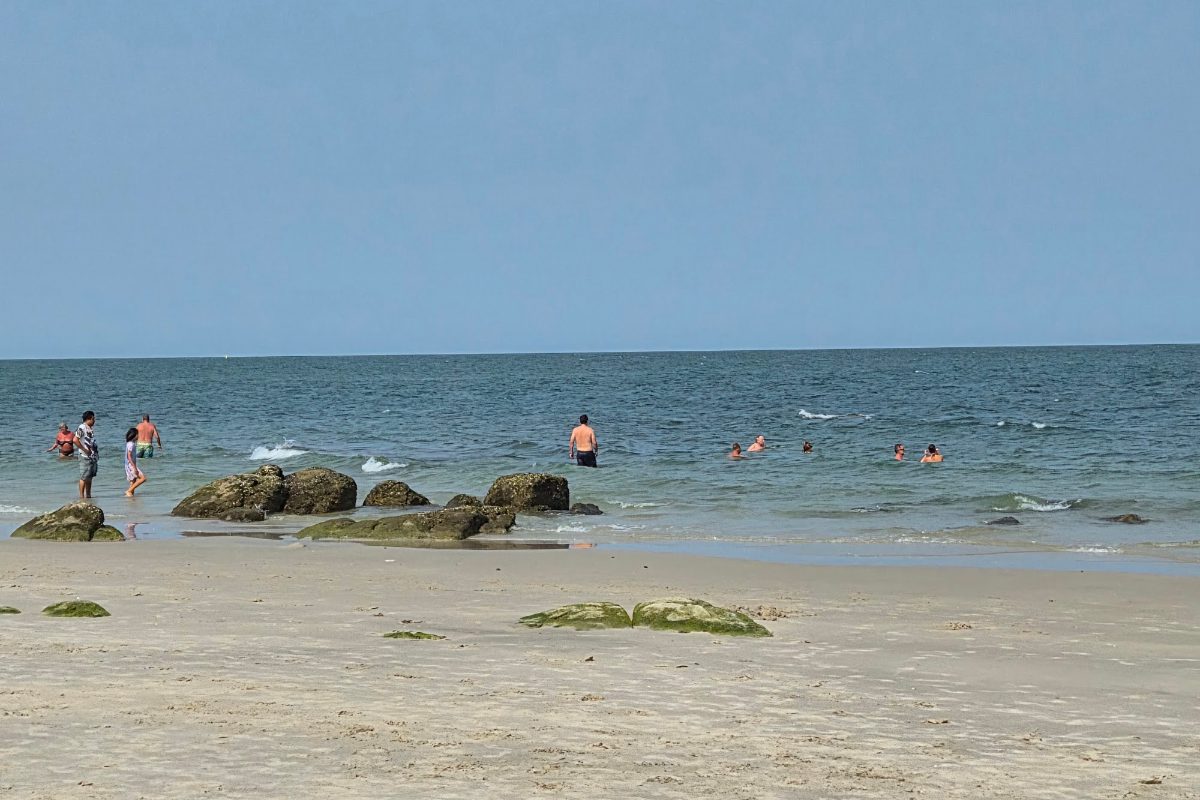
Right next door was the terrace of a little beach bar: stone pillars, white plastic chairs, painted wooden tables, flags of every color snapping in the wind, and a metal railing above the sand. And beyond it, the sea. Not the gray, crowded sea of Pattaya. A pale green and blue sea, calm, clear at the edge, with little waves that came to die on the fine sand without making a fuss. A well-mannered sea.
And then there were the airplanes.
The airport wasn’t far, to the north, on the other side of the hills, and roughly every hour a plane that had just taken off appeared over the sea in front of us and climbed, banking gently toward the mainland. First you heard the rumble, then you saw it emerge from the hills, small and shining, with the sun on its wings. The first time, I followed it with my eyes. The second time, I raised my hand. The third time, I started counting them.
For months now, I’ve been counting steps. On Lamai Beach, I counted airplanes. It’s far more restful. Airplanes, you don’t have to climb. You watch them go by from a distance, you wave, and they carry other people somewhere else. From her hammock, Chu pointed one out to me every time it came, the way you’d point out a shooting star to a child.
“Another one, Michael.”
“Another one. That one’s going back to Bangkok.”
“How do you know?”
“It’s dragging its feet.”
Read on
This excerpt comes from chapter 8, “The Crossing,” of The Season of Breath, the true story of a man from Liège who goes to live a season in Thailand with an illness no one can see. The book is available in English.