Renting a scooter is one of the best ways to discover Thailand outside the cities: you stop where you want, take small roads, reach beaches and temples the buses ignore. It is also one of the fastest ways to turn a holiday into a problem, if you skip the three steps that matter: the licence, the deposit and the insurance.
Legality and which licence
Riding a scooter in Thailand requires a valid driving licence and, for a foreign one, an international driving permit. This is not a formality: without it you face a fine at a checkpoint, and after an accident the insurer may refuse to pay.
Mind the category: a car licence does not cover a two-wheeler. If your licence has no motorbike entitlement, you are not legal, even with the international permit.
The international permit
It is obtained before departure, in your own country, as a booklet in several languages. It does not replace the national licence: both must be shown together. Once abroad, it is too late.
Where to rent
Everywhere: hotels, guesthouses, street agencies, local renters. Prices vary little, service a lot. Always ask for a written contract and a copy of the vehicle papers. If the renter refuses, move on.
The passport deposit
This is the classic trap: the renter asks for your passport as security. Never leave it. A retained passport becomes leverage in any dispute over the vehicle’s condition.
Offer a copy, a cash deposit or a reasonable amount. Serious renters accept. Those who refuse announce the problem to come.
Insurance
The rented scooter carries minimal insurance, often insufficient. Check what the contract covers and, above all, what it excludes: often damage to the vehicle, sometimes theft, almost never medical costs.
Does your travel insurance cover riding a two-wheeler? Often not, or only with the right licence. Check before leaving: this is the most important question in this guide.
Vehicle condition
Before leaving, walk around the scooter with the renter and photograph everything: scratches, dents, tyres, mirrors, odometer. Take a video in their presence. It is your best protection against invented damage bills.
Check the brakes, lights, indicators and tyre pressure. A scooter that brakes badly is more dangerous than a slow one.
The helmet
Helmets are compulsory for rider and passenger. Checks are frequent and fines are real. Many renters supply poor helmets: ask for your size, and a decent model if possible. An oversized helmet does not protect.
Driving on the left
Thailand drives on the left. Adaptation takes a few hours, and mistakes happen at junctions and roundabouts, often late in the day. Stay focused for the first kilometres, avoid riding at night, and never ride after drinking.
Police checks
Frequent in tourist areas. You are asked for your licence, sometimes the helmet, sometimes the vehicle papers. Stay courteous and show the documents. Fines are paid at the station, with a receipt.
Fuel
Petrol stations are numerous, but in rural areas you also find roadside bottles of fuel. Practical and cheap, but uneven quality. Fill up before long distances.
Roads to avoid
Main highways around Bangkok and mountain roads in the north demand experience. Country roads are often nicer and safer, provided you watch for dogs, gravel and slow trucks. Avoid night rides.
Rain
In the monsoon the road turns slippery in minutes and puddles hide potholes. Slow down, brake earlier, and stop if the shower is heavy. A poncho in the box beats an umbrella.
Classic scams
Three recur: the retained passport, the inflated damage bill on return, and the already-damaged scooter whose scratches are blamed on you. Photos at departure settle the last two; refusing the passport settles the first.
When not to rent
If you lack the right licence, if your insurance excludes two-wheelers, if you have never ridden one, or if you plan to drink. In those cases taxis and buses cost less than an accident.
What it costs
A rental costs a few euros a day, less by the week. Fuel is cheap. What changes the bill is a possible fine, the deposit and repairs. For several days and two people, a scooter is often worth it; for a single city trip, it is not.
After an accident
Secure the scene, call help if needed, and inform the police: a report is essential for insurance. Photograph everything. Keep every document: without them, no compensation is possible.
FAQ
Is the international permit really required?
Yes. Without it you are breaking the law and insurance may refuse to act.
Can you rent without a licence?
Some renters agree, but that does not make riding legal.
Is a helmet provided?
Often, of variable quality. Check the size.
Can you ride two-up?
Yes, with a helmet each. Mind the weight and braking.
What if the scooter breaks down?
Call the renter, who must come or send someone. Note the number at departure.
Can children ride?
Technically no, and it is not prudent: no suitable seat, no helmet their size.
Also read
- Getting around Bangkok
- Koh Samet from Bangkok
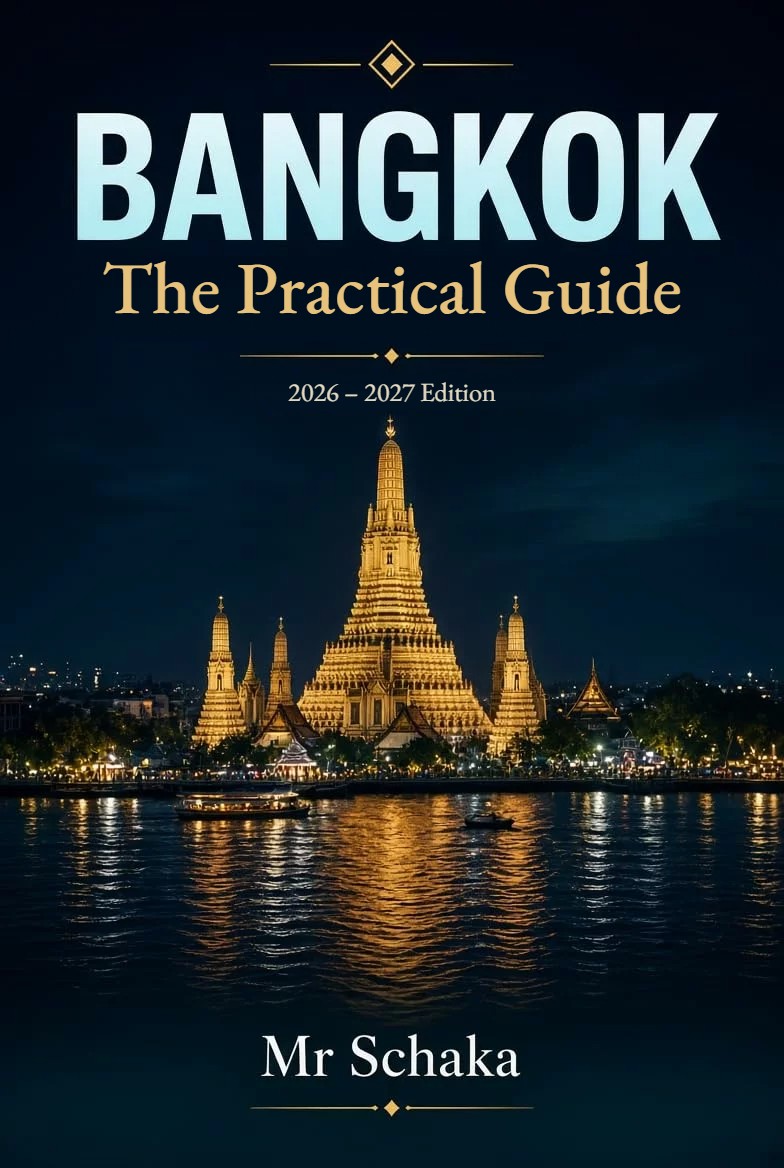
To go further
Mr Schaka’s guidebook, Bangkok – The Practical Guide, covers the essentials: transport, neighbourhoods, addresses, food, etiquette and safety, updated for 2026–2027.