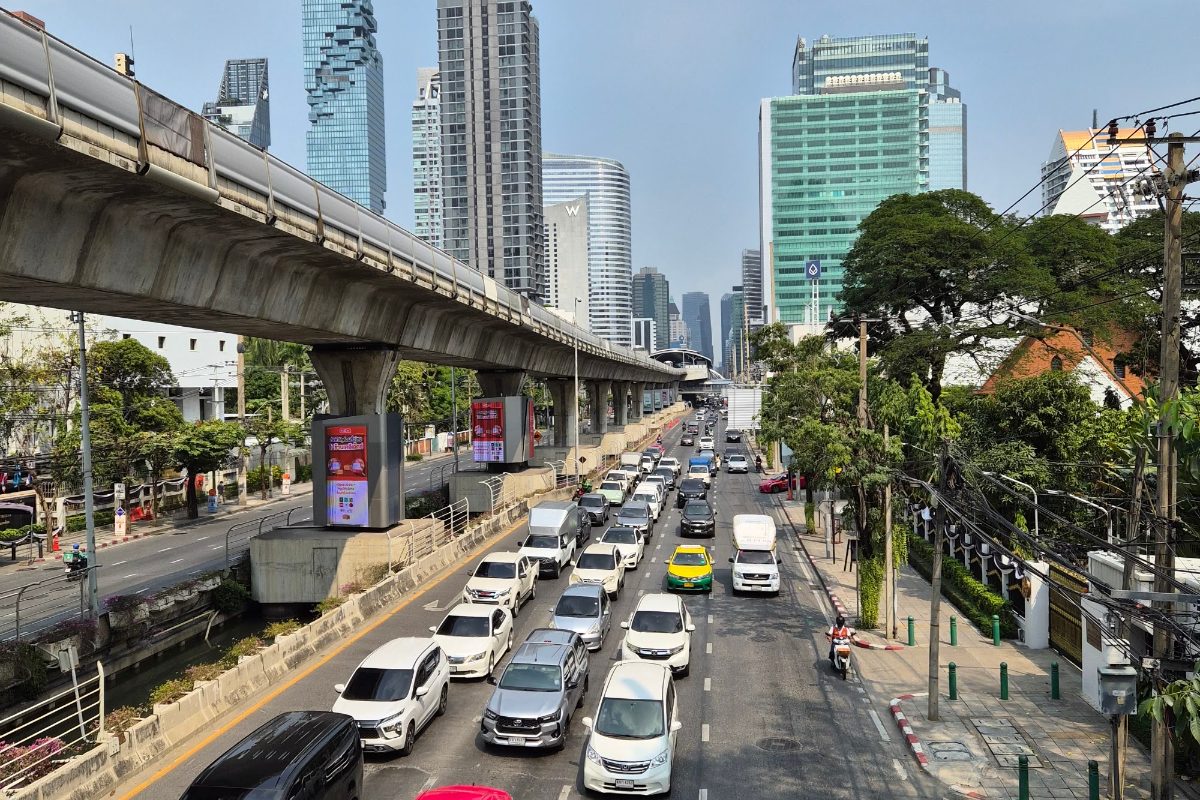
Bangkok’s traffic jams are legendary, and at rush hour they still live up to the reputation. The good news is that the city now has a clean, air-conditioned and cheap rail network that floats above (or runs beneath) all of it. The slightly confusing news is that it’s really two networks, run separately: the BTS Skytrain and the MRT.
After years of shuttling between them, here’s my plain-English guide to which one to take, how to pay, and when to avoid both.
The short answer
- The BTS is the elevated train. It’s the backbone of the modern city center: Siam, Sukhumvit, Silom and the river pier at Saphan Taksin.
- The MRT Blue Line is the subway. It’s your train for Chinatown, Hua Lamphong and the old town (Wat Pho and the Grand Palace via Sanam Chai).
- They meet at a few key stations, but they are separate systems with separate tickets.
My rule of thumb: to cross the city, take the train; for the last stretch, take a taxi, a Grab or your own two feet; for the old town, take the boat or the MRT.
The BTS Skytrain: the lines that matter
The elevated railway opened in 1999 and has three lines:
- Sukhumvit Line (light green): from the north (Khu Khot, via Mo Chit and Chatuchak) to the east and southeast (Kheha, Samut Prakan), through Siam, Chit Lom, Asok, Phrom Phong, Thong Lo and Ekkamai. If you’re staying on Sukhumvit, this is your line.
- Silom Line (dark green): from National Stadium to the Bang Wa district west of the river, via Siam, Sala Daeng, Chong Nonsi and Saphan Taksin, the station for the river’s main pier.
- Gold Line: a small three-station automated shuttle between Krung Thon Buri and Iconsiam.
The two main lines cross at Siam, the central interchange, where you change without leaving the BTS system.
The MRT: the Blue Line and the rest
The MRT has several lines, but as a visitor you’ll mostly use one.
- Blue Line: a big loop serving Chatuchak, Sukhumvit (change for the BTS at Asok), Lumpini, Silom (change for the BTS at Sala Daeng), Hua Lamphong, Wat Mangkon (Chinatown), Sam Yot and Sanam Chai (Wat Pho and the Grand Palace), before diving under the river and looping back through Thonburi.
- Purple Line: northwest into Nonthaburi province.
- Yellow Line (monorail): from Lat Phrao southeast to Samrong, handy for the Srinakarin Rot Fai night market.
- Pink Line (monorail): across the north of the city from Nonthaburi to Min Buri, with a branch to Muang Thong Thani for the Impact Arena concert venue.
BTS vs MRT at a glance
| BTS Skytrain | MRT (Blue Line) | |
|---|---|---|
| Type | Elevated | Subway |
| Best for | Siam, Sukhumvit, Silom, the river pier | Chinatown, Hua Lamphong, Wat Pho and the Grand Palace |
| Fares | 17–65 THB depending on distance | Roughly 17–45 THB |
| Contactless bank card | Not accepted at the gates | Accepted (card or phone) |
| Other ways to pay | Ticket machines, 150 THB one-day pass, Rabbit card | Just tap in and out with your card |
| Hours | About 6 am to midnight | About 6 am to midnight |
How to pay: the big difference
This is where most first-timers get caught out.
On the MRT: just tap
The MRT accepts contactless Visa and Mastercard bank cards. Tap your card (or your phone) on the reader on the way in, and again on the way out. That’s it. For a visitor, it couldn’t be simpler.
The SRT Red Line trains and the Airport Rail Link also accept contactless cards.
On the BTS: ticket, pass or Rabbit card
Warning: the BTS does not accept contactless bank cards at the gates. Tapping your Visa on the reader won’t open anything.
You have three options:
- Single tickets from the machines, which now take coins, notes and often QR-code payment.
- A one-day pass for 150 THB. It pays for itself if you make at least four or five trips that day.
- The rechargeable Rabbit card, sold at ticket counters on presentation of your passport. For a longer stay, it’s the way to go: no more lines at the ticket machines.
Tip: if you’re in town for more than a few days and staying near the Skytrain, get the Rabbit card on day one. The time you save at the machines adds up fast, especially at busy stations like Siam and Asok.
The 20-baht flat fare is not for you
You may hear about a flat 20 THB fare across the whole network. It does exist, since October 2025, but it’s reserved for Thai citizens registered through a government app with their national ID number. Visitors pay the normal distance-based fare. A common ticketing system for all lines has been announced for 2027.
Changing between the BTS and the MRT
The two systems connect at several stations, notably:
- Asok (BTS) / Sukhumvit (MRT)
- Sala Daeng (BTS) / Silom (MRT)
- Mo Chit (BTS) / Chatuchak (MRT), in the north, near the weekend market
Changing means leaving one network and entering the other, with a new ticket. Budget a few minutes for the walk and the gates.
Which train for which trip?
| Where you’re going | Best option |
|---|---|
| Siam malls, Chit Lom, Sukhumvit | BTS Sukhumvit Line |
| Silom, Lumpini | BTS Silom Line or MRT Blue Line |
| Wat Pho and the Grand Palace | MRT to Sanam Chai, or BTS to Saphan Taksin then the boat |
| Chinatown | MRT to Wat Mangkon |
| Iconsiam | BTS Gold Line from Krung Thon Buri |
| Suvarnabhumi Airport | Airport Rail Link from Phaya Thai (BTS) or Makkasan (linked to MRT Phetchaburi) |
If you haven’t booked your hotel yet, staying within walking distance of a BTS or MRT station makes everything easier. I compare the neighborhoods in Where to Stay in Bangkok.
Rush-hour survival tips
The network is wonderful, until 8 am on a Tuesday.
- Avoid the peaks: roughly 7:30–9:30 am and 5–7:30 pm. BTS trains are packed.
- Let one or two trains go by if you can’t get on comfortably. Another one is coming.
- Travel light at rush hour. The Airport Rail Link, in particular, is uncomfortable with big suitcases when it’s full.
- Bring a light layer. The air-conditioning in stations and trains is serious.
A few rules on board
- No eating or drinking in stations or on trains. And no durian, ever.
- Some seats are reserved for monks, the elderly, pregnant women and children: give them up.
- Last trains run around midnight. After that, it’s Grab, Bolt or a metered taxi.
For the bigger picture, including boats, taxis, tuk-tuks and walking, see my full guide to Getting Around Bangkok, and if you want to put it all into practice, my Bangkok in 3 Days itinerary uses the trains (and the river) to link the sights.
FAQ
Can I use my credit card on the BTS?
No. The BTS does not accept contactless bank cards at the gates. Buy a ticket from a machine, get a 150 THB one-day pass, or use a Rabbit card. The MRT, on the other hand, does accept contactless Visa and Mastercard.
Is the BTS or the MRT better for the Grand Palace?
The MRT Blue Line takes you to Sanam Chai station, close to Wat Pho and the Grand Palace. The scenic alternative is the BTS to Saphan Taksin, then a boat up the river.
Can one ticket cover both the BTS and the MRT?
Not for now. They’re separate networks, and changing between them means exiting one and paying again on the other. A common ticketing system has been announced for 2027.
To go further
Entry rules, transport, neighborhoods, food and the traps to avoid: Mr Schaka’s guidebook, Bangkok – The Practical Guide, gathers everything you need to plan your stay and find your way around the Thai capital. The English edition is out now as a PDF ebook: buy it here →