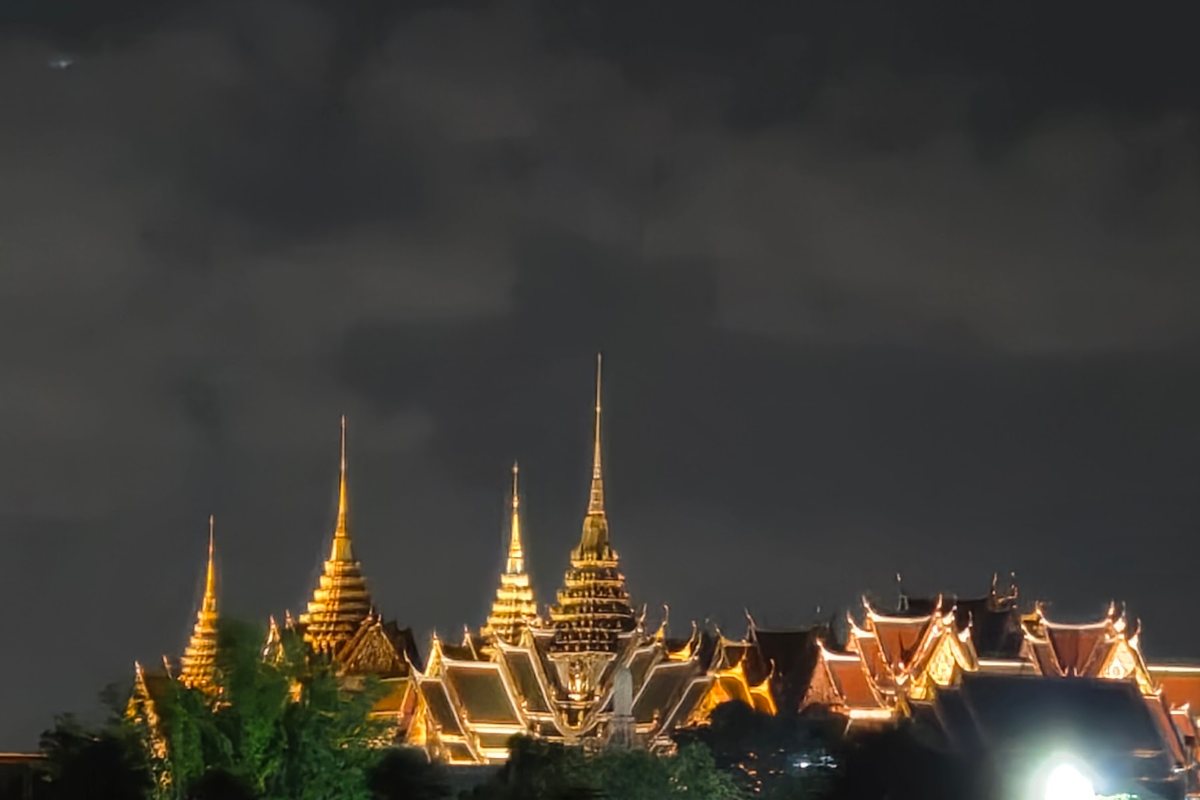
Wedged between the river and the old canals, Rattanakosin Island is the cradle of Bangkok. Packed into less than one square kilometer are the country’s most famous landmarks: Bangkok’s Grand Palace, the Temple of the Emerald Buddha, Wat Pho and its Reclining Buddha, and the major museums. Allow at least one full day, ideally two early-morning half days.
Bangkok’s Grand Palace and Wat Phra Kaew
Built from 1782 onward, the Grand Palace was the residence of the kings of Siam for 150 years. Today the king lives elsewhere, but the palace is still used for official ceremonies. Behind its high white walls lies a dazzling complex of gilded pavilions, glazed-tile roofs, giant guardian statues and murals.
The jewel of the site is Wat Phra Kaew, the Temple of the Emerald Buddha, the most sacred in the country. The statue, carved from green jade, stands only 66 centimeters tall. It sits high up on a golden altar, and the king himself changes its robes three times a year, with the seasons. The cloister walls are covered with 178 murals telling the Ramakien, the Thai version of the Indian epic, the Ramayana.
In the palace section, take in the Chakri Maha Prasat, a surprising blend of Victorian palace and Thai roofs built under Rama V, and the Dusit Maha Prasat, a throne pavilion of great purity.
- Opening hours: daily, 8:30 a.m. to 3:30 p.m. (last entry).
- Admission: 500 THB for foreign visitors.
- Time needed: 2 to 3 hours.
Three things to know before you go
- What to wear: the dress code is strictly enforced. Shoulders and knees covered, no tight, see-through or ripped clothing, no shorts. Clothes are available at the entrance, but the line is long. Show up properly dressed.
- The “palace is closed” scam: if someone approaches you near the entrance to tell you that “the palace is closed today” and offers you a tuk-tuk to another temple, it’s a classic scam. Go and check for yourself at the official entrance on Na Phra Lan Road.
- The right time: get there at opening time, 8:30 a.m. By 10, the tour groups pour in and the heat climbs. The site may be fully or partly closed during royal ceremonies, notably from December 15 to 19, 2026 (the Queen Mother’s funeral): check before you come.
Wat Pho and the Reclining Buddha
Just south of the Grand Palace, Wat Pho is Bangkok’s oldest and largest temple. Many travelers prefer it: it’s less crowded, more alive, and serenely beautiful.
Its star is the Reclining Buddha: 46 meters long, 15 meters high, entirely covered in gold leaf. It depicts the Buddha entering parinirvana, the final release. The soles of his feet, three meters high, are inlaid with mother-of-pearl and decorated with 108 sacred symbols. Along the wall, 108 bronze bowls await your coins: you drop a small coin in each one for good luck. A cup of coins costs 20 THB at the entrance.
Then wander among the four great chedis covered in colorful ceramics, through the cloisters lined with nearly 400 Buddha statues, and around the gardens. Wat Pho is also home to the country’s most famous school of traditional Thai massage: you can get a massage there (about 500 to 600 THB an hour) or take a course.
- Opening hours: daily, 8 a.m. to 6:30 p.m.
- Admission: 300 THB, with a free bottle of water.
- Time needed: 1.5 to 2 hours.
Museums, amulets and flowers
- The National Museum, the largest in Southeast Asia, occupies the former palace of the viceroy: Buddhist art, royal funeral chariots, textiles, puppets. Free guided tours in French are run on certain days by French-speaking volunteers. Admission: 200 THB. Closed Mondays and Tuesdays.
- Museum Siam, a stone’s throw from MRT Sanam Chai, takes a playful look at what it means to be “Thai.” Ideal with kids, and air-conditioned. Closed Mondays.
- Wat Mahathat is a center for Buddhist teaching and meditation. Next door, the amulet market is fascinating: collectors examine thousands of tiny protective Buddhas through magnifying glasses.
- The City Pillar (Lak Mueang), erected in 1782, marks the founding point of Bangkok. Free entry.
- Pak Khlong Talat, the flower market, runs day and night. It’s at its most impressive late in the evening and at dawn, when jasmine garlands for offerings are being strung.
To finish, the little Tha Tien neighborhood, between Wat Pho and the river, has kept its shophouses. Several rooftop cafés facing Wat Arun offer one of the best sunset views in the city.
A perfect morning in Rattanakosin
Getting there: MRT Sanam Chai (Blue Line), next to Wat Pho, or the orange-flag boats to Tha Tien and Tha Chang piers. Here’s the itinerary suggested by the guide:
- 8:30 a.m.: Grand Palace and Wat Phra Kaew (2.5 hours).
- 11 a.m.: quick lunch at a canteen in Tha Tien or near Tha Maharaj.
- 12 p.m.: Wat Pho, followed by a massage at the temple school.
- 3 p.m.: air-conditioned break at Museum Siam, or back to the hotel.
- 5 p.m.: ferry to Wat Arun, then sunset on a Tha Tien rooftop.
Read also: Bangkok Temples Off the Beaten Path: 6 Quiet Sacred Places
Want to go further?
Mr Schaka’s practical guide, Bangkok – The Practical Guide (“Bangkok – The Practical Guide,” in English), covers Rattanakosin and every other Bangkok neighborhood, with opening hours, prices, traps to avoid and ready-to-follow itineraries. The English edition is out now as a PDF ebook: buy it here →