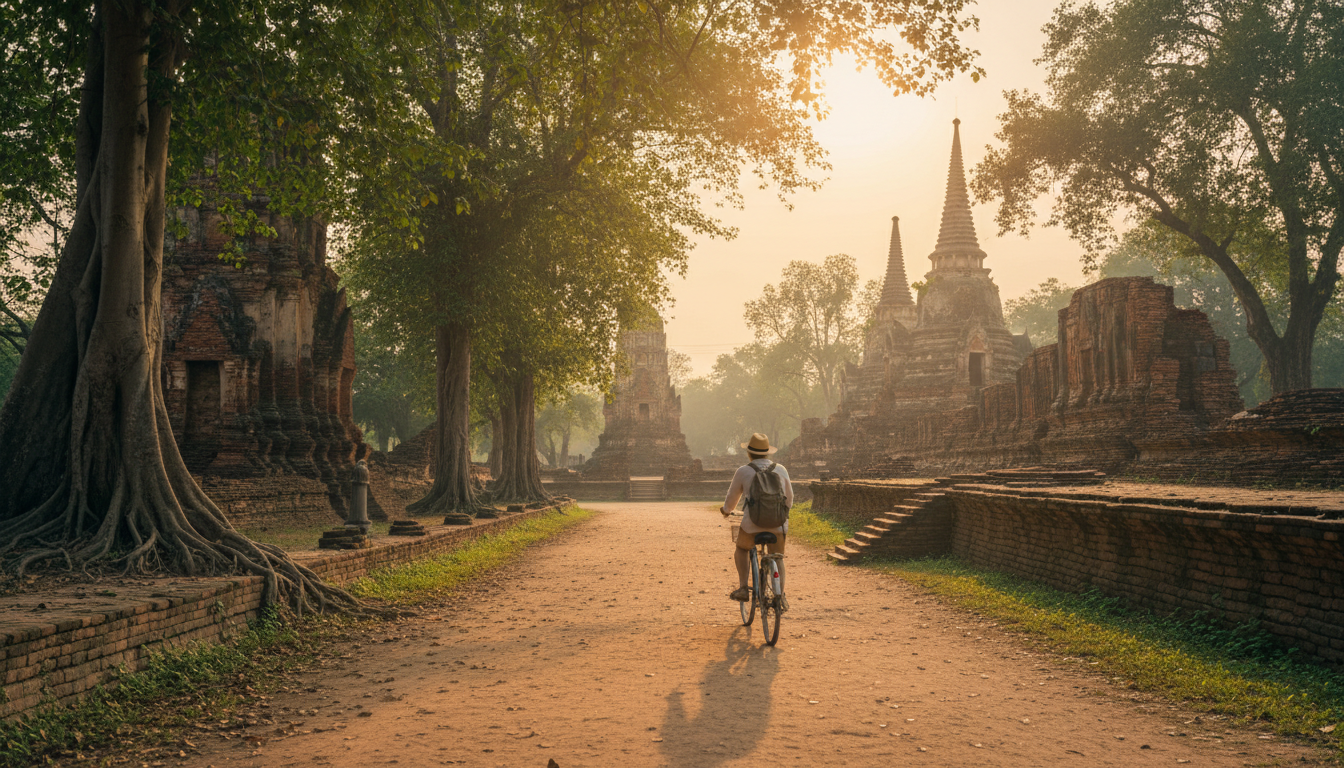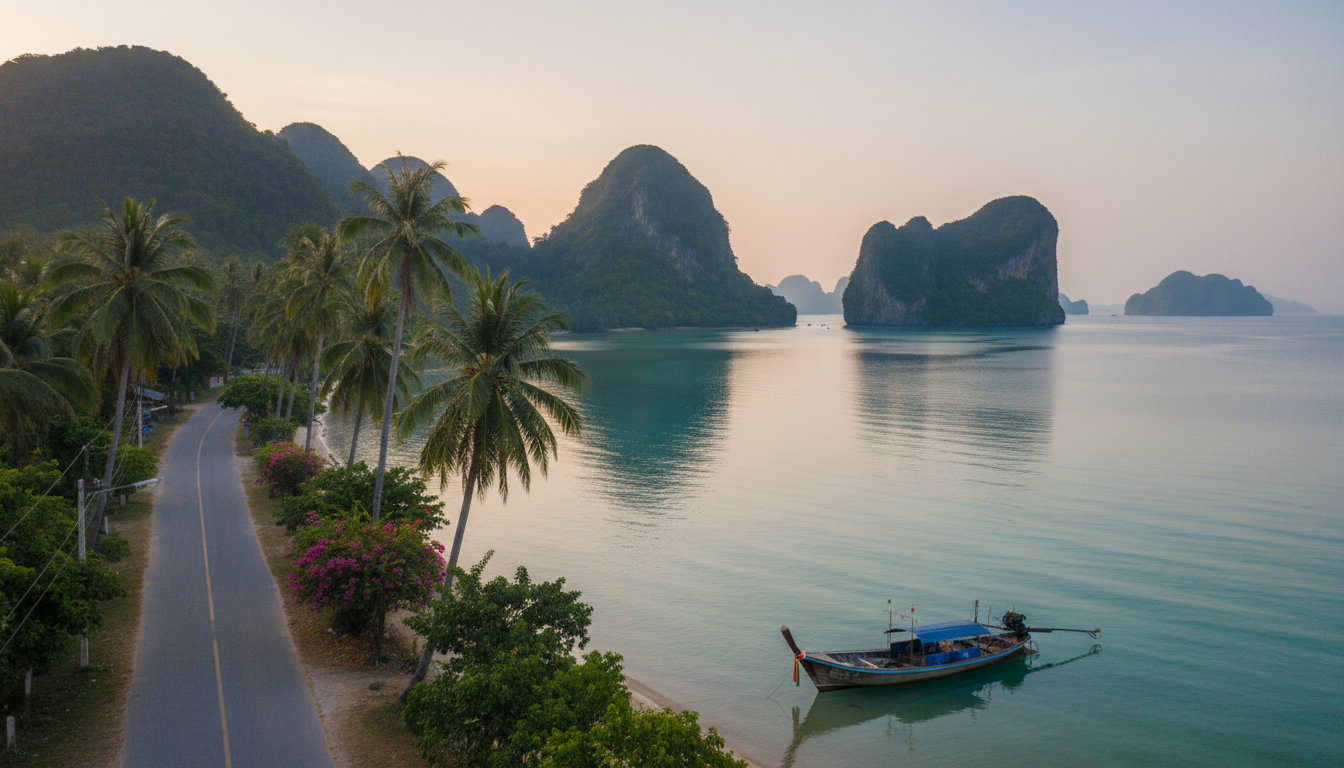
Khao Sok is not a beach destination, and that is exactly what makes it one of the finest stops in southern Thailand. The national park protects a rainforest considered one of the oldest in the world, cut by an artificial lake whose shores bristle with limestone peaks. You go to sleep on the water, walk in the jungle and accept having no signal.
Why Khao Sok is worth the detour
The forest is often described as older than the Amazon, which is hard to verify but conveys the climate: hot, humid, dense, with immense trees and a canopy that blocks the sun. The park shelters gibbons, macaques, hornbills, snakes, and at times wild elephants — rarely seen, and not to be sought out.
The second asset is Cheow Lan lake, formed by a dam in the 1980s. The drowned hills form hundreds of islands with vertical walls, and you navigate between them on green, calm water. It is the landscape that made the park famous, and it resembles nothing else in Thailand.
How to get there
The park is reached from Surat Thani, the nearest town, or from the west-coast resorts: Khao Lak, Phuket, Krabi. From Surat Thani, allow an hour and a half to two hours by road to the main entrance, near the village of Khao Sok. Minibuses connect airports and towns to the village, which serves as a base for most visitors.
From Phuket or Khao Lak the journey is longer, three to four hours, but it lets you combine the park with the coast. Many travellers do the opposite: they finish at Khao Sok before the sea, avoiding backtracking.
There is no train, and the lake is reached only by boat from the dam. You do not drive to the lake: you leave the car at the jetty.
Cheow Lan lake
This is the heart of the stay. The lake is explored by long-tail, motorboat or kayak depending on the package. Organised days include the transfer from the village, the crossing, a meal, a walk or a swim, and the return. It is the simplest formula, and enough to see the essentials.
The best way remains to sleep there. The raft houses are grouped in a few areas of the lake, reached only by boat. In the evening the groups leave, the engines stop, and only water, insects and monkeys remain. It is the experience that justifies the journey.
Sleeping on the lake
Floating rafts offer simple rooms, sometimes without continuous electricity, with meals served on site. Comfort varies: some have private bathrooms, others shared, and hot water is not guaranteed. It is not a hotel, it is a camp on the water.
Book ahead, especially in high season: places are limited and packages go through agencies or the establishments directly. Check what is included — transfer, meals, activities — because displayed prices do not always say.
Bring a headlamp, mosquito protection, a swimsuit, and accept leaving the phone at the bottom of the bag: there is often no signal and no socket.
The jungle and the trails
Around the village, several trails can be walked without a guide, including a short loop through the forest along the river. For longer walks a guide is necessary: the forest is dense, trails fade, and animals are not always friendly.
A one-day trek with a night in the forest exists, run by local guides. It is demanding — heat, humidity, leeches — and it is also the only way truly to enter the park. Ask about the fitness level required before booking.
Wildlife
Gibbons are heard more than seen: their call carries at dawn and is part of the soundscape. Hornbills pass over the trails, macaques come near busy areas, and elephants stay far away. Snakes are present, as everywhere in Thailand, and you do not walk barefoot.
Bats leave at dusk and insects are numerous: it is a tropical forest, not a garden. Bring long clothes for the evening.
Kayak, caves, hiking
Besides the boat, kayaking lets you approach the walls and coves in silence. Some packages include a morning paddle, when the water is smooth. The park’s caves are visited with a guide, sometimes partly swimming: you must accept getting wet and squeezing through narrow passages.
The hike to a viewpoint over the lake is the most popular activity after the cruise: a steep climb through forest, one or two hours depending on pace, and a view that justifies the effort.
A typical day on the lake
Early wake-up, before the engines. In the morning the water is often misty and the gibbons call. After breakfast, a boat or kayak trip to a cove, a swim, back for lunch. In the afternoon, a short walk or a nap. In the evening, sunset on the peaks, a simple dinner, and a silent night.
When to come
The dry season, December to April, offers the best conditions: calm water, walkable trails, clear sky. From May to November the monsoon brings showers, sometimes heavy, but the lake is higher, the waterfalls finer and the forest greener; prices fall and crowds vanish.
Careful: in full monsoon some activities are cancelled and trails become slippery. Check before booking, and leave a margin.
What to budget
The village offers cheap rooms, guesthouses and a few hotels. On the lake, packages with a night, meals and transfers are higher, and the price depends on comfort and number of activities. A day trip is the cheapest option, but it does not give you the evening.
Over two days, excluding transport from the coast, a reasonable budget holds if you sleep in the village and do one day on the lake; more if you sleep on the water.
Mistakes to avoid
Arriving without booking in high season and finding no raft. Believing you can visit the lake by car. Underestimating mosquitoes and leeches. Booking a trek without the fitness. And leaving waste behind: the lake is closed, but not eternal.
FAQ
Are two days enough?
One night on the lake and a morning on the boat, yes. To walk more, allow three days.
Do I need a guide?
For the lake and caves, yes. For the short trails around the village, no.
Can I bring children?
Yes for the boat and swimming. Long treks do not suit young children.
Is there a signal?
In the village, yes. On the lake, almost never.
Best starting point?
Surat Thani, or Khao Lak to combine with the west coast.
Also read
To go further
Mr Schaka’s guidebook, Phuket and the Andaman Sea – The Practical Guide, covers the essentials: transport, neighbourhoods, addresses, food, etiquette and safety, updated for 2026–2027.