
Look at the process before the object
Around Chiang Mai, crafts are easier to understand when you watch how an object is made. A workshop may show a surface being prepared, a pattern painted or a piece of wood shaped. Not every venue opens its production area, so ask before entering or taking photographs. This first step changes how you see the shops: instead of comparing prices alone, you can notice materials, time and technique. A visit is an encounter with people at work, not a guaranteed performance for tourists.
Bor Sang and paper umbrellas
Bor Sang is associated with hand-decorated paper umbrellas. Floral patterns and colours attract attention, but making one involves several stages: assembling the frame, applying paper, letting it dry and painting the design. Notice how the image follows the curved surface and how colours are layered. Products and practices vary between workshops. Ask which parts are handmade and whether an umbrella is intended for indoor or outdoor use. These simple questions improve both the visit and the purchase.
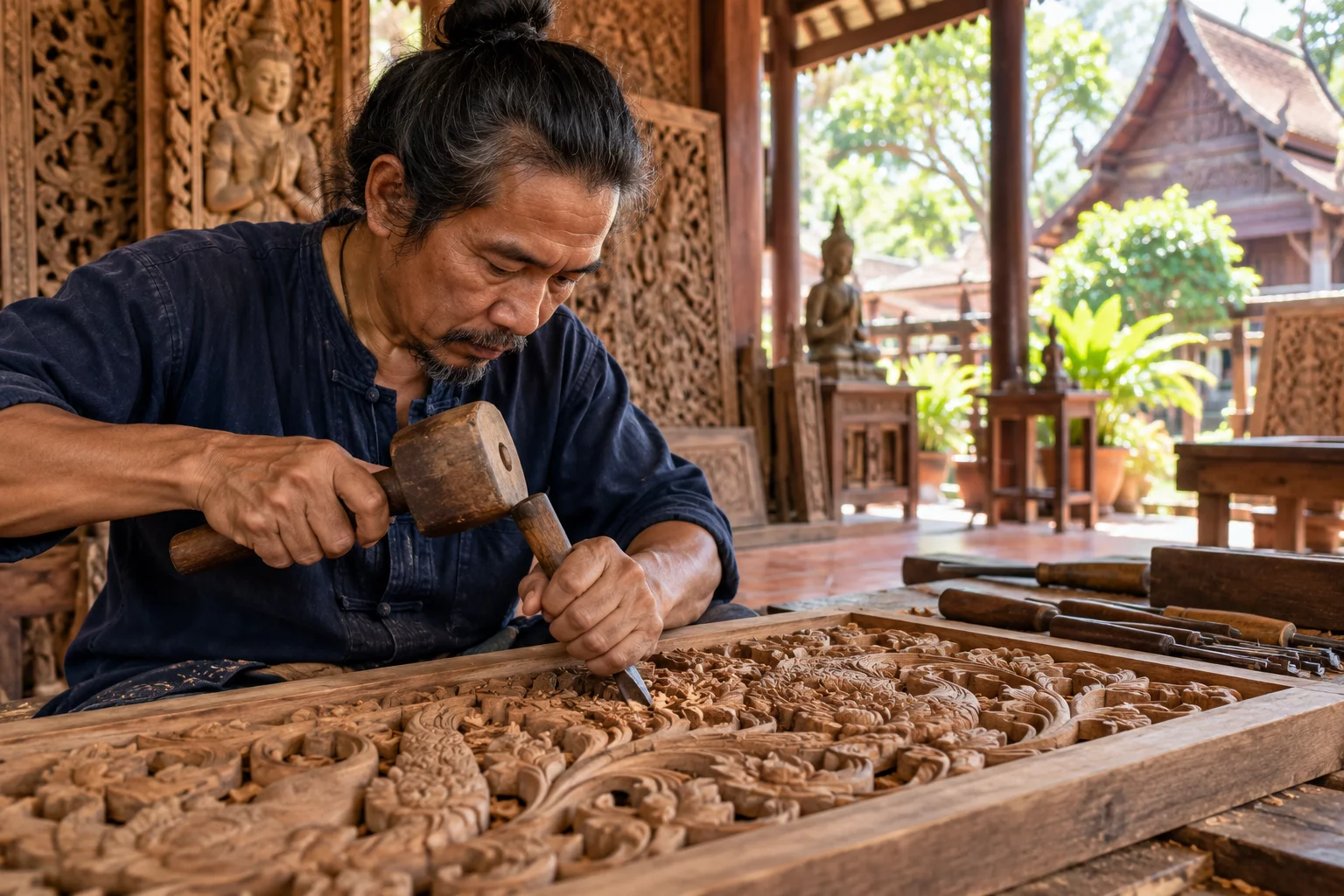
Baan Tawai and wood carving
Baan Tawai, in Hang Dong district, is known for woodwork and decorative objects. Visitors find pieces of many sizes and styles, and some venues explain production steps. Look at carving details, finishing and joints. Price can reflect material, labour and detail, so ask questions rather than judging by size alone. Find out what kind of wood was used, where it came from and how the piece should be cared for.
Understand where a piece comes from
Markets and shops may bring together items made in several villages or workshops. A well-known address does not by itself prove that every object was produced there. Ask clear questions about where it was made and how much work was done by hand. The answers help you understand the object without asking for confidential techniques. If the information remains unclear, simply compare other sellers. Respectful questions make the purchase more informed without putting pressure on a craftsperson.

Buy without reducing work to price
Bargaining may be part of commerce, but it should take time and skill into account. Before buying, check construction, finish and intended use. Ask whether an umbrella can handle moisture and sun; for wood, ask about treatment and maintenance. Avoid unclear provenance or products made from protected species. If the price is not right for you, thank the seller and continue. Buying directly from a workshop can make conversation easier, but does not automatically verify every component’s origin.
Photograph with consent
A craftsperson at work is not a prop. Ask before photographing a person or workstation, accept a refusal and avoid disrupting production. For a memory, photograph tools, materials and finished work too, when permitted. A precise caption naming the village, material and technique tells the story better than a broad phrase about “Thai crafts”. If you publish the image, do not imply that all makers in the region use one technique or produce the same objects.
Plan the route and visit
Craft villages are outside Chiang Mai’s main tourist centre. Allow time for transport, confirm opening hours and avoid combining distant stops without a buffer. If hiring a driver, agree on fare, stops and return time before leaving. Traffic can make distances deceptive. Choose two complementary visits, such as umbrellas and woodwork, then leave time to listen and rest. A lighter plan helps you stay attentive to the place.
Bring home a story, not only a souvenir
The best memory may be a pattern, a technique or a conversation about the hours required to finish a piece. If you buy something, choose an object you will use or display and whose origin you understand. Afterwards, describe what you actually saw rather than generalising about the whole region. Skills remain alive because people practise, adapt and pass them on. Which moment stayed with you: careful umbrella painting or wood taking shape under a chisel?
Meet workshops with curiosity and care
A craft workshop is easier to appreciate when you accept that you will not understand everything at first glance. Before entering, check whether the space welcomes visitors or is a private workplace. A smile and a simple question are often enough to find out whether a demonstration is possible. A weaver’s, carver’s or paper maker’s gesture reveals a skill, but it is not the whole story of the person doing the work. Listen to explanations, ask how an object is used, and do not touch tools or materials without an invitation. If you do not share a language, a few polite words, respectful gestures and attentive listening can make the exchange more pleasant. Workshops do not all keep the same hours, and an artisan may be away or busy with an order. Do not turn a spontaneous visit into an expectation of a performance. A short conversation, when both sides welcome it, can mean more than a long demonstration that has been forced. Ask before photographing people, their workspace or a particular technique. Some steps may be confidential, or simply require too much concentration to interrupt. Explain why you are taking a picture and accept a refusal without pressing. This attention lets you encounter Chiang Mai craft as living work connected to time, livelihood and the choices of the people who make it.
Understand the price and value of an object
The price of a handmade object often reflects much more than its raw materials. It may include the time required, the finish, the complexity of a pattern, the maker’s experience and the small scale of production. Comparing a hand-made piece with a mass-produced souvenir therefore tells you little about its value. Look closely at the details: the consistency of a weave, the precision of carving, the strength of stitching or the shade of a dye. Ask what materials are used, how the object should be cared for and whether it was made on site. A clear answer helps distinguish local production from an item that is simply sold in a tourist shop. Bargaining is part of some commercial settings, but it should not erase the cost of labour. A polite negotiation over a group of items or a reasonable discount is different from pressing for a price that leaves the maker’s work undervalued. Think about transport too. A fragile, bulky or regulated object can be difficult to take home. Ask for suitable packing and check the rules that apply in your country before buying. If you are uncertain, photograph a label or note the workshop’s name, then return later. That pause avoids impulse purchases and helps you choose something you will actually use. A souvenir with a story about who made it and how it was designed lasts longer in memory than an object selected only because it is easy to pack.
Plan an enjoyable craft day
To explore Chiang Mai’s crafts, avoid trying to cross the whole city in a few hours. Choose one or two areas and leave room for travel, breaks and conversation. Workshops are places of production: opening times may change with orders, rest days and seasons. Check information before leaving and, if possible, contact the workshop to confirm that visitors are welcome. In hot weather, start early and bring water; in the rainy season, allow extra time for showers and slower journeys. A flexible plan helps if a demonstration starts later or a workshop is closed. You can add a market or gallery, but distinguish sales spaces from places where objects are made. That difference enriches the day: a market shows how creations circulate, while a workshop may explain how they are produced. Follow each venue’s guidance on transport and payment. Carry some cash if small businesses prefer it, while avoiding the assumption that they do not accept electronic payments. For journeys, compare options according to distance, traffic and your needs; travel times can vary considerably by hour. At the end of the day, write down the names of makers and techniques that stayed with you. You can then share a precise recommendation and help other visitors find a workshop that fits their interests.
Travel without turning culture into scenery
Northern Thai arts are connected to communities, histories and uses that go beyond the appearance of an object. A respectful visit avoids generalisations: one motif or technique does not represent an entire region, and practices continue to change. Ask about materials and how makers describe their own work. Let them choose what to tell you; a question about technique does not entitle a visitor to personal details. In a workshop, do not move objects and keep children close when tools are within reach. Materials may be delicate, paint may be wet and some steps may be unsafe. If a workshop offers a hands-on activity, follow instructions and accept an imperfect result: the aim is to try, not to leave with professional work. Buy fewer things and choose carefully. You can also support makers by recommending the workshop, sharing its details with permission or returning for a considered purchase. When posting images, provide context and credit the venue if requested. Avoid presenting a community as frozen in time or exotic. Chiang Mai is a contemporary city where skills adapt to clients, available materials and new generations. That perspective makes an encounter more accurate and more interesting.
Choose a useful, lasting souvenir
Before buying, consider where the object will be used at home and how it will travel. Light textiles, compact decorative pieces and small accessories are easier to transport than bulky items. For something fragile, request suitable protection and check that the packing will fit in your luggage. Ask about care for natural materials: some fabrics need hand washing, some dyes may run, and wood can require particular storage conditions. Avoid buying animal-derived materials or pieces with unclear origins; import rules can be strict and differ by country. A maker or reliable seller should be able to explain the materials and intended use. You do not need to know the entire supply chain to make a more informed choice; a few practical questions are enough. The lowest price is not always the best choice if the item will deteriorate quickly or does not suit your needs. With permission, take a picture of a business card or workshop name so you can remember the purchase. At home, this information lets you tell the object’s story and recommend the maker directly. A carefully chosen item becomes a souvenir tied to an encounter and a gesture, rather than another purchase forgotten in a drawer.
Observe techniques without interrupting work
A craft demonstration calls for a balance between curiosity and discretion. Stand where you are invited to stand, keep a sensible distance from tools and avoid leaning over someone who is working. Machines, blades, dyes and hot surfaces can present risks that visitors may not notice immediately. Wait for a pause before asking several questions; one question at a time makes conversation easier. If an answer is brief, do not take it as unfriendliness: the maker may have an order to finish or a delicate step to monitor. When a technique interests you, ask its name and what a tool does instead of requesting a full explanation in a few minutes. It can help to write down the terms or ask whether a leaflet is available. For a hands-on session, check the length, price, clothing advice and language in advance. A well-organised activity gives the maker time to guide each person. Do not post a close-up of a process if the venue has asked visitors not to photograph it. That restraint respects the work and avoids circulating a method without context. Careful observation can teach as much as trying it yourself: you may notice preparation, repeated movements, quality checks and the small corrections that make an object strong and useful.
Connect workshops to Chiang Mai’s neighbourhoods
Workshops make more sense when placed within the city and its surrounding villages. Some are in urban neighbourhoods; others are on the outskirts, where the journey becomes part of the experience. Do not assume that a workshop that looks close on a map is quick to reach: traffic, road works and weather can change travel times. Group visits by area and choose transport suited to the distance and your party. If you visit a craft village, learn which spaces are open to the public and observe local customs. A family shop, a production workshop and an organised attraction offer different relationships with visitors. Recognising the difference helps set expectations and avoids imposing a visit where it is not welcome. Consider the community’s needs too: visitors can bring income, but visits should remain compatible with daily work. Avoid very large groups and unannounced arrivals when a contact is available. If a local guide accompanies you, ask how payments are handled and how much time is planned at each stop. Keep a return plan and your accommodation details, especially if the area has limited evening transport. Craft becomes more meaningful when you understand the connection between an object, the people who make it and the place where it takes shape.
Advice for families and curious travellers
Workshops can interest children when the visit is suited to their age and attention span. Before entering, explain that they should ask before touching anything and speak calmly. Choose a workshop with a supervised activity and check that its materials are appropriate for children. Sharp tools, dyes and small pieces need close attention. A short visit followed by a break often works better than a long circuit. Travellers with accessibility needs can contact the venue to ask about stairs, doorway width and places to sit. Traditional buildings are not all easy to navigate, so these questions help you choose a suitable location. People sensitive to heat or dust can ask whether the workspace is ventilated. If you travel as a group, split into smaller numbers and avoid taking up all of the maker’s time. A successful visit considers the pace of both visitors and the workshop. Prepare a few simple questions: what is the first step, how long does one piece take, or how can you recognise a well-finished object? These open a conversation without treating the artisan as an obligated guide. When you leave, thank the people who welcomed you and make recommendations that accurately reflect what you experienced.
Keep a useful record of the visit
Afterwards, turn your impressions into precise notes rather than general praise. Record the workshop name, neighbourhood, stated hours and technique you observed, then distinguish what the maker told you from what you inferred. This prevents uncertain information from being repeated as fact. If you took photographs, organise them with the venue’s name and follow any conditions on publication. A portrait or image of a workspace deserves the agreement of the people concerned. When writing an article, describe gestures and materials without inventing an origin or tradition. Say clearly if you bought an object or joined an activity; that helps readers understand your experience. Addresses and opening times change, so encourage future visitors to verify details before leaving. If you recommend a maker, explain what you valued: the welcome, quality, chance to observe or range of products. A concrete recommendation is more useful than a string of superlatives. Keep a card or receipt with the object to remember its story. This memory extends the journey and recognises the work behind the object. It also makes it possible to contact the workshop later, ask a follow-up question or buy directly if the maker offers a remote service.
FAQ
Which craft villages should I visit near Chiang Mai?
Bor Sang is associated with painted umbrellas and Baan Tawai with woodwork. Confirm opening hours and activities before travelling.
Can visitors watch the making process?
Some workshops show parts of their work, but access varies. Ask permission before entering or taking photographs.
How do I choose a craft item?
Ask about material, origin, handwork, intended use and care requirements.
Is bargaining appropriate?
It can be part of a sale, but be respectful of labour time and the stated price.

To go further
Mr Schaka’s guidebook, Chiang Mai and the North – The Practical Guide, covers the essentials: transport, neighbourhoods, addresses, food, etiquette and safety, updated for 2026–2027.