

When somebody appears well, what do we really know about what they are experiencing? That question accompanies Je respire encore, Mr Schaka’s personal testimony. The book begins with illness and a limited breath that changes the rhythm of ordinary actions. Readers do not need the same experience to enter. They are offered a place from which to listen, reconsider familiar situations and allow a particular life to remain particular. Understanding need not begin with comparison or a demand that another person’s story supply a lesson immediately.
The author discusses pulmonary fibrosis, rheumatoid arthritis, close relationships and daily life becoming different. This introduction draws on the manuscript and official presentation. It invites discovery of a book, not interpretation of a medical file. The following questions concern voice, imagery and relationships. Every reader remains free to decide what, if anything, to connect with personal experience. No confession is required, and the account is not offered as a model of behaviour. Reading can begin simply with attention to how an individual chooses to describe what is often invisible to others.
What can a number change in a life?
The opening recalls a prognosis received as a possible duration. Within the account, a number becomes more than information. It enters the relationship with time, what is told to others and what somebody chooses to do. Observe that movement: how does something heard in a medical setting acquire a place in memory and ordinary days? The book answers through one person’s experience rather than a rule about how everyone should respond. Its value includes the particular details through which a statement gradually becomes part of lived reality.
The question can remain open for readers. You need not have received a prognosis to understand that numbers carry different weight in different circumstances. A date, waiting period or deadline is not experienced only as data. Testimony gives it a place and a voice. Avoid reducing the book to a formula about courage or a contest between pessimism and willpower. The account is more interesting when allowed to describe what the presence of time does to decisions and relationships, without requiring each paragraph to prove a ready-made conclusion.
Why speak about something that cannot be seen?
One contrast running through the opening is appearance against effort. The narrator can look well while describing breathlessness other people do not recognise. What portion of a person’s day remains outside our view when we observe them for a few seconds? The text does not turn every tiring moment into a universal explanation. It gives words to an experience that can pass unnoticed in ordinary encounters. The gap matters because how someone looks may invite assumptions quite different from the work required to carry out a seemingly straightforward action.
Writing makes something perceptible without showing everything. A pause, staircase or way of speaking may communicate the mismatch. This economy can interest readers far from the medical subject. It demonstrates what writing permits: time given to a situation an outside glance quickly crosses. Follow the details that stop you without immediately seeking a conclusion or phrase to apply to everyone met afterwards. An individual account can broaden attention while still leaving room for other people to have different needs, feelings and ways of describing what they experience in similar circumstances.
Is a staircase only a passage?
In the early pages, steps become precise reference points. Where a passer-by sees access, the narrator anticipates effort and a pause. This changing function forms a powerful image without needing a dramatic event. What does a place contain according to the person crossing it? The same entrance can mean habit, difficulty, memory or quiet calculation even though its structure has not changed. The reader is invited to encounter a familiar built environment through another rhythm rather than assume everybody experiences the same route in the same way.
This is not an invitation to scrutinise strangers and guess their health. It makes space for what remains unknown. Someone slowing down need not supply a full explanation before their pace is accepted. The testimony gives that thought depth without making every page an instruction. Readers can meet it within the account and decide how it resonates with habits, relationships or their own movement. The distinction matters: attention is not the same as surveillance, and understanding more does not mean acquiring a right to demand another person’s private history.
How do you announce what you are still trying to understand?
The opening also describes time needed before speaking to close people. Reticence is not treated as an absence of connection. It belongs to finding words that can be said and heard. Does describing a difficulty simply mean delivering information? Or does it also involve finding a moment, protecting something and accepting that a conversation will not immediately relieve everyone in the same way? The book gives room to this process rather than presenting the announcement as one clean action completed as soon as the necessary facts have been spoken.
Approach the question without deciding the correct way to announce illness. People and circumstances differ. What matters here is the work of narration: a thought held privately gradually finds a shareable form. You can watch that change without extracting a method to reproduce. In discussion, ask which writing details make the moment understandable, leaving others free not to answer with their own experience. A literary conversation can be meaningful without becoming a compulsory exchange of personal histories, particularly when the subject touches people whose silence may have reasons not visible to the group.

What does slowing down mean when it is not a travel preference?
Slowness is sometimes presented as a happy choice, a way to enjoy more. Here it can also be a condition around which the day must be organised. The distinction matters. The account describes concrete adaptations: leaving earlier, not running and approaching a slope differently. Does taking your time mean the same thing when acceleration is available and when the body imposes another pace? This question brings nuance to a phrase often used as if everybody had equal freedom to choose the rhythm of movement and the length of a pause.
That does not exclude pleasure; it changes its texture. A day can hold a constraint and an enjoyable moment without either cancelling the other. The testimony need not prove that limitation improves everything in order to describe valued experiences. How can room be made for what remains possible without erasing difficulty? There is no universal motto to settle it. The account develops through scenes, people and places. Allowing those elements to remain together avoids turning another person’s life into either a catalogue of losses or a compulsory demonstration of gratitude.
Why does water hold a special place?
The narrator describes water as a setting where the body feels different. This creates a sensitive motif contrasting with the steps. One movement requires anticipation; another moment is described through being supported. Retain this as a personal perception. Its literary interest lies in contrast and precise feeling, not a promised result that an article could extend to every reader or medical situation. The image matters because it belongs to this voice and this account, rather than because it could be detached and used as a general instruction about what others should do.
Follow the image while reading: what changes when one feels supported, physically or within a relationship? This connection is a proposed interpretation, not an authorial intention to attribute without confirmation. Testimony can create different echoes for different people. Allowing that response makes discovery richer than a sequence of events while preserving the difference between what is actually narrated and questions raised by our own attention. A reading can be personal without claiming that every meaning it finds was deliberately placed in the book for all readers to experience identically.
What place do close people occupy?
Parents, Gabriel and relationships accompany the life described in the manuscript. Their presence prevents everyday experience from becoming wholly isolated. Yet it does not make those people figures about whom readers now know everything. This remains a situated voice selecting moments. How does a presence, habit or exchange become important without a grand scene or an explicit speech about friendship? Looking for such moments may reveal a different kind of narrative weight, carried by ordinary contact rather than a dramatic announcement that someone has changed the entire course of another person’s life.
This approach may suit readers hoping to understand someone close. It does not promise an exact portrait of that person. The value is in broadening perspective, not replacing a real conversation with a borrowed account. After reading, a respectful question can be more useful than certainty taken from the book. Understanding sometimes begins by accepting that someone may answer differently or not wish to discuss the subject just when we have discovered its importance. The reader’s new interest need not become an obligation imposed on the person they now want to understand better.
Can a personal account be read without seeking a verdict?
Je respire encore includes the author’s relationship with cannabis and reflection on research and limitations. This article does not present his experience as proof of effectiveness or a recommendation. These are choices and perceptions described by one person within an explained context. Keep separate the value of an experience, discussion of research and conclusions that could legitimately apply to others without individual examination. The distinction allows an account to be heard without silently changing the kind of evidence it provides or the responsibilities that would accompany a different kind of claim.
Listening need not require either accepting everything as established or dismissing the entire story. You can understand what a perceived change meant for its author while leaving questions requiring another kind of answer open. The book presents itself as personal testimony rather than medical advice. That boundary respects the voice without making it establish what it cannot. A life story can be valuable without becoming a protocol. Attention to narration does not require extracting instructions for yourself, nor does choosing not to do so prevent the book from having an emotional or intellectual effect.

What do explanations and references contribute?
The official presentation announces a glossary and medical sources alongside testimony. These offer different entrances. Narrative conveys experience; explanation clarifies a term; a reference makes a document traceable. They can coexist without being interchangeable. When a word is unfamiliar, pause, read the explanation and return. You do not have to turn every page into technical investigation before being allowed to respond emotionally. Different readers may need different amounts of explanation, and the book’s additional tools can support those needs without determining one compulsory route through the whole account.
Conversely, references do not make every personal sentence a scientific conclusion. A document has a question, method and limits. How might different kinds of knowledge meet without replacing one another? This is a useful reading question. Sometimes a reader seeks a voice, sometimes a clearer word and sometimes an issue to discuss with a professional. Those needs can differ across people and even across moments for one person. Recognising them makes it easier to appreciate the materials together without confusing the intimacy of an experience with the function of a research source.
What does the title say without announcing a final victory?
Je respire encore speaks in the present. It can be heard as a statement, persistence or a way to place the current day at the centre. It would be reductive to treat it as an announcement that difficulty has disappeared. The manuscript continues to describe limits and change. The word encore holds a tension: it affirms something now without claiming knowledge of everything that follows. This is a reading proposal, left in conversation with the rest of the text and each person’s response, rather than a definitive explanation of what the author must mean.
Return to the title after a chapter. The words may feel different according to the details retained. That is part of testimony’s interest: a short phrase gradually receives the density of a narrated life. It need not become a slogan. It can remain something understood more slowly after encountering steps, pauses, relationships and places that give it concrete reach. Reading provides this time without requiring an instant verdict about the emotion one ought to feel. A book can matter through a question that remains with the reader rather than a message repeated as if it answered everything.
How can readers discuss it with care?
Begin with the text rather than personal disclosures. Which detail stopped you? What contrast feels most expressive? When did you want to slow your reading? Such questions leave room for someone unwilling to discuss health or family. There is no need to compare suffering or decide who would be most courageous. The book can create a space of attention without demanding an exchange of intimate accounts. This makes discussion possible for a broader group, including people whose reasons for responding strongly or quietly are not known and need not become part of the conversation.
If offering the book, keep the intention open. A gift should not be an indirect instruction about how another person ought to live or think. Explain what interested you, then leave them to choose their reading. That freedom connects with the subject: appearances cannot reveal an entire experience. Respecting a reader’s pace, including postponement, may extend the testimony more meaningfully than enthusiasm expecting an immediate, particular reaction. Sharing a book is an invitation. Its value need not depend on another person confirming every feeling or interpretation that made it important to you.
Why choose this book within Mr Schaka’s work?
Readers of Le carnet d’Oscar encounter another register, whose reading agreement is not fictional investigation. Those familiar with the guides meet a voice directed less towards arranging a stay than towards one person’s experience. Je respire encore deserves this distinction. It can be read alongside La Saison du souffle while retaining its own subject and questions. The official page explains current formats and introduces the account without confusing its purpose with the other books. Choosing it is not choosing a substitute for the novels or guides, but a different way of meeting the same author.
Perhaps keep one question before opening: what have I not yet noticed in someone’s ordinary actions? You need not find a final answer. The testimony may make looking less hurried, assumptions less certain and listening more available. That is already a significant movement for a book. It leaves the author his story, the reader freedom and their encounter a space not reducible to a lesson in courage or a medical explanation. What remains afterwards may be a detail you look at differently, and a little more room for what another person has not chosen—or not yet found the words—to tell you.
The book and this introduction
Discover the book on Mr Schaka’s website.
Prepared from the book or its opening and the official book page, checked on 4 November 2026. Interpretations are offered as reading suggestions. Check the book page for current formats and availability.
French, English and Thai versions of this article do not imply that the book is sold in all three languages.
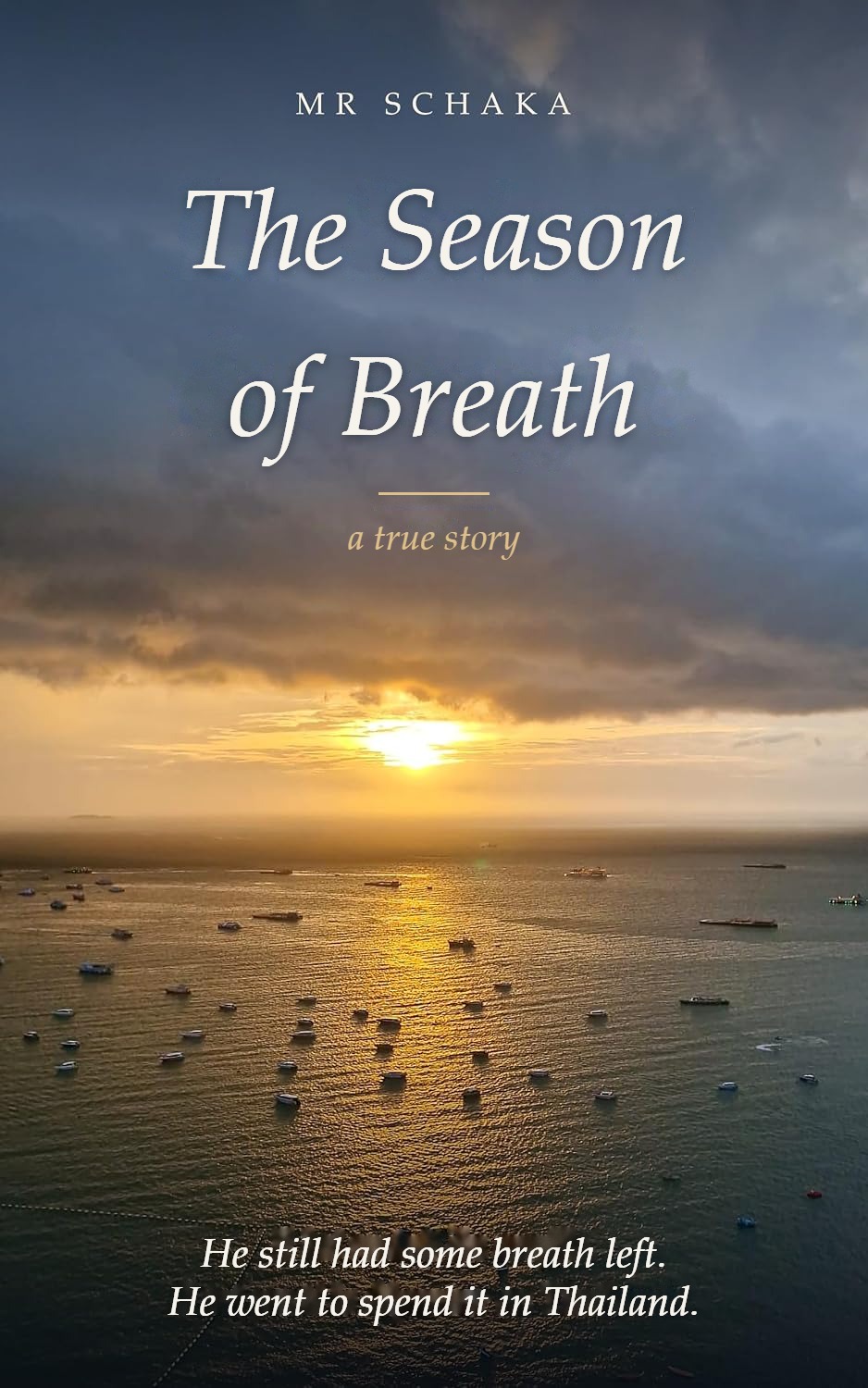
The book
Mr Schaka lives with pulmonary fibrosis and has been travelling in Thailand for years. In The Season of Breath he tells the story of that journey, one step at a time, with humour and no self-pity.