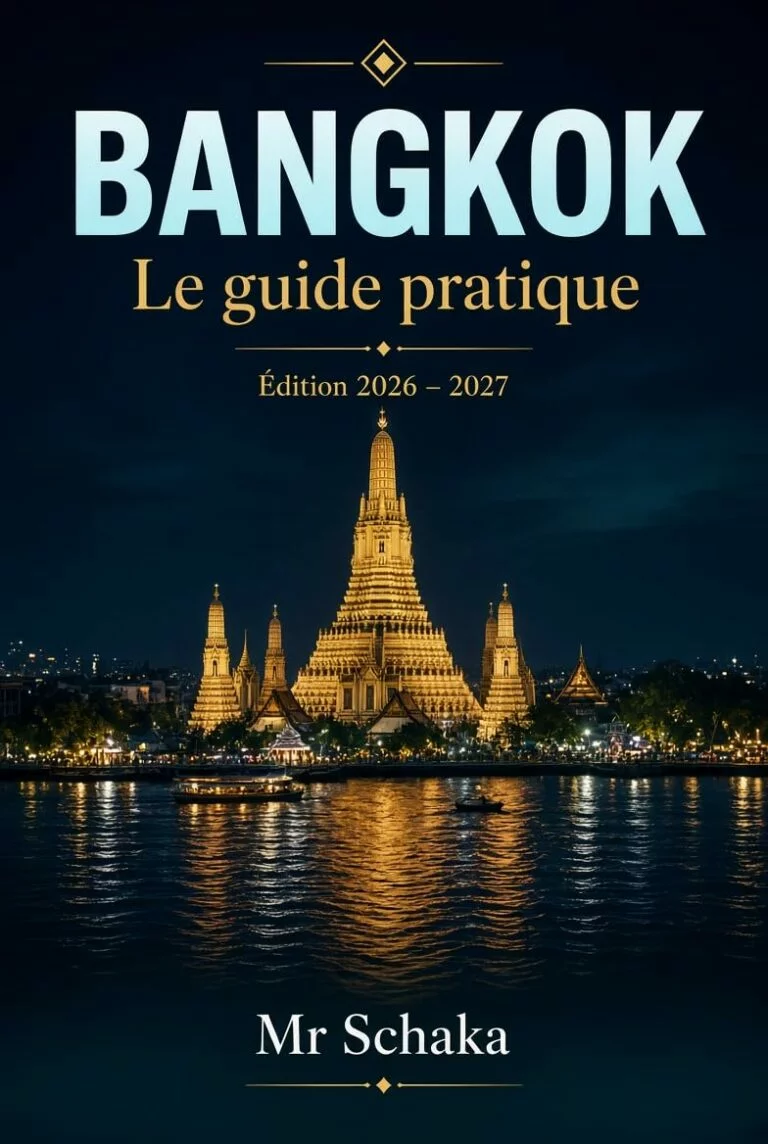
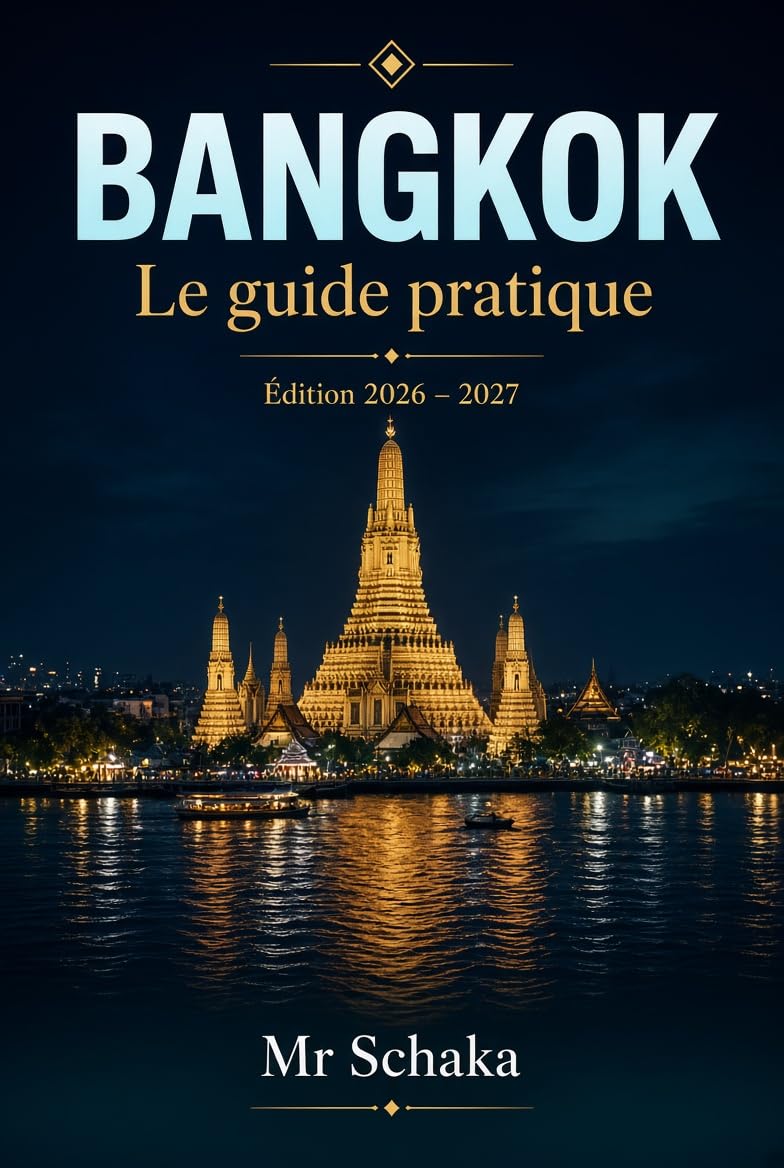
You arrive in Bangkok with a list of places to see. But do you already know how to connect them, where to pause and which neighbourhood will make you want to go out in the evening? Discovering a city involves more than collecting familiar pictures. A few reference points help turn travel intentions into comfortable days. That is the role proposed by BANGKOK – Le guide pratique by Mr Schaka in its 2026–2027 edition, a book designed to connect practical choices with the pleasure of discovery.
Preparation, transport, neighbourhoods, food and local conduct appear together because they affect one another. Accommodation influences journeys; a sightseeing plan changes the need for breaks; understanding an everyday convention may improve an encounter. To introduce the guide, let us begin with questions a reader can ask before departure. What do you want to experience in Bangkok, and which reference points would help make that intention concrete? Answering this is more personal, and often more useful, than selecting a universal list of places everybody supposedly needs to visit.
Do you want to see everything or understand your first day?
The first temptation is often to create an ideal programme from a map. Attractions appear close, journeys become simple lines and rest vanishes between stops. A real day, however, includes a body, an arrival time, weather and companions. What would count as success: ticking off several names or returning with the feeling of having properly encountered one part of the city? Your answer may change the whole preparation. It can also prevent an apparently impressive schedule from becoming an experience remembered mostly through tiredness and transfers.
Read the proposed itineraries alongside the thematic chapters. An itinerary supplies progression; other sections explain what that progression implies for you. You can keep an idea, shorten a sequence or set aside another day. This freedom does not weaken a guide. It demonstrates its usefulness: enough information to make decisions rather than an obligation to reproduce a list that knows nothing about your energy or interests. Preparation works best when it gives you choices you can explain, including the decision not to add one more attraction.
What do you actually need from your neighbourhood?
The book distinguishes accommodation areas with different settings and uses. Before comparing addresses, write down three needs: a straightforward journey, a pleasant local walk or dinner within easy reach, for example. This gives the accommodation chapter a clear purpose. It prevents a striking picture or enthusiastic comment from arranging every day on your behalf before your priorities have been named. An appealing hotel can still be a poor fit for a particular trip if the surrounding arrangements repeatedly work against what you came to enjoy.
Think about coming back as well as going out. Travellers readily plan the outward journey to an attraction, less often the final return when tired. An area is understood through its surroundings and connections, not just its apparent distance from a monument. Use the guide to identify questions, then compare them with current property and operator information. A suitable base is not the one every traveller prefers. It is one whose advantages and limitations you understand in relation to the actual stay you are preparing with your own companions.
Is transport an inconvenience or a way to read the city?
The book gives space to movement, from urban rail to boats and road journeys. This does more than help people move quickly. It explains why the city is arranged as it is and why two pairs of addresses do not connect in the same way. Instead of seeking one perfect mode for every journey, ask a more precise question: what works for this movement, at this time, with these people? A question of that scale can produce a usable answer without requiring complete mastery of Bangkok’s transport systems.
Distinguish understanding a network from confirming a service that day. A simplified map explains a relationship; it does not replace current information about a line, departure or fare. Prepare one first journey and a return option without trying to learn the entire city before arrival. The guide can then support confidence through organisation and gradual learning. It need not promise that nothing will surprise you outside the airport. Knowing how to ask the next question can be more useful than imagining every possible inconvenience has already been eliminated.
What connects the neighbourhoods on your list?
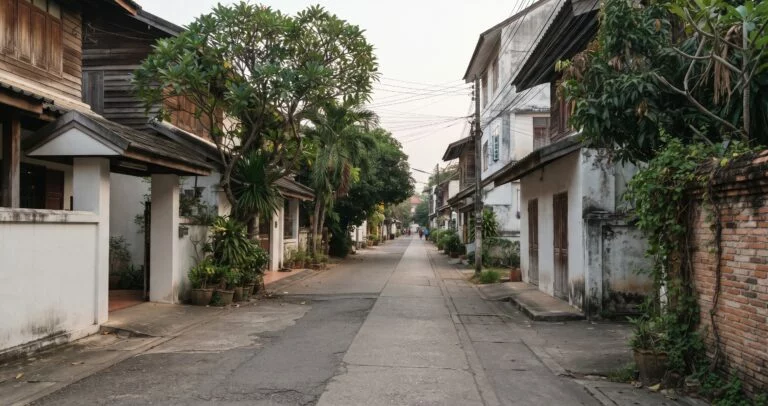
Rattanakosin, Thonburi, Chinatown and Sukhumvit are not merely names to memorise. The contents place them within groups of discovery alongside other parts of Bangkok. That structure encourages comparison rather than accumulation. What would you like to observe in each? What changes between a waterside area and a commercial street? A neighbourhood becomes clearer when associated with a question, a moment and a way of moving, instead of one emblematic image that may tell little about the experience of spending time there on foot.
Open two chapters and compare their functions within your trip. One may suit an introduction, another a day when fewer transfers appeal. This does not create a ranking of districts. It provides a grammar for your plan. You know why you choose one stage and save another. Postponing a visit can then become a positive decision intended to improve the stops retained, rather than a failure caused by not following every recommendation. A guide is most useful when its structure helps explain both inclusion and omission.
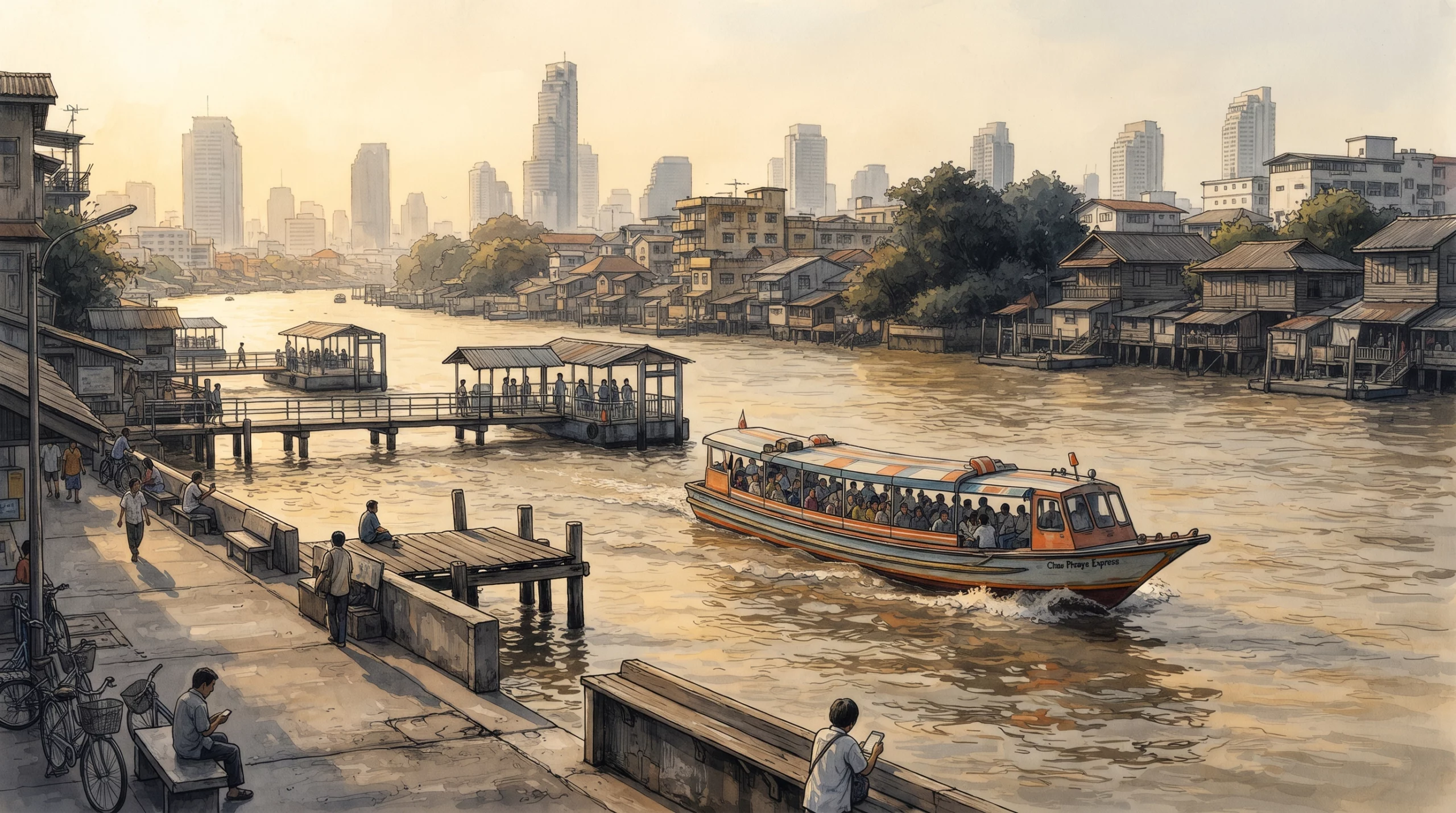
Are you interested in a monument itself?
Famous names can be reassuring: see them all and the trip must surely be successful. Yet a visit can remain thin when you do not know what you hope to notice. The guide introduces well-known places within the shape of a day. Before choosing a stop, ask what attracts you: architecture, water, a religious setting, curiosity about history or simply the desire to see somewhere often photographed? Any of these can begin a worthwhile experience when recognised honestly instead of hidden behind an obligation to admire.
Use the pages to identify one or two threads. Then allow local information and current conditions to refine the visit. Someone interested in a detail may spend time differently from a group seeking a broad introduction. Knowing your interest helps you decide rather than improvise under pressure. Afterwards, you can describe what was actually observed instead of searching for a sophisticated caption for pictures whose original purpose has been forgotten. Understanding does not require seeing every part of a site; it can begin with one feature noticed carefully.
Is food a programme or an encounter?
The food chapter offers reference points for an experience that can seem intimidating on a first stay. It need not become a competition to eat the greatest possible number of specialities. What would you like to understand: a preparation, ingredient, ordering process or the rhythm of a small business? Choosing a question changes attention. A meal can become a discovery without turning into a challenge organised around a checklist, allowing the people serving and eating to remain part of an ordinary shared setting.
The book’s discussion of conduct is useful in everyday actions: asking, waiting, understanding a price and leaving space. Information relevant to your needs must still be clarified with the person serving. Do not leave a health-related question to an assumption based on a dish name. Reading prepares an exchange without replacing the need to listen to its actual answer. This keeps a meal human as well as practical. You can learn something valuable while choosing only what you genuinely want to eat at that moment.
How can you prepare without freezing the city in place?
A practical edition has a date. The manuscript places its information checks in September 2026 and notes that details may change. That is a normal feature of a travel book. Separate relatively durable reference points from information needing confirmation before a decision. A neighbourhood’s organisation and a service’s availability do not require the same kind of check at the same stage. Recognising this difference makes a publication easier to use than either trusting every detail indefinitely or treating any possible change as a reason to abandon preparation altogether.
Keep a space in your notebook for checks: intended transport, visiting arrangements, a possible reservation and a contact. The guide helps identify what to seek, while a current source confirms what you can do. Travellers can be organised and receptive to the unexpected at the same time. Those qualities reinforce each other when information retains context and dates. A changed detail then becomes a manageable update rather than proof that the whole plan has failed or that the book has suddenly lost all its practical and explanatory value.
What changes between twenty-four hours and a week?
The book suggests possibilities for different durations. This matters because time between two journeys is not the same as a stay allowing a return to a neighbourhood. Establish the hours actually available after arrival, rest and departure. A day in a calendar is not always a complete day in the city. That distinction can make an apparently attractive programme unrealistic before you even begin, especially when luggage, a fixed departure or the needs of travelling companions take a significant share of the time.
On a brief stay, look for coherence: a few connected places rather than repeated crossings. With more time, alternate activities and rhythms. Do not enlarge every programme simply because more days are available. Revisiting a place, exploring one district more deeply or keeping an unplanned morning can make duration valuable. Rest is not necessarily travel lost. It may be what lets a later encounter register clearly, instead of becoming one more blurred memory from a city experienced continuously at the limit of available attention and energy.
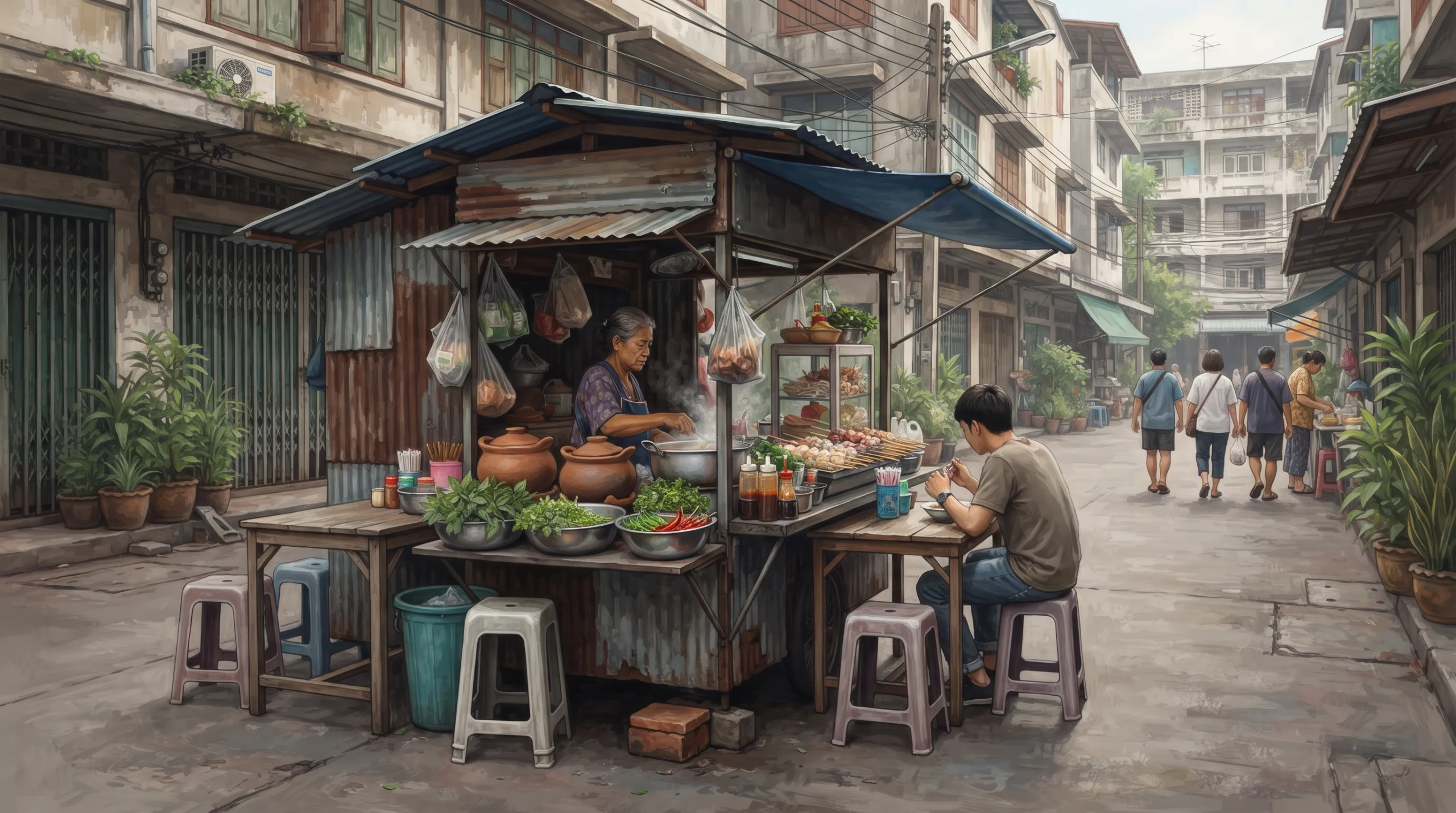
Should maps decide everything?
The manuscript describes its maps and diagrams as simplified original creations not drawn to scale. This indicates how they should be read: they reveal an arrangement rather than replace measurement of an actual journey. Use them to understand relationships, then check practical conditions before moving. An elegant line cannot describe all of traffic, heat, an interchange or the time a group needs to progress comfortably. The map offers orientation; the lived journey adds details no single diagram can fully contain for every person and every day.
Annotate your reading with simple categories: easy to connect, needs checking and save for another day. The book becomes an active tool rather than an authority determining every movement. This also supports discussion between companions whose preferences differ. A map makes options visible and understandable without replacing individual needs or the freedom to change direction. A carefully prepared day may still unfold differently. Knowing why an arrangement was chosen makes it easier to revise sensibly than following a route whose logic was never understood in the first place.
What would you like to be able to ask in Thai?
The small glossary and practical notebook can be mistaken for appendices to open only during a problem. They can also help from the beginning. Choose situations in which you would like to hesitate less: greeting, thanking, asking for information or explaining a destination. The purpose is not mastery of a language before departure. It is recognising that an exchange belongs to travelling and deserves a little preparation alongside tickets, accommodation and a list of places you hope to see during the visit.
Keep necessary names and addresses in a form easy to show. If an answer is unclear, clarify rather than agree simply to avoid looking lost. The book’s tools can help anticipate such situations without automating encounters. You can appreciate a city while needing to ask twice. Good preparation does not remove uncertainty; it provides courteous ways through it. A misunderstanding can then remain a small event instead of becoming a conflict or a reason to stop asking the questions that would make the rest of the day easier.
Which reader and which edition?
The official presentation addresses a first visit, a stopover and family holidays. These readers share needs without having identical ones. The useful question is not whether you are the guide’s ideal traveller, but which sections serve your actual plan. Scan for what answers a concern, feeds an interest or can wait until later. A book need not be consumed uniformly from cover to cover to become useful. Its arrangement allows different readers to build a personal route through material according to the experience they are preparing.
The official page also presents an English edition. Check the language and format of the copy selected. The language of an introductory article does not establish that every book edition exists in that language. This matters when buying a gift or sharing with a companion. A purchase matched to real use is preferable to a quick choice based on a familiar cover followed by discovering an unsuitable language or format. Practical care begins before the journey, including the apparently small decision about which version of a guide to open.
What if the best result is choosing more clearly?
BANGKOK – Le guide pratique is not understood only by counting its topics. Its value can be approached through a personal question: after reading, do you better understand why this day, neighbourhood or journey suits you? If the answer is clearer, the book has already begun to work. It provides reference points and a way to connect them, not a demand to reproduce somebody else’s holiday in a city where your own interests, pace and companions will shape the experience from the moment you arrive.
Consult the official page for current formats and choose the edition suited to your use. Then open the guide with three questions still in mind. They may be your earlier questions made more precise, or new ones the contents have prompted. That is a productive beginning in Bangkok: not certainty that everything has been predicted, but sufficient understanding to decide, ask and look. The city can remain surprising without becoming something to endure throughout the entire trip. A useful guide leaves room for that surprise while helping you recognise the next practical choice.
The book and this introduction
Discover the book on Mr Schaka’s website.
Prepared from the book or its opening and the official book page, checked on 4 November 2026. Interpretations are offered as reading suggestions. Check the book page for current formats and availability.
French, English and Thai versions of this article do not imply that the book is sold in all three languages.
To go further
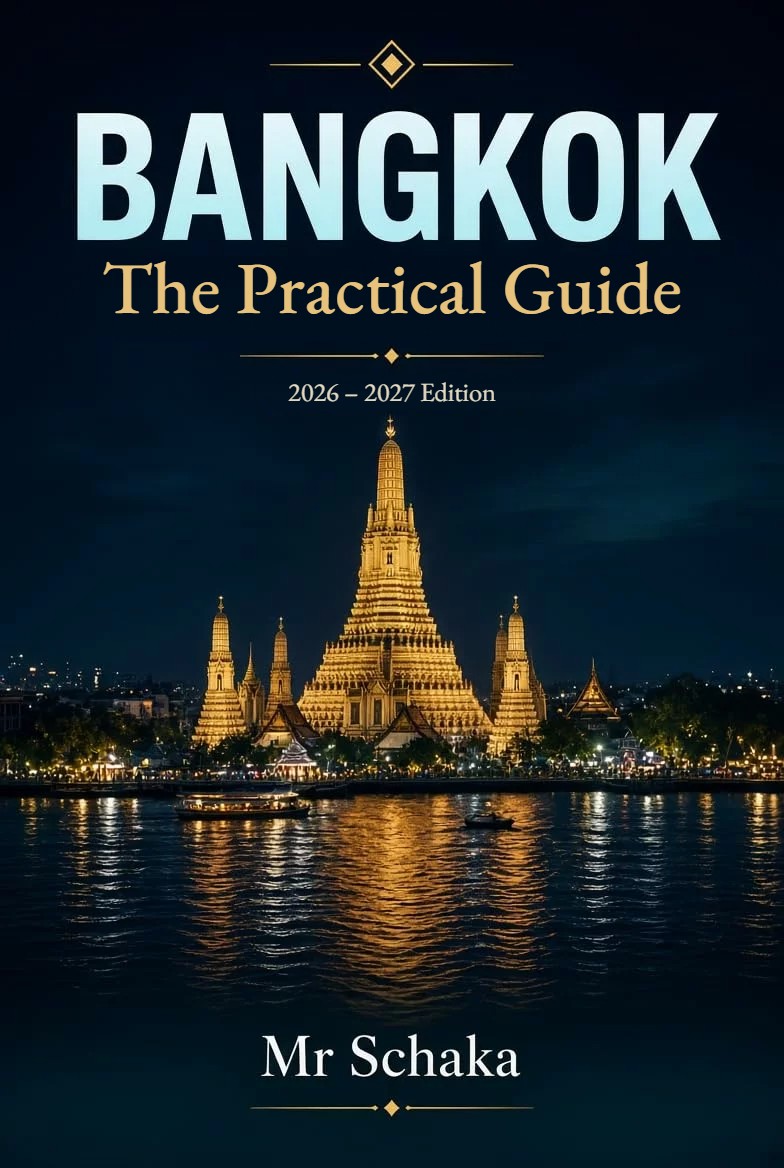
Mr Schaka’s guidebook, Bangkok – The Practical Guide, covers the essentials: transport, neighbourhoods, addresses, food, etiquette and safety, updated for 2026–2027.