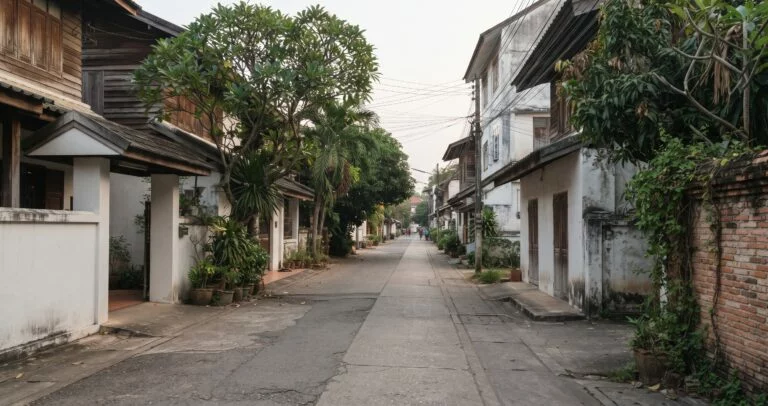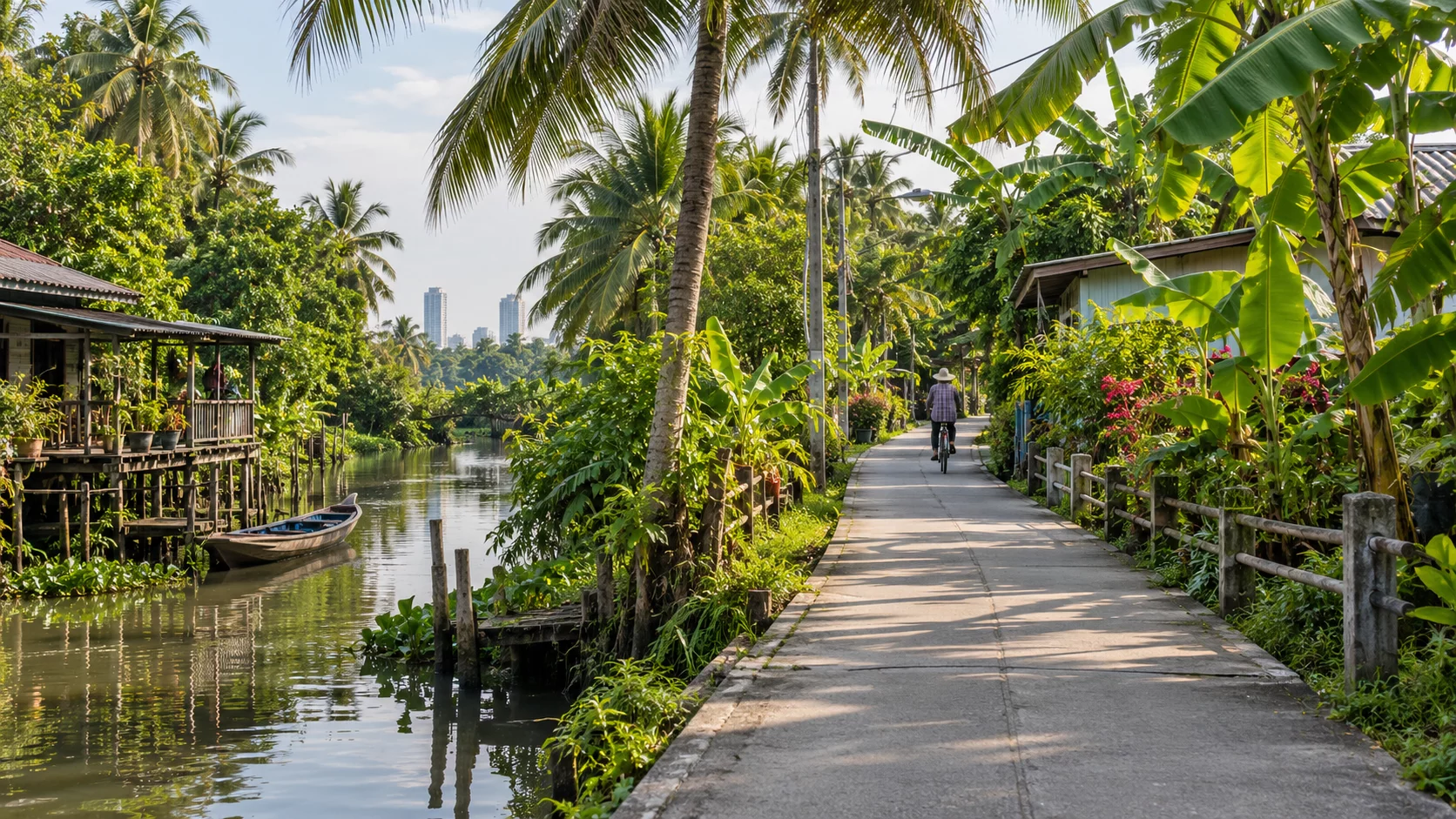
On a map, Bang Krachao first attracts attention through the space left to greenery near densely built areas. On arrival, interest may come from another relationship: water and paths, trees and homes, a park and activities continuing around it. Preparing a visit therefore takes more than finding a bicycle and an appealing passage beneath palms. It helps to understand what you have chosen to discover. Bang Krachao lies in the Phra Pradaeng area of Samut Prakan province and should not be presented as an administrative neighbourhood of Bangkok. Proximity to the capital provides context for the outing; it does not summarise the place's identity or make its different spaces interchangeable.
Begin with the river bend, then change scale
The provincial tourism description locates the green area within a bend of the Chao Phraya. Look at that shape on a map before searching for stops. It helps explain why water forms part of the place's image. Then move closer: what appears as one green area from a distance includes passages, lived spaces and places with different uses. The overview provides orientation rather than permission to move everywhere inside the shape. A continuous patch of colour on screen does not tell you how individual paths connect or which passages are suitable for visitors.
Choose the scale at which you want to look. A visit centred on a park differs from exploring several inhabited areas. The first may allow longer observation within an identified setting; the second requires more checks about passages and transport. Neither is automatically better. The mistake is to confuse their preparation and assume a path seen in a picture guarantees an easy connection to the next chosen point. Decide what kind of outing interests you before collecting more destinations. A smaller, understood area can offer more than a larger route followed without knowing what its lines represent.
Distinguish Bang Krachao from its park
Si Nakhon Khuean Khan Park and Botanical Garden is a concrete reference point in the area. Thailand's tourism authority places it in Bang Kachao, Phra Pradaeng district, and mentions its variety of plants. Record the full name so you do not confuse a precise destination with the wider area's name. Bang Kachao and Bang Krachao both appear in tourism resources. Compare addresses and positions rather than assuming that the spelling difference necessarily identifies two separate places. Keeping a consistent name in your own notes will make later searches and captions easier to check.
A park can provide an anchor without summarising everything around it. Start with its entry information and the routes available on your visiting day. Do not automatically extend those conditions to neighbourhood paths outside. Conversely, a photograph of a small passage between homes does not describe a circuit within the park. This distinction clarifies the plan and improves the account. You can say where you actually went instead of gathering every impression under an excessively broad label. The specificity is useful even when the purpose is simply to spend time looking rather than completing a formal itinerary.
Read the green-lung metaphor as a metaphor
The phrase Bangkok's green lung appears repeatedly in descriptions of Bang Krachao. It draws attention to vegetation near the capital, but it is not an air-quality measurement or a promise of wellbeing. Replace the phrase with observable questions: where do trees close the view, where does light pass through an opening, and how does a path meet water? You move from an attractive label to attention that can genuinely inform a memory. The metaphor may introduce the visit, but your observations should provide the substance rather than merely illustrate a slogan already accepted.
Avoid describing the place as nature without residents or a past left untouched. A hedge, building or passage may reflect current uses whose history you do not know. Notice their presence without inventing the lives of people using them. An attentive visit does not need to oppose an allegedly artificial capital to an allegedly pure countryside. It can be interested in their proximity, boundaries and relationships visible in the landscape. Allow a scene to contain ordinary work, movement and buildings without treating them as interruptions to the picture you came hoping to find.
Choose a purpose before choosing a bicycle
Bicycles are closely associated with images of Bang Krachao, but they should not determine the project alone. First ask what you want to do: observe a green space, pause to draw or reach a particular place. Then choose movement suited to your abilities and confirmed conditions. The availability of a rental does not establish that every passage will suit you. A visit on foot within an identified setting, or fewer stops, can still be a substantial discovery. There is no need to reproduce the most common image in a guide to make the outing count.
If considering cycling, request a precise description of the proposed route. Width, surface, crossings and the ability to return matter more than a general promise of an easy ride. Check equipment and rental conditions before committing. Do not follow a segment that makes you uncomfortable merely because it appears in a popular photograph. Dismounting or declining a passage must remain genuine options, considered before you are halfway through a difficult situation. A clear decision made early is more useful than hoping every unfamiliar section will somehow match the easiest part of the route.
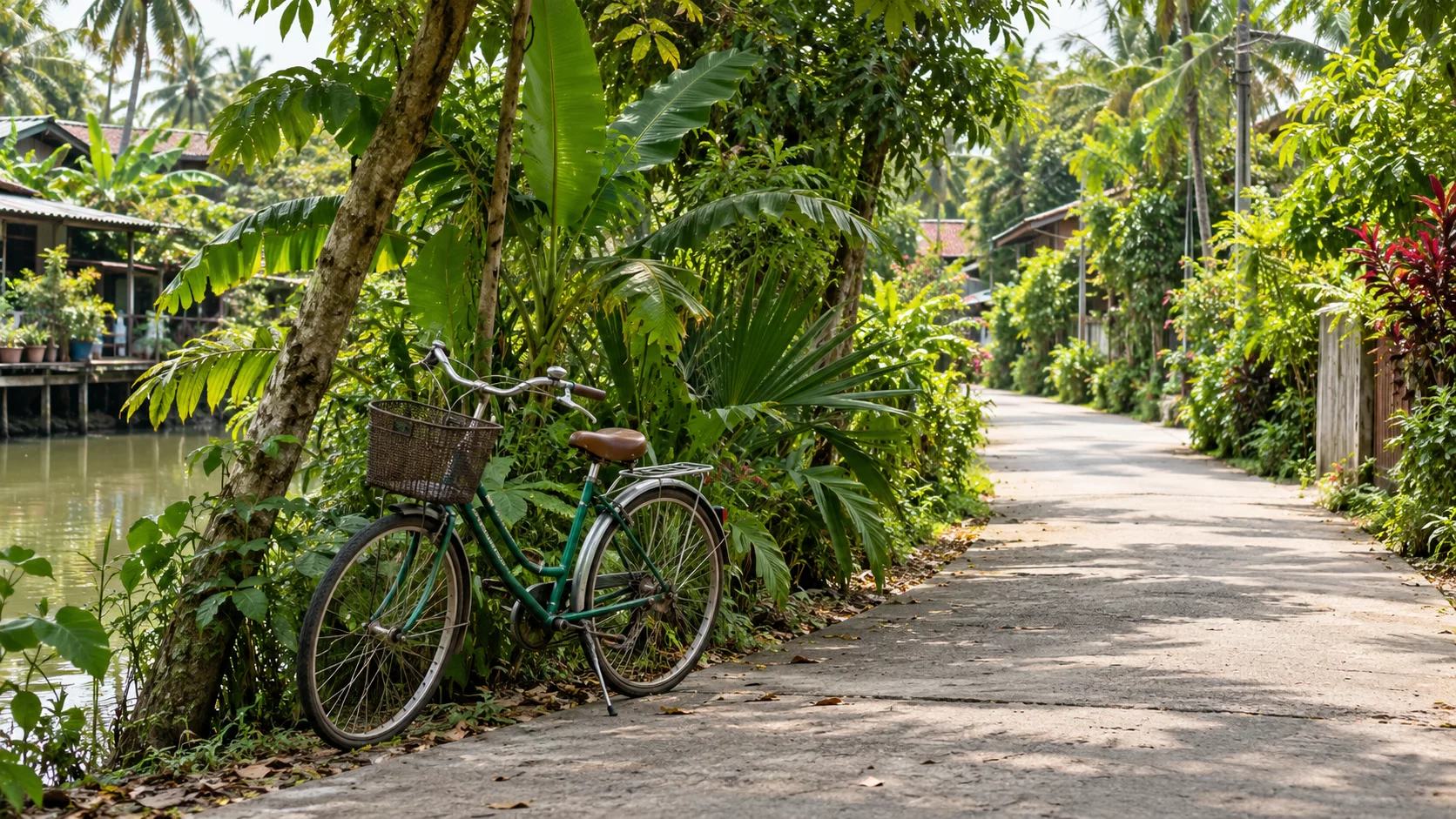
Do not turn everyday passages into available scenery
A narrow, vegetated lane may be photogenic while also serving everyday movement. You are not the only person entitled to decide its pace. Do not stop in the middle to obtain several versions of a picture. Find a place where your presence blocks neither passage nor entrance. If uncertain whether a route welcomes visitors, ask for confirmation instead of treating the absence of a barrier as an invitation. Curiosity cannot replace access information. A path's visual appeal and the practical conditions for using it are separate questions, even when they seem inseparable in travel photographs.
A visible canal does not establish permission to follow every bank either. Remain on confirmed passages and respect closures. Do not approach a home to complete a view or move an object to make the frame appear more natural. That would construct a scene while erasing its actual use. You can write about an interrupted connection or a decision to turn back. Such limits belong to the geography of an honest visit rather than a flaw to hide. They may also explain why your account differs from another traveller's without implying that either person has seen the whole area.
Look at vegetation through three planes
At a suitable stopping position, identify a foreground, middle distance and background. A nearby leaf may frame water; a mass of vegetation may hide a building; an opening may reveal something farther away. Describe those relationships without guessing every species. A plant name adds value only when it matches what you observed. Otherwise, shape, colour and position already provide precise, personal material. You can compare a broad leaf with a narrow one without assigning either a confident botanical identity. The aim is to look more carefully, not to decorate the notebook with unsupported expertise.
To continue, change just one thing: distance or angle, where the authorised passage allows it. Note what disappears and what becomes visible. This reveals the difference between treating vegetation as a uniform background and seeing a landscape of several depths. It requires no collecting, entry into planting areas or rearrangement of the scene. Patient observation from an appropriate position can produce a more interesting page than a sequence of greenery portraits made without intention. If you cannot change position conveniently, remain where you are and change the question instead of forcing a new viewpoint.
Include water without giving it an invented history
When water enters the route, notice its role in the frame: a line, reflection, boundary or space crossed through an identified passage. Do not infer use, depth or quality from appearance. You can describe a reflection without asserting that water is clean, or note a structure without guessing its operation. What you do not know may become a question for later conversation or research. Keeping that question visible gives the account room to develop without turning a brief observation into an explanation of a system you have not studied.
Apply the same care to sound. Activity behind trees does not establish a story about work or justify calling an entire neighbourhood silent. Record what you heard at a particular moment from your position. Readers can understand a situated experience. You avoid the account in which every detail confirms a preselected idea: absolute calm, simple living or uniformly preserved nature. The place can be interesting precisely because it resists such a single description. A changing soundscape or an unexpected ordinary activity can add substance instead of spoiling the intended atmosphere.
Treat the market as a separate visit
Bang Nam Phueng is among markets mentioned in tourism resources for the area. The government portal describes it through community food and craft products. If you want to visit, confirm its own calendar and current conditions before adding it. A busy market photograph does not prove operation on every date or at your arrival time. Do not build the day around availability you have not checked. It is better to retain the market as a confirmed option than to make every other part of the outing depend on an assumed final stop.
When stalls are operating, understand the offer without turning a purchase into an authenticity test. Ask about ingredients or how something is sold if that information matters to you, and accept that you may choose not to buy. Conversation can remain brief. People working do not owe their life stories to make a visit memorable. Ask before making a close photograph of a person or their work, and make refusal easy. The market remains a place of activity when it welcomes visitors. Allow transactions and ordinary movement to continue rather than treating them as a scene arranged for your camera.
Consider what community-based means for your attention
An official Public Relations Department release places the Khung Bang Kachao sustainable-tourism area across several subdistricts of Phra Pradaeng. This context recalls a territory more complex than an isolated park. It does not establish that a particular activity will be offered during your visit. For an organised experience, identify the responsible provider, content and current conditions. The word community-based should begin a check rather than function as an automatic guarantee of encounter. A description of a programme and the arrangements available for your date remain different pieces of information that need connecting explicitly.
You can support a local activity by respecting how it is offered: booking when requested, clear payment and agreed time. Avoid promising exposure or benefits whose reality you cannot know. If someone shares an explanation, ask before publishing it with their name or image. An experience can be enriching without becoming a representative story about the entire population. Maintaining this scale protects the encounter and makes your writing more credible. It also allows the person who helped you to remain an individual rather than a character required to illustrate a broad theme about the place.
Prepare the return before the final discovery
Check the return separately from the outward journey. If the plan includes a boat or another service, confirm the departure point, conditions and last option relevant to your day with the operator. This guide promises neither a frequency nor a timetable. Keep a margin for reaching the correct place and changing the programme if needed. Bangkok's apparent proximity on a map does not remove the actual stages of travel. Even a short visit can require attentive organisation, particularly when several forms of movement need to fit together rather than operate as one continuous service.
Before adding a final stop, identify what remains: returning equipment, collecting belongings or reaching a connection. Do not treat these tasks as invisible time. If you have already found a good observation point, keep it as the end of the outing. Wanting to continue does not oblige you to follow a new path with unknown conditions. A comfortable return belongs to the outing's quality and leaves a fairer impression than a final rush to complete a list. You can retain an unfinished idea for another visit without presenting it as something you failed to accomplish.
Keep the account at the scale of what you saw
After returning, choose three connected elements: the river bend on the map, a plant detail actually observed and a boundary that influenced your route. This small structure gives the article substance without claiming to explain all of Bang Krachao. Identify what comes from a source and what belongs to your perspective. If you visited only the park, say so. If the market was not part of the day, do not introduce it as a personal experience. Useful preparation information can be included without disguising it as testimony about a stop you made.
Identify generated images as atmospheric illustrations rather than records of a particular passage. A palm-lined lane, parked bicycle or notebook near greenery can accompany the reading, but cannot prove a path's condition or accessibility. Personal photographs need precise captions too. An unknown position remains unknown until checked, even if attributing it to Bang Krachao would produce a more appealing title. Fidelity begins with these small editorial choices. A clearly labelled illustration can support an original guide without pretending to provide evidence of a view or encounter that it did not document.
Three questions for choosing an outing
Can you visit without cycling? Yes: plan around a place and observation rather than a cycle circuit. You still need to check access and the exact movement involved. Removing a bicycle does not automatically resolve every route question. The appropriate choice fits your abilities and confirmed information rather than imitating the image most frequently reproduced in guides. You may discover more through a short, clearly understood visit than through a longer ride whose practical demands keep you from looking at the surroundings.
Is Bang Krachao a Bangkok park? No. The area lies in Phra Pradaeng, Samut Prakan province, and includes a park with its own name. This distinction helps with searching, asking directions and describing the outing without erasing local geography. Bangkok may be your starting point without becoming the name of every nearby place you discover. Keeping the location precise is not a minor technicality: it changes which information you need and prevents you treating one park's visitor conditions as a rule for the whole surrounding territory.
Should you seek the most isolated route? Not necessarily. Isolation is neither a guarantee of quiet nor a sufficient criterion for selecting a passage. A clearly accessible place where you can pause without obstructing others may offer more than an uncertain segment followed for its reputation. Bang Krachao rewards being viewed as a living territory with uses and limits, rather than a green interval in which everything is available to visitors. The attention you bring can make a modest route distinctive without requiring the place to become the idealised escape promised by a photograph.
Sources and preparation references
- Samut Prakan provincial tourism: Si Nakhon Khuean Khan Park
- TAT: park and botanical garden
- Government portal: metropolitan-region markets
- Public Relations Department: Khung Bang Kachao

To go further
Mr Schaka’s guidebook, Bangkok – The Practical Guide, covers the essentials: transport, neighbourhoods, addresses, food, etiquette and safety, updated for 2026–2027.