Look at the city on more than one scale
You can begin a visit to Verviers with a question rather than a ranking of monuments: how do you look at a city whose textile history remains important without reducing every building to that history? The Pays de Vesdre tourism office connects the river, wool working and local skills in its introduction to the city. That thread is a starting point, rather than an automatic explanation for every street. An interesting walk also leaves room for present uses, residents and details that do not fit a quick interpretation. The city is something to explore, not an illustration of a conclusion already written.
This guide moves from a broad view towards a detail: a relationship with the Vesdre, a facade, an opening, then a question about work. It does not define an official circuit or guarantee access to buildings or a continuous riverside path. Prepare a small area using a reliable map and adapt the outing to what you find. The aim is not to identify a former factory at every corner. It is to distinguish a visible clue, documented information and a possibility that should remain a question until there is evidence to support it. Leaving with a more precise question can itself be a worthwhile result.
Start with one precise question
Before leaving, choose a question short enough to fit in your notebook. You might ask how buildings organise light, how streets lead towards the river, or how several periods coexist within a facade. One question can guide attention better than a long collection list. It also helps you choose a limited part of the city rather than adding journeys simply to cover more ground. In a group, people can choose different angles and share one observation afterwards. There is no need to insist that everyone approaches the city in exactly the same way. Different interests can make the discussion at a break more rewarding.
Write down what you will not attempt to decide from the street as well. A facade cannot, by itself, identify an owner, a profession or an exact period. A large window alone does not prove industrial use. These limits do not make the outing less interesting; they prevent an impression from becoming an unsupported fact. Three notebook columns are useful: what I see, what a source establishes, and what I want to check. Over the course of a walk, this distinction helps you understand more while making fewer confident claims about things you cannot yet know. It also gives later reading a definite purpose.
Use the Vesdre as a reference point
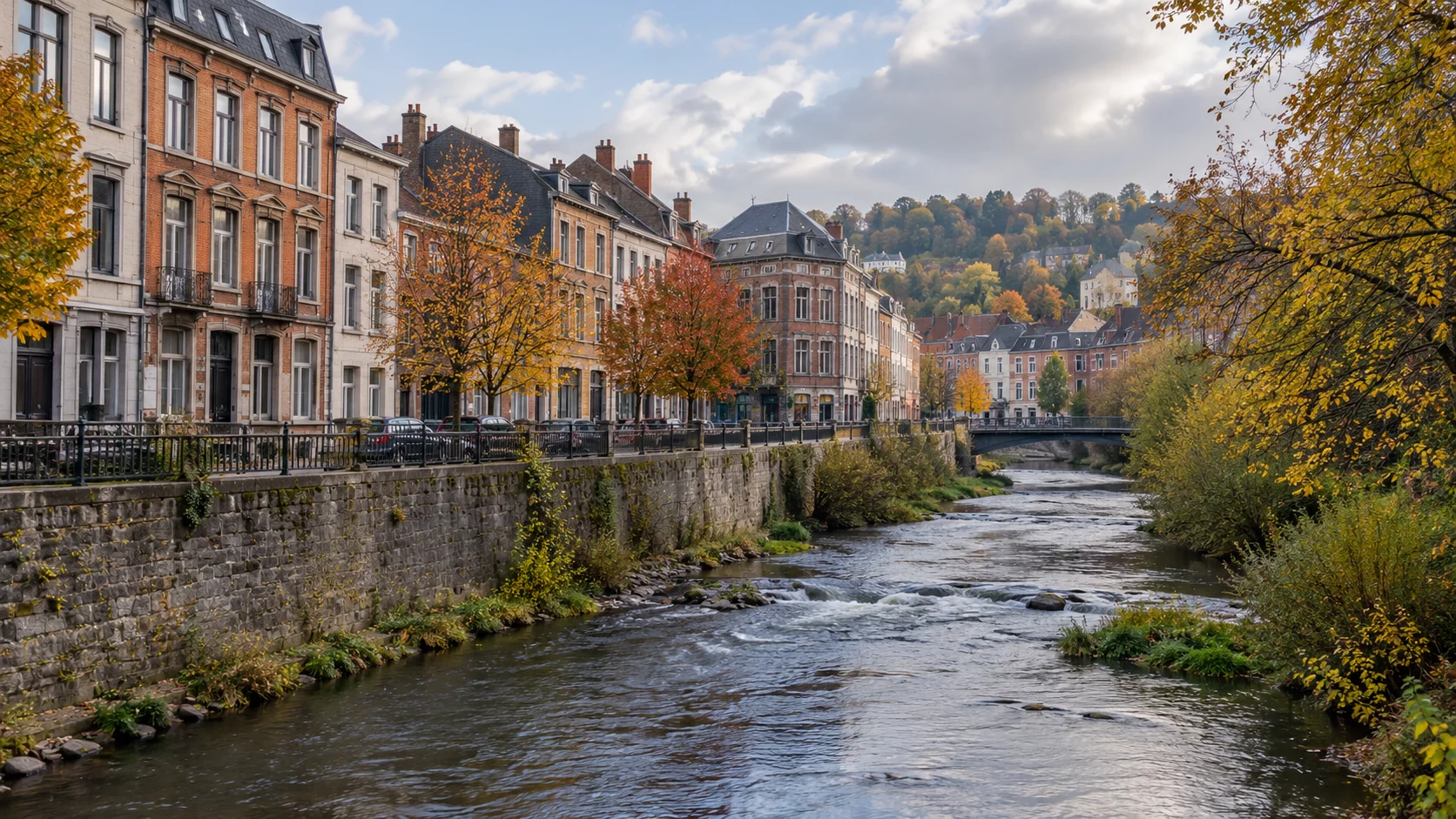
Locate the river on your map and select a public place where you can look without obstructing others. Observe the visible relationships between water, bridges, streets and buildings. Where does the view open? Where does a building form a screen? What journey is actually required to reach the other bank? These questions concern the place in front of you. They give the city a first structure before any historical explanation. They also help distinguish a short distance drawn on a map from an easy or suitable passage on the ground. An actual usable detour is more helpful than an imagined direct line on a screen.
The broad connection between Verviers, wool and the Vesdre invites research rather than an invented explanation for each detail. Avoid presenting every waterside building as a factory or each structure as textile equipment. A particular function requires a particular source, an explanatory plaque or relevant heritage documentation. If you cannot find confirmation, simply describe the building’s position and the question it raises. The landscape keeps its visual interest without having to prove more than it shows. An honest uncertainty can give a reader a better starting point than an attractive story presented as established history. A hypothesis clearly named as such can remain a useful research lead.
Read a facade as an arrangement
Choose a facade you can view from a comfortable position. Before taking a photograph, look at its proportions and the repetition of openings. Do the windows follow the same rhythm? Is one entrance wider? Does a material change between sections? Ordinary vocabulary is enough: tall, narrow, regular, altered, filled in. You do not need to assign an architectural style to write a precise description. A concrete sentence often helps more than an impressive adjective intended to communicate that something is old. Describe the feature before deciding what larger interpretation it can support, and allow a modest observation to stand on its own.
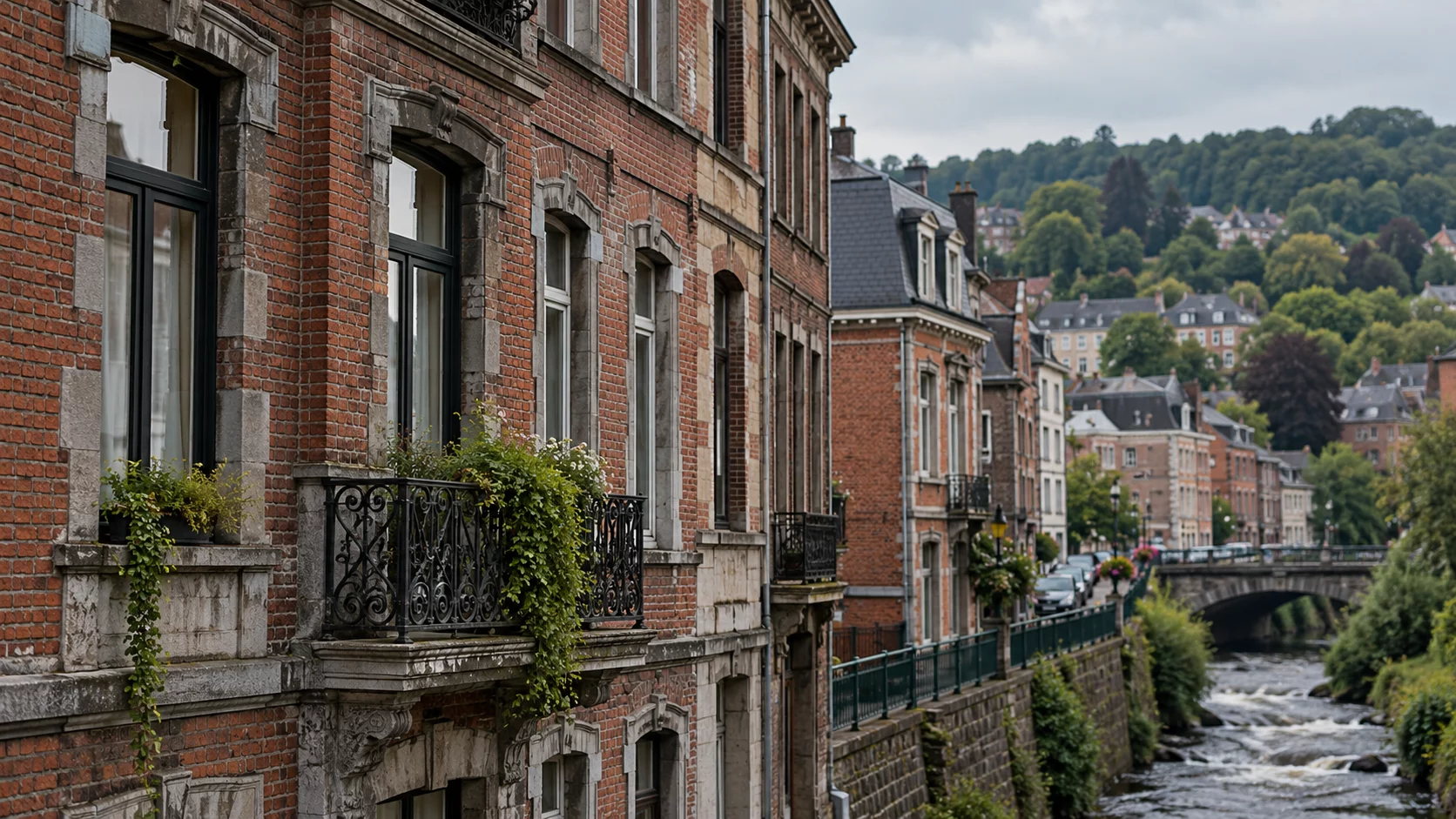
Then change your position slightly, if doing so is safe and does not inconvenience anyone. A projection may become clearer from an angle; a difference in depth may appear; two apparently identical parts may separate visually. Note how the movement changes your reading. This shows that observation depends on where you stand as well as what you look at. Do not enter private doorways or move into a road to obtain a better picture. A building is not scenery reserved for visitors. It belongs to a functioning street whose ordinary users still need access and space. Another framing is always possible if the first would obstruct someone.
Treat light as a question to investigate
Openings can suggest questions about light and the organisation of working spaces when looking at industrial heritage. Compare what different facades allow you to notice: repetition, apparent orientation, window depth or obstructions nearby. This remains an observational exercise. Establishing a room’s former function or the working conditions within it requires additional documentation. An appealing deduction should not be presented as a certain reconstruction of an activity. You can be curious about the connection between architecture and work without pretending that the outside of a building answers every question about its inside. Being clear about that distinction makes the enquiry stronger.
Try writing two versions of a sentence. The first describes: a row of tall windows occupies this floor. The second asks: what use might have required this arrangement? Keeping them separate lets you tell the story of a walk without exaggerating what you know. With children, ask which detail they would like someone familiar with the place to explain. The value of the exercise is the quality of the question, rather than how quickly an adult supplies an answer. Several different questions may arise from the same window, and none has to be resolved immediately. Save a useful question rather than rushing to produce a convenient explanation.
Notice materials, repairs and present uses
Brick, stone, metal and wood offer other ways into the streetscape. Look at joints, thresholds and changes in surface rather than touching fragile elements or equipment. A visible repair can be described without dating it. A recent door in an older facade does not disclose the complete history of a conversion. Your notebook can record the coexistence of materials and ask how it developed. Caution does not remove the detail; it preserves it accurately. Later documentation may clarify the sequence, but you do not need to settle it while standing on the pavement. An accurately recorded question is easier to investigate than an embellished impression.
Look for indications of present use as well: visible activity, an entrance open to the public, a shopfront or residential access. A building associated with the past does not need to be empty or available to enter to deserve attention. The people living and working there are part of the city now. Avoid photographing through windows or blocking a door while composing an image. You can discuss a changing environment without turning occupants’ private lives into a visitor attraction. Respect for current use is part of reading a place carefully, rather than a separate interruption to the subject. The present deserves as much attention as the past.
Think about work without inventing workers
The textile theme invites attention to work, but a picture of a wall cannot reconstruct an individual’s day. Organise questions around actions: preparing a material, transforming it, checking a result or moving a product. These are research categories, not assertions that all those operations occurred in the building you are observing. They can help prepare a cultural visit or further reading. A precise question is more likely to find an answer in a suitable resource than a whole story invented from architectural appearance. Your task is to notice a useful line of enquiry, not to manufacture a complete reconstruction from insufficient evidence.
Leave room for what an introductory source does not immediately cover. A working city cannot be reduced to machines, facades or its most familiar names. To explore living conditions, occupations or social change, find documents that address those subjects. Do not assign feelings, dialogue or memories to anonymous workers simply to make a travel article more vivid. Curiosity can be warm without producing fictional biographies. Saying what you would like to understand already gives the subject of work a presence. It also gives a future museum visit or reading session a clear purpose beyond collecting additional facts. Real testimony should be approached as testimony, not replaced by an imagined voice.
Examine a cultural resource before arranging a visit
The website of the Centre Touristique de la Laine et de la Mode introduces wool and fashion experiences in former spinning and weaving premises. That focus makes it a resource to examine when preparing a textile-themed visit. Check current practical information before making arrangements, including the spaces actually accessible, booking conditions and arrangements for your date. A venue’s presence in cultural documentation does not guarantee that a particular activity will be available on a particular day. Treat its website as a starting point for preparation rather than an invitation to assume every interior is accessible. Preparing a stop includes identifying what still needs confirmation.
Keep three questions from the street ready for this possible visit. What is the relationship between a material and the objects used to work it? How does an activity shape a space? What evidence distinguishes a technical function from an architectural appearance? If a visit is possible, the questions give your attention a direction. Otherwise they can guide later research. An exterior walk remains worthwhile in itself, provided you do not describe rooms you have not seen or experiences you have not had. It is entirely possible to leave with a better question instead of a completed explanation. That question may become the most valuable part of a later return.
Make the outing workable for your group
Choose a starting point, a limited area and a return journey you understand. Total distance is only part of the picture: crossings, slopes, surfaces and opportunities to sit matter too. For a specific mobility requirement, check the route and venues with appropriate local contacts. A broad label such as easy walk does not replace details about the person and the journey concerned. Prepare a shorter version so that the same theme can remain interesting if weather or energy requires less walking. Removing a section need not remove the reason for going. A clear aim can survive changes to the shape of the day.
In November, look at actual conditions rather than assuming the character of the day from the month. Low light may make a detail harder to read; rain may affect the comfort of a stop; cold wind may shorten observation. Plan a break and a place to check your map without obstructing others. Do not assume a business is open because it appears on a map. The programme should accommodate a change in order or an omitted stop while keeping its central interest. A small, coherent outing can offer more attention than a longer one spent managing discomfort. Let the conditions inform the plan rather than treating the original plan as an obligation.
Photograph relationships rather than proof
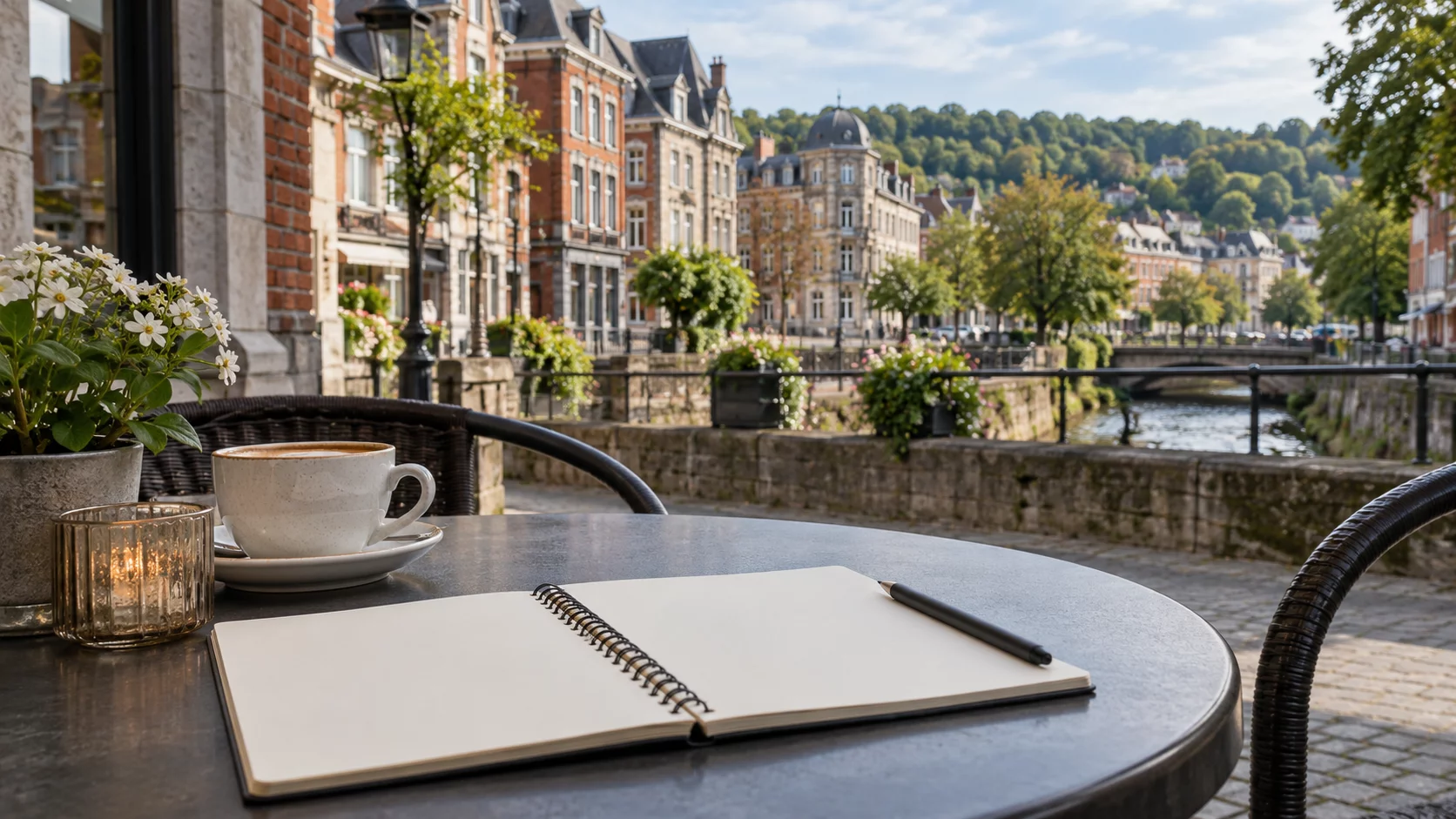
Three carefully chosen images can be enough to tell the story of a visit: a view that places a feature in its surroundings, an architectural detail and a moment of making notes. Not every photograph needs to function as historical evidence. A caption can identify what is visible and the question that interests you. Apply the same restraint to your own photographs. A picture shows a frame, a moment and a viewpoint; it does not summarise a city. A note can complement the image without giving it the power to confirm an interpretation that cannot actually be established from what it shows.
Ask permission when an identifiable person becomes the main subject and accept refusal without argument. Avoid seeking supposedly typical scenes to confirm a story already drafted. A contemporary city does not have to perform the role a visitor assigns to it. A modest detail observed accurately can provide richer material than a spectacular image obtained by forcing a situation. If you choose an illustration rather than a documentary photograph, make that role clear. It can accompany the discussion, but it does not prove the condition of a real building or the existence of particular equipment at a specific address. The subject gains clarity when the limits of the image remain visible.
Build a story that separates its levels
When reviewing the notebook, arrange a short account in three stages: a concrete observation, checked information, then an open question. You might describe a rhythm of windows, recall that the city has a documented textile history and ask about this particular building’s function. This avoids attaching a general explanation to an unidentified example. It helps readers distinguish what they could notice themselves from what requires further research. A story does not become less engaging because its writer shows the boundary between knowledge and uncertainty. That boundary can be part of what makes the account trustworthy, and it gives readers room to explore rather than merely repeat an assertion.
End with a decision for another visit: examine a cultural resource, return to an area in different light or seek documented information about a specific building. This does not justify what you failed to complete; it shows where curiosity leads next. Verviers can remain a present, inhabited and changing city rather than becoming only an image of an industrial past. The textile thread gives attention a direction. It should not imprison everything you encounter within a single story. A good walk leaves both a clearer impression and enough freedom to discover something unexpected another time. The return visit can begin with a new question rather than an unfinished checklist.
Preparation sources consulted on 31 October 2026: Pays de Vesdre Tourism Office, https://www.paysdevesdre.be/decouvrir/pays-de-vesdre/verviers/ ; Centre Touristique de la Laine et de la Mode, https://ctlm-verviers.be/index.php/fr/le-ctlm/histoire-ctlm ; City of Verviers, https://www.verviers.be/. Check practical arrangements for the actual date of your visit.
#Verviers #LiegeProvince #IndustrialHeritage #MrSchaka

The book
The Empty Wall is the second book of Oscar’s Notebook, a series of crime novels set in Liège.