You can cross a landscape looking only for the next waypoint. You can also slow down enough to notice how a hedge divides a slope, how a roof meets the horizon or how a path disappears behind a change in the ground. In the Pays de Herve, in the province of Liège, a notebook gives a walk another shape. It helps preserve relationships between things rather than a collection of interchangeable views. You do not need drawing skills or prior knowledge of the area. What matters is choosing a suitable outing, observing from the authorised route and distinguishing what you see from what you imagine.
Let the idea of hedgerow country guide your attention
The local tourism office presents the Pays de Herve through its hedgerows and orchards. Treat this as an initial reference rather than a fixed picture that every walk must reproduce. Once there, look for visible relationships: a planted boundary, a meadow, a group of trees and the way those elements fit together. Record what is actually in front of you, including interruptions and contrasts. An interesting notebook allows a landscape to differ from the postcard imagined before departure. The question is not whether the scene matches your expectation, but what its particular arrangement invites you to notice.
Divide a page into three bands: foreground, middle distance and background. In the first, record a detail you can inspect without leaving the chosen passage. In the second, sketch the main divisions between fields or buildings. In the third, place a simplified horizon. This does not claim to analyse the entire territory. It simply helps explain why a view held your attention. Repeat the exercise elsewhere and compare two arrangements without needing specialist vocabulary. The drawings can remain rough as long as they preserve a difference you found meaningful.
Choose one area instead of collecting stops
Herve, Aubel and Clermont-sur-Berwinne can be separate planning anchors rather than obligatory boxes in a single outing. The association Les Plus Beaux Villages de Wallonie identifies Clermont-sur-Berwinne as a village in the municipality of Thimister-Clermont, in the province of Liège. Choose one anchor for your notebook, then find an official walk suited to your circumstances. A village and one landscape stop can provide material for several pages. Adding journeys does not automatically improve observation, and a less ambitious route can leave you more available to notice what is already nearby.
Compare the starting point, length, terrain and conditions in the description of the exact route. A cycling brochure does not become a walking guide because its photographs are attractive. Similarly, two circuits with similar names may follow different lines. Keep the description that matches the project you have actually chosen. If something remains uncertain, ask the organisation publishing it for clarification before relying on that passage. The notebook should accompany a prepared outing, not become a reason to improvise shortcuts. An appealing view on a map is not enough information to establish how to reach it.
Prepare one page before departure
Write down your chosen place, the date of the outing and the source of your route. Leave room for conditions observed on arrival, to be completed there rather than copied from an online picture. Add a guiding question: how do hedges organise the view, where does the village appear, or what changes between two stops? One question is enough. It gives the notes continuity while leaving room for surprises and details outside the original project. You can cross out the question if the landscape suggests something more interesting. The page is a guide for attention, not a contract with yourself.
Keep equipment light: an easily opened notebook, a pencil, protection for the pages and your usual walking essentials. A camera may supplement the notes, but it is not necessary. Avoid carrying equipment that encourages you to remain in an unsuitable position simply to justify bringing it. You need to be able to close the notebook quickly, clear the passage and move on. A useful page can be made without obstructing other uses of the place. If the conditions do not suit writing, retain a few words and develop them at the next appropriate stop.
Let the real landscape continue outside the notebook
The meadows, orchards, fences and buildings you admire are more than visual motifs. They belong to lived and working spaces. A pleasing opening in the view does not establish an entrance. Stay on your officially selected route and follow the instructions encountered. Do not move a fence or pass a closure to obtain a better composition. If the planned passage appears unavailable, return to a known point and look for a confirmed alternative instead of inventing continuity across a field. The landscape does not need to become more convenient for your drawing in order to be worth observing.
Watch animals from a distance and avoid changing the scene to suit a sketch. There is no need to attract, feed or approach them. Choose stopping positions that do not obstruct an entrance, activity or movement. If people are working nearby, quiet observation should not become a continuous demand for explanations. A conversation can enrich an outing when it is welcome, but it is not a service owed to a walker. Be ready to close the notebook and move on when your presence becomes inconvenient. Consideration belongs to the practical organisation of the outing, not merely to the caption written afterwards.
First stop: draw the boundaries
At the first suitable point, trace the lines separating the large parts of the view. A hedge may form a continuous line or appear in fragments. A row of trees can create a different rhythm from a solitary building. Do not attempt to draw every leaf. Look for main directions and spaces. Even a sketch of a few lines can preserve the structure that interested you. Indicate the direction of your view only if you can establish it. There is no need to invent an orientation simply to make the page look complete or technically impressive.
Add three short sentences: what brings your eye closer, what leads it through the scene and what stops it. This language describes an experience of reading the landscape rather than assuming an intention on the part of its inhabitants. You can write that a hedge leads your eye towards a roof without knowing why the hedge was planted there. Keep that distinction visible. An open question may later become something to research, without reducing the quality of the moment you observed. Uncertainty can be useful material when it is presented honestly instead of disguised as explanation.
Second stop: look at the relationship with the village
If the route offers a view of a built settlement, consider how it fits into its surroundings. Which elements remain visible from a distance? Do the roofs form one group or several? Does a road, tree or slope hide part of the village? These questions work without assigning ages to buildings or retelling history from memory. For a precise heritage detail, record an indicated name and later seek a source about that particular building rather than the region in general. A nearby landmark and a building in your view are not necessarily the same thing.
In Clermont-sur-Berwinne, for example, the village name can help you find documentation after the walk. It does not turn every facade you glimpse into an identified monument. Reserve two columns in the notebook: observation and verification. A roof shape belongs in the first; a possible construction date stays in the second until confirmed. This prevents pages from filling with fragile assertions. It also makes rereading more interesting because you can see which questions arose from your own attention. Research can add context while leaving the original observation intact rather than replacing it with a polished account.
Third stop: listen without explaining everything
When a position allows a quiet pause, note three sounds and their apparent distance. Distinguish something close, something intermittent and a more continuous background. Do not identify every source if you cannot see it. A metallic sound in the distance is a more accurate note than an invented account of work on a hidden farm. Add a moving detail, such as a branch, shadow or change in the light. The notebook becomes more than an album of still pictures, and the page can retain something of the time you actually spent looking.
Do not present a minute of listening as a permanent truth about the place. A walk captures a particular moment from your position and with your attention. On another day, the same stopping point may feel different. State this limit simply. During my pause is often enough. You are describing an experience a reader can understand, not measuring the territory's silence or activity scientifically. This precision protects the account from easy generalisations. It also gives a reason to return: a repeated observation may change the question rather than merely provide another version of the same photograph.
Explore a documented option around Val-Dieu
For a separate project near Aubel, the official Val-Dieu abbey website describes the Saint-Bernard walk as 2.2 kilometres. This is an option to examine, not a guarantee of suitability for every person or date. Read the description and current instructions before choosing it. A short distance does not describe the surface, individual passages or the group's needs. Keep observation time separate from the time required to reach and follow the route. A notebook outing may take longer than a straightforward walk even when the distance remains modest.
If you select a documented route, identify only two or three potential opportunities to pause, without promising a bench or a precise panorama. Decide on arrival whether the position is genuinely appropriate. A path through an attractive landscape does not mean you should stop exactly wherever you wish. Good organisation gives priority to movement and actual conditions. Sometimes the notebook should remain closed through a whole segment and reappear at a better stopping point. That does not make the segment wasted: looking while moving can prepare the choices you later make on the page.
Make room for the season without inventing the scenery
An article prepared for early November should not promise a particular colour, golden light or dry weather. Instead, prepare a list to check on the day: weather conditions, published route information, access and your planned return time. Then let the notebook receive the season as it appears, including when it is less spectacular than expected. An unremarkable branch or a partly hidden view may still show how your expectation met reality. The point is to record an actual relationship with a place rather than manufacture the version of autumn that would look best in an introduction.
Do not add blossom or fruit simply because a brochure shows it at another time of year. If you want to return for a different atmosphere, write that as a project requiring confirmation. Keep observation, documentation and desire distinct. These three materials can share a page as long as they remain recognisable. Months later, you will be able to reread the notebook without confusing a scene you saw with an outing you only imagined. A future idea can be inviting without being presented as a certainty about what the next visit will provide.
Return with three pages rather than an endless folder
After the walk, select one page about structure, one about detail and one about questions. Do not immediately copy everything neatly. The hesitation of an initial sketch may preserve something of how you looked. Add only confirmed information, with a source and consultation date where useful. If research does not resolve a question, leave it open. A walking notebook does not need to become an encyclopaedia to be shareable or enjoyable to reread. The small number of pages helps you choose what mattered rather than postpone selection indefinitely.
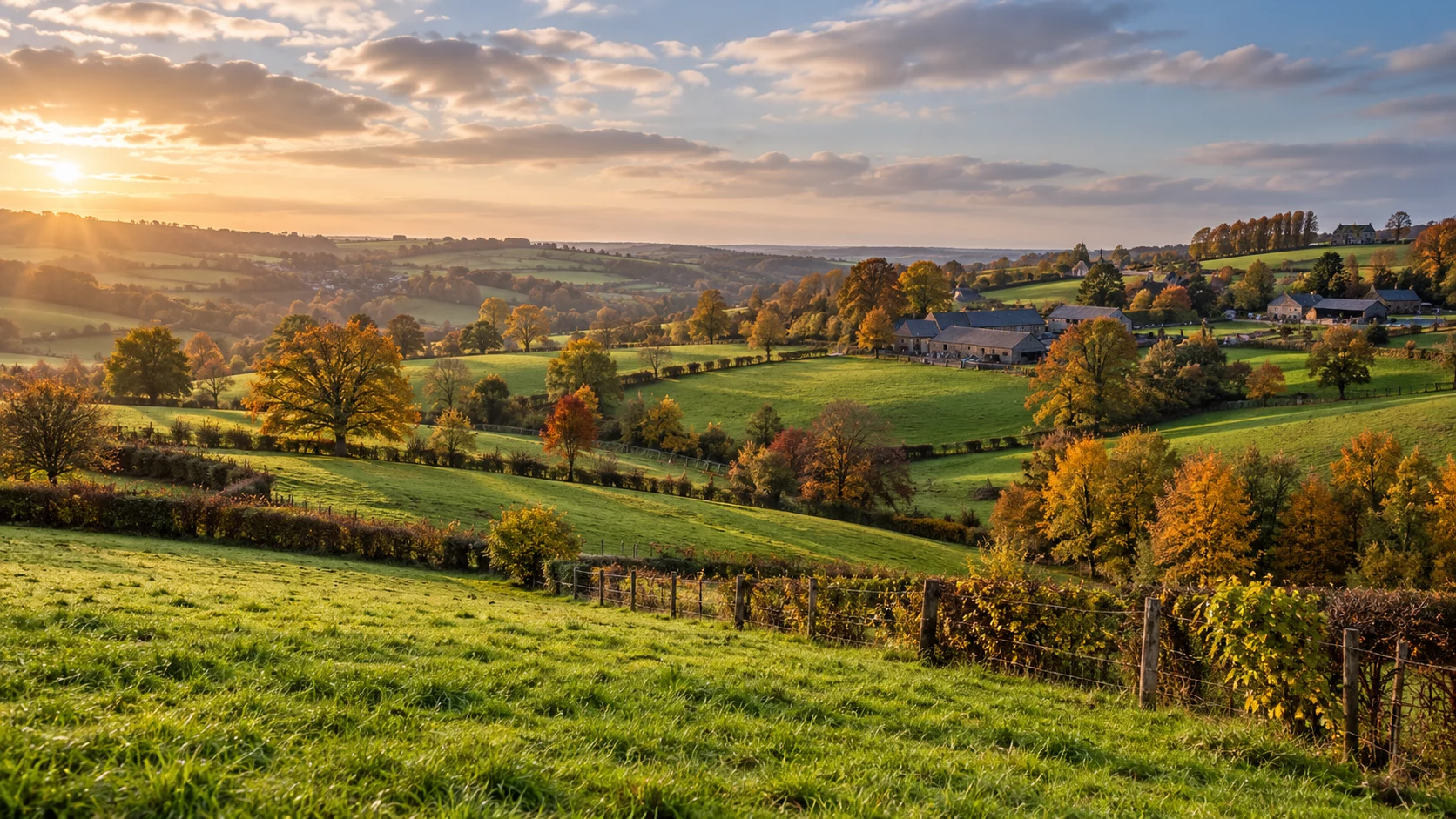
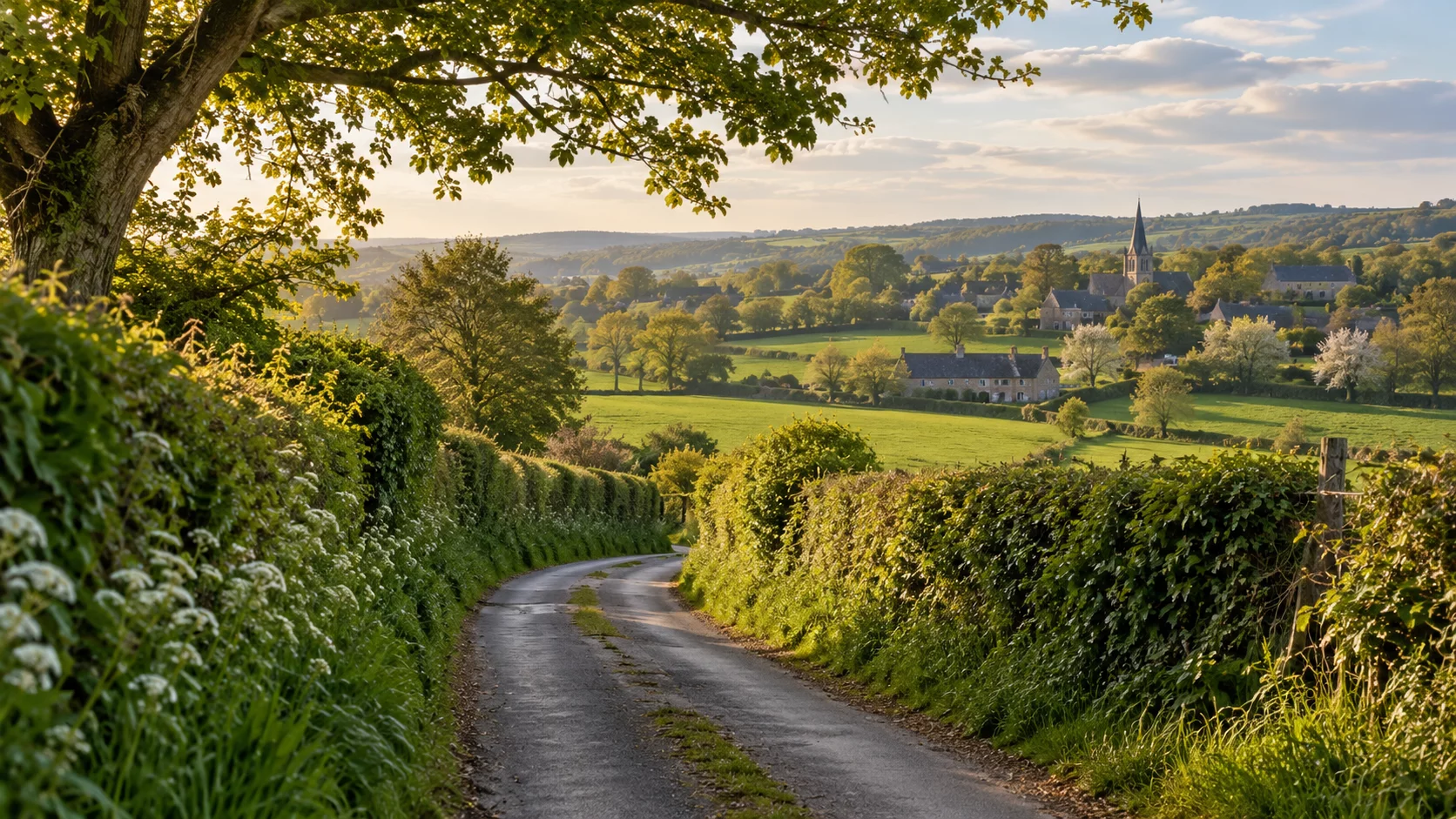
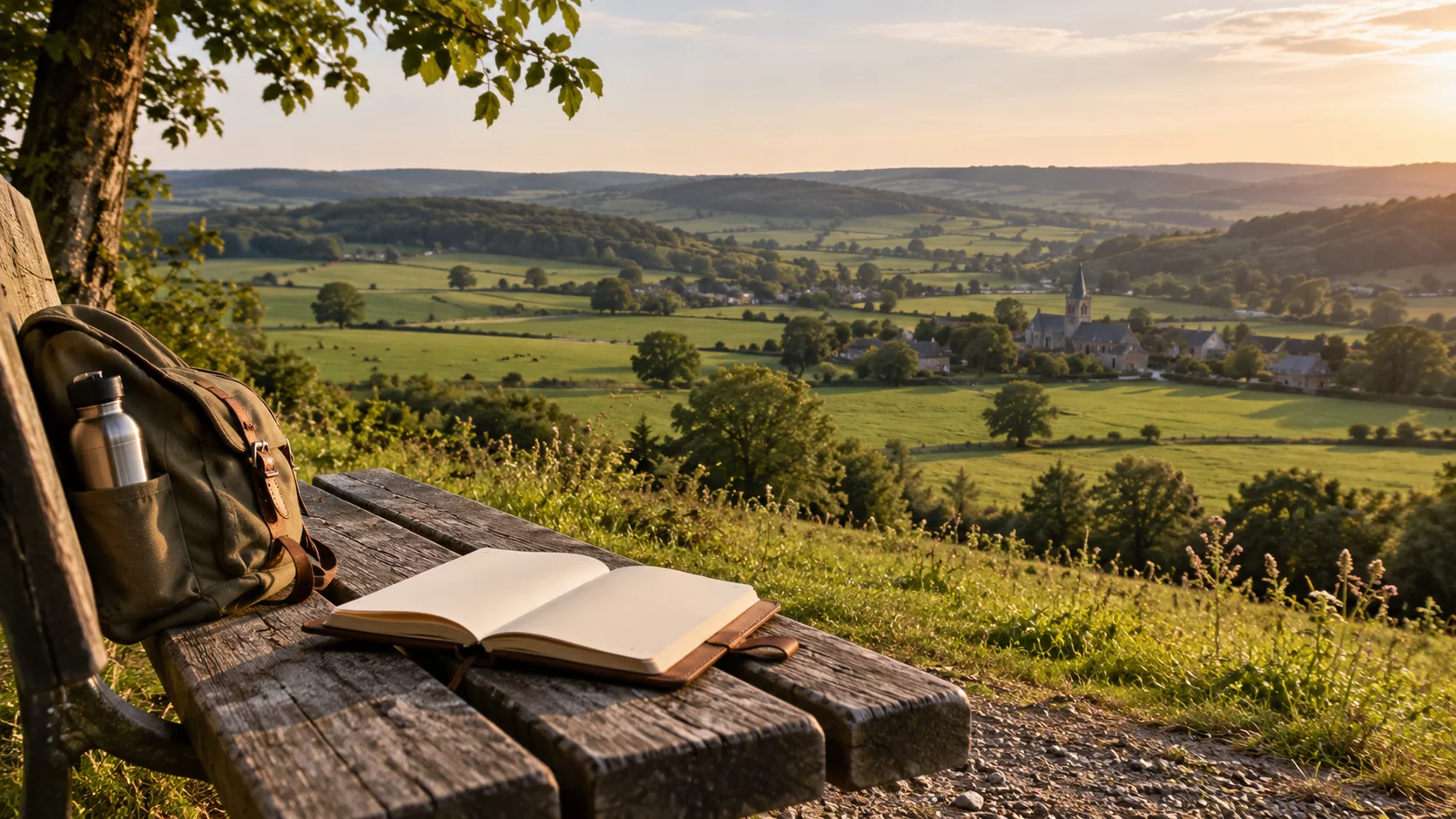
To tell somebody about the outing, choose one thread: how boundaries guided your eye, how the village appeared or how an initial idea changed. Avoid listing every impression. Three connected elements can evoke the experience more clearly than a long accumulation. If generated images accompany the text, identify them as illustrations. They may suggest meadows, hedges or a moment of writing; they do not prove that you photographed a precise location in the Pays de Herve. Keeping that distinction explicit allows the images to support the article without claiming an encounter or view they cannot document.
If you also take personal photographs, connect each selected picture to a page with a simple number. Note the framing that interested you rather than a vague comment about a beautiful view. This makes choosing between similar images easier and helps recover an unanswered question without searching the entire folder. Keep initial notes alongside the revised version. You can then distinguish what came from observation and what was added after research. The relationship between the two can become part of the pleasure of reading your own notebook later.
Two questions before the next outing
Do you need to draw well? No. Lines, a few words and a clearly expressed question are enough. The notebook first helps you slow down and choose what to keep. You can describe a difference between two planes without drawing accurate perspective. If a page seems awkward, ask whether it recalls the relationship you observed. That function matters more than resemblance to a photograph or being able to display the result immediately. A private page may be useful long before you decide whether it belongs in a shared account.
Can you improvise the entire route? Observation can be spontaneous; choosing passages deserves separate preparation. Select a suitable official route, check its conditions and retain a return option. Then leave room for discoveries within that framework. The Pays de Herve becomes a place to look at attentively rather than scenery to cross at random in order to fill a notebook. The next page may begin with a different question in another area, with the same freedom not to see everything. An unfinished list is less important than a particular detail you have learned to notice.
Sources for preparation and verification
Pays de Herve tourism office; Les Plus Beaux Villages de Wallonie: Pays de Herve; Val-Dieu abbey: marked walks. The notebook exercises are original suggestions, not activities announced by these organisations.
The book
The Empty Wall is the second book of Oscar’s Notebook, a series of crime novels set in Liège.