In Limbourg, relief is more than an attractive line behind a photograph. It shapes arrival, movement and the way the upper town can be understood. A descending street, a change of level or a glimpse towards the valley already says something about the relationship between buildings and their site. This walk begins with those tangible clues. It does not require an immediate search for a spectacular panorama or an attempt to follow every surrounding path. A few public spaces, considered at different scales, can provide a coherent reading of a place where history and topography remain closely connected, while leaving enough time to notice how the spaces are actually used today.
Choose the right Limbourg in the province of Liège
The name can cause confusion with other territories. This article concerns the town of Limbourg in the province of Liège, not an entire Belgian or Dutch province bearing a related name. That distinction matters when searching for a map, accommodation or transport. Check the complete destination and the actual point of arrival. A broad search can easily produce information unrelated to the intended visit. Once the framework is clear, the historic centre becomes easier to approach. You know which place you are looking for and can devote attention to its streets, rather than spending the opening part of the day correcting a destination mistake that could have been avoided.
Understand the site before collecting monuments
The Walloon heritage description places the former stronghold on a rocky spur within a bend of the Vesdre. This relationship explains why the eye moves between higher and lower ground, and between the built environment and its landscape. There is no need to turn the information into a complete military history lesson. It already supplies a useful question: how have people and activities adapted to that position? On arrival, distinguish what the visible relief tells you from what requires a map. The two readings support each other, but a particular viewpoint cannot reveal the whole geography of the municipality simply because it offers an attractive view.
Separate an upper-town visit from a larger walk
Tourist information for the Pays de Vesdre also introduces villages, landscapes and walking possibilities around Limbourg. Combining everything in one outing risks spreading attention too thinly while increasing practical demands. For a first visit, choose the scale clearly: a few spaces in the historic centre, or a more extensive walk prepared as such. Gradients, access and the return journey cannot be inferred from the apparent length of a line on a map. Choosing a shorter programme does not mean seeing less carefully. It often gives you permission to return to a detail rather than passing it once on the way to an increasingly distant objective.
Read Place Saint-Georges as an ensemble
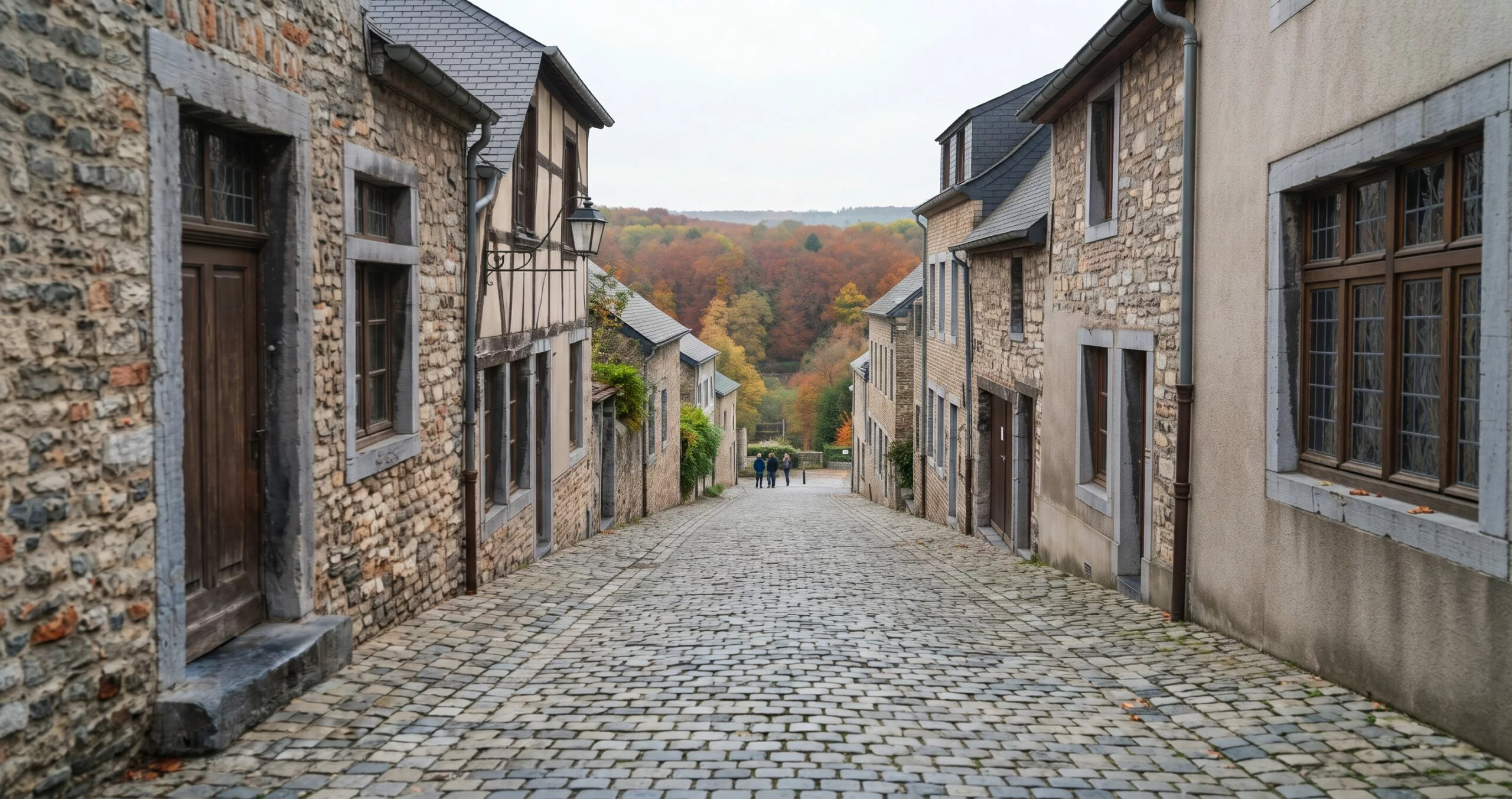
Place Saint-Georges is recognised as a heritage architectural ensemble. That word encourages a slight shift in attention. Instead of searching only for the most impressive house, consider the relationships between frontages, the width of the space and the ground beneath them. A quiet building may contribute as much to the place’s coherence as a more prominent feature. Look in one direction, then turn around from somewhere that leaves movement unobstructed. A simple change of position reveals other alignments. The square becomes a composition that people inhabit and cross, rather than a general façade that must somehow be squeezed into a single photographic frame.
Cobbles also describe an experience of moving
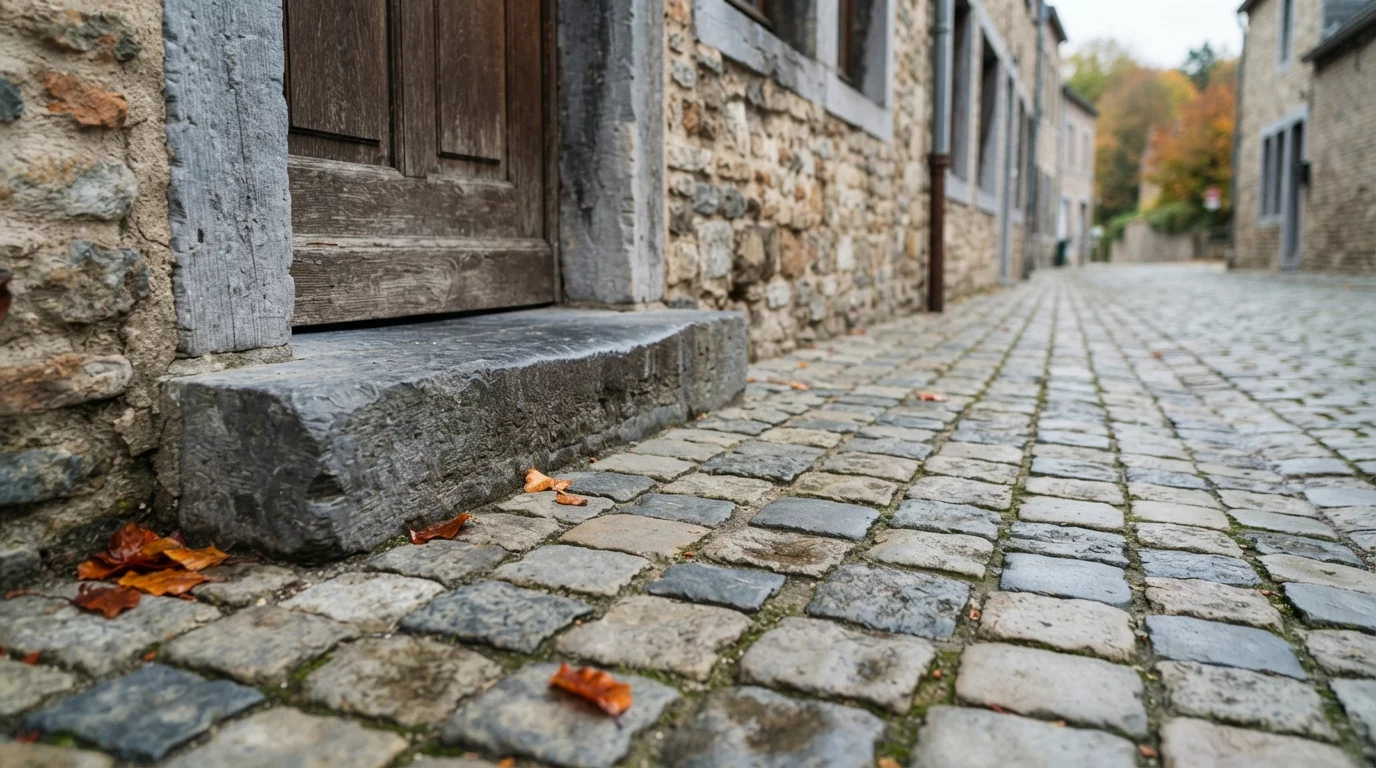
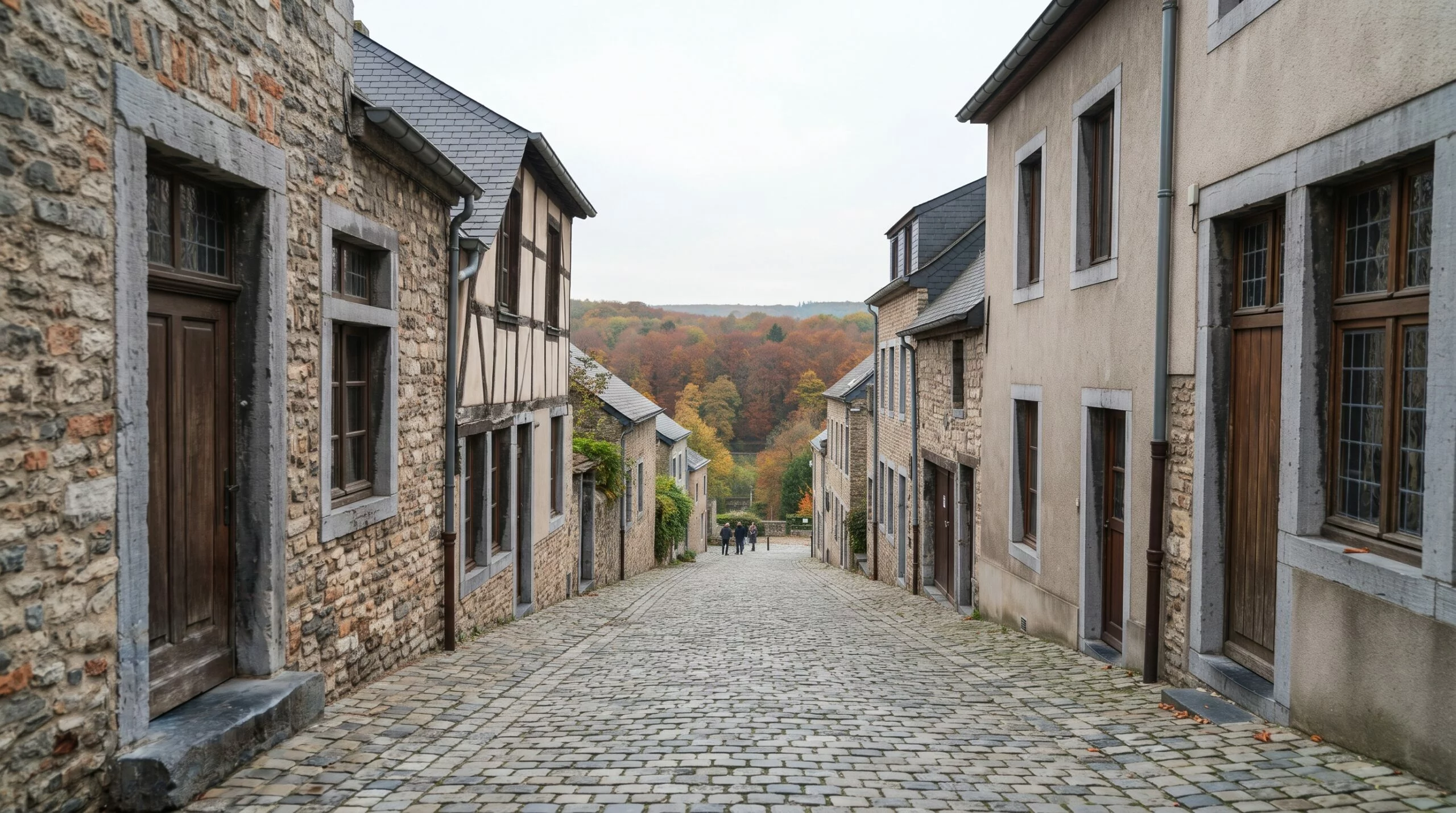
Paving attracts cameras, but it should also be considered as the surface on which people walk. Texture, irregularity and present conditions affect comfort. Wear footwear suited to your needs and take particular care when surfaces are wet or covered by leaves. Attractive material does not remove practical requirements. To examine a threshold or frame a detail, find a stable position without closing the passage to others. This double reading, aesthetic and practical, does greater justice to the place. It avoids presenting a historic centre as a flat picture that can be crossed without experiencing the physical reality of the ground or adapting to the way different people move.
Move from broad lines towards material
After taking in the overall arrangement, bring attention closer to a section of wall from public space. Stone, brick, joints and window surrounds do not all produce the same continuity. Look for a meeting of materials or a visible repair. Avoid assigning dates without evidence: a frontage may retain an older design while having undergone successive interventions. Material deserves more than an invented age. It can prompt a question about construction, maintenance or use. In a notebook, a description such as different pointing below the window is often more precise than naming an historical period that has not been checked against a reliable local source.
Doors remind us that the town remains inhabited
A doorway, curtain, plant or letterbox indicates that frontages are not simply heritage objects. The historic centre remains a living environment. Avoid close views through windows, prolonged photographic sessions outside an entrance and moving objects to improve a composition. A visible porch does not become public because it appears picturesque. The quality of the visit partly depends on recognising this. Residents should not have to pause their everyday lives so that a visitor can imagine a town without contemporary presence. Noticing signs of use can make heritage easier to understand, connecting the attractive surface with the ordinary needs that continue behind it.
From stronghold to surviving urban ensemble
The Connaître la Wallonie description recalls Limbourg’s military past and its decommissioning by Joseph II in 1781. That is enough to open a reading of transformation without rushing through a sequence of battles. A place may lose a strategic function while retaining urban organisation and architectural value. During the walk, distinguish what history explains from what is genuinely visible. Do not invent a continuous defensive circuit, a castle available to visit or fortifications from an ordinary wall. Sources help make sense of absence as well as survival. They allow a visitor to recognise that the present arrangement is the result of change, not an untouched military scene.
The Arvô suggests another change of scale
Local tourist information mentions the former town hall, known as the Arvô, and an historical scale model. A reduced representation can help connect what has been encountered on foot: arrangements, boundaries and relationships between parts of the town. If this kind of visit interests you, check current conditions directly with the relevant organisations. Information on a tourism website does not guarantee that every interior will be available in November. Even without entering, the principle of moving between a detail and an overall representation remains useful. A walk becomes more understandable when it alternates several viewing distances rather than treating close observation and the bigger picture as competing ways of seeing.
The church is more than a background feature
Saint-Georges church belongs to the visual reading of the old centre, but a church is not merely a photographic landmark. Access may depend on uses, works or temporary conditions. Check on-site instructions and current information before making an interior visit a necessary part of the programme. From public space, it is already possible to consider how a building organises a perspective and attracts the eye. If entry is available, behave in a way compatible with the place’s purpose. Cultural discovery benefits from acknowledging that buildings may carry several meanings for the people who use them, none of which has to disappear when visitors become interested in their appearance.
Look towards the valley without demanding a total panorama
Views of the surroundings add another dimension to the upper town. They reveal a difference in height, a more open area or a direction previously hidden by buildings. There is no need, however, to name every settlement that might be visible. A reliable map or orientation panel can supplement observation where one is available. Otherwise, record what can actually be distinguished: landforms, tree lines, roofs and the valley. A landscape does not become less interesting because some elements remain unidentified. Modest precision is more useful than a confident caption that assigns names to features the view does not clearly show or claims a breadth of knowledge the visitor has not established.
Consider a sloping lane in both directions
Before descending out of curiosity, think about coming back. The advice sounds obvious, yet an attractive route can feel very different when the group is tired or needs to reach transport at a fixed time. A short out-and-back section already helps explain the slope’s role without continuing towards an uncertain objective. Assess the surface, light and remaining energy. You can also look into a street from its entrance and decide not to take it. This is not a defeat for the visit. It simply recognises relief as a real element of movement, rather than a decorative feature forgotten as soon as the first picture has been taken.
Let returning become a second reading
Passing a square or frontage again creates an opportunity to notice what the first encounter left aside. A surround makes more sense after comparing materials; an opening takes on another role when the direction of the valley is clearer. To benefit from this second reading, resist filling every minute with a new point. Leave some unallocated time. It may allow a return to a question or a few quiet moments where changing light makes a texture easier to see. A walk can progress through greater understanding. It does not always need to demonstrate progress by increasing distance or adding another place to a growing list of completed stops.
November calls for a margin of daylight
When preparing a November outing, consider the day’s conditions and the return time rather than inventing ideal weather. Arriving later may reduce the time available to read the terrain, especially if you plan to go beyond the centre. Keep a shorter version of the route and the practical information needed for departure. Leaves and damp surfaces may also require a slower pace. This is not a reason to dramatise an urban visit. It is simply a way of giving practical choices the same attention as attractive ideas. A reasonable margin lets you stop and look without every pause feeling like a threat to the remainder of the programme.
Water belongs to geography, not only to pictures
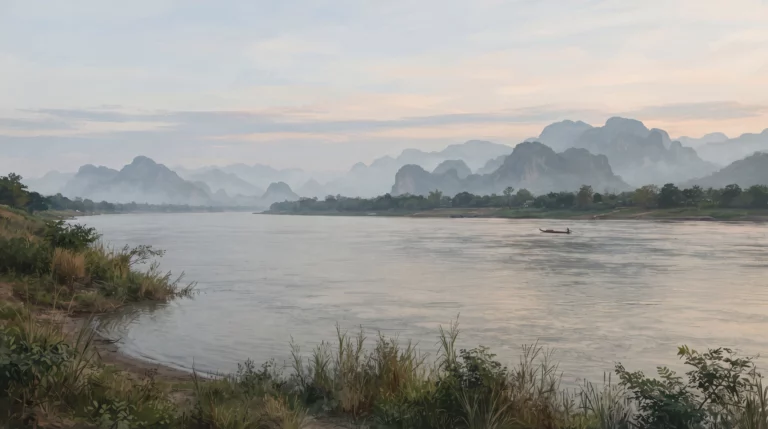
The Vesdre helps locate Limbourg within a landscape and a wider territory. It is important, however, not to reduce the whole municipality to one river view or a single narrative. Higher ground, residential places and areas of activity have rhythms of their own. When mentioning water, specify the relationship you are trying to understand: terrain, settlement, passage or landscape. That precision also protects against easy associations between images made in different parts of the valley. A photograph of a watercourse cannot tell every story or represent every experience of a territory. Geography becomes more useful when its different scales are kept visible rather than merged into one convenient illustration.
With a child, compare simple forms
For a family visit, propose a limited search: two kinds of paving, a doorway wider than its neighbour, a changing roofline or a street whose slope can be recognised. These observations allow several responses and do not require a complete heritage vocabulary. Let children also decide which detail they want to remember. The activity must remain compatible with circulation and residents’ lives: no running through passages and no handling objects without permission. A well-chosen question can hold attention longer than numerous instructions designed to teach too much at once. It leaves space for the child to contribute an interpretation, rather than merely trying to guess the adult’s expected answer.
Prepare mobility needs without relying on general labels
For some visitors, cobbles and gradients matter more than total distance. Ask for precise information about where you intend to arrive, the sections to be covered and the possibility of resting. A broad accessibility label cannot replace a description of a threshold or slope. Explain what is required and verify possible arrangements with the relevant people. Adapt the programme on arrival rather than feeling obliged to complete a planned circuit. A carefully chosen observation point can reveal the ensemble, materials and relief without imposing a succession of unnecessary difficulties. The visit is not diminished when its design takes actual needs seriously and allows everybody a meaningful way to participate.
Rest or buy without taking over the space
A break in a business can complement the walk when its welcome suits the needs of the moment. Check conditions, current hours and available room; do not treat an old listing as a guarantee. If you remain outside, choose a place where doors and movement stay clear. In a compact historic centre, a stationary group can quickly become noticeable to others. A discreet pause leaves more room for ordinary uses. It can also provide a moment to gather thoughts: what connection has become clearer between a material, an urban form and a landscape situation? Rest then belongs to the interpretation of the place, rather than interrupting it with another demand for activity.
Two similar views can invite comparison
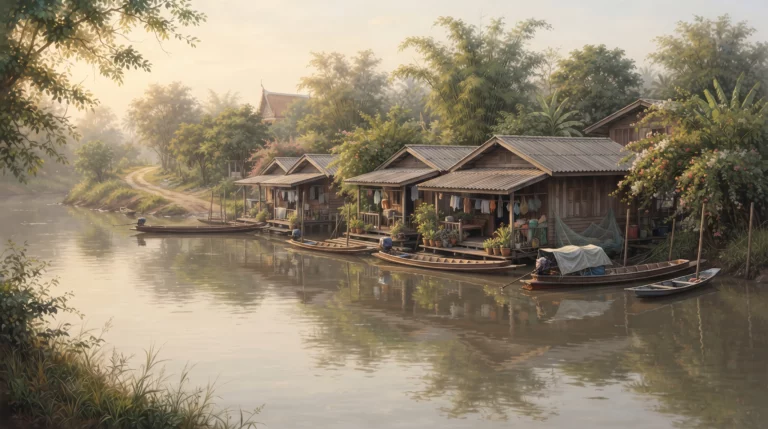
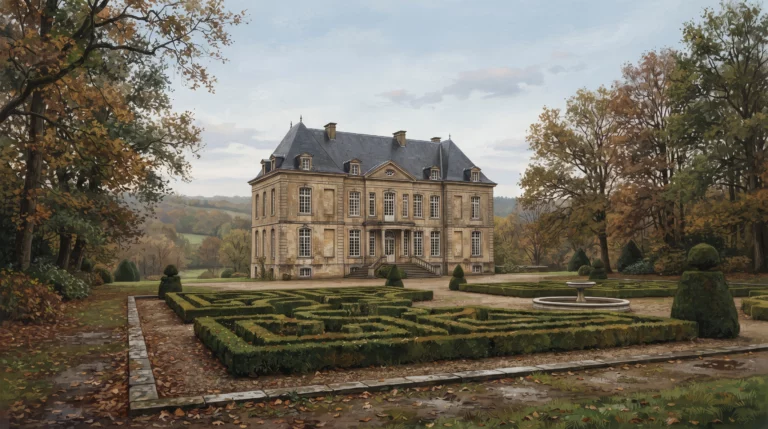
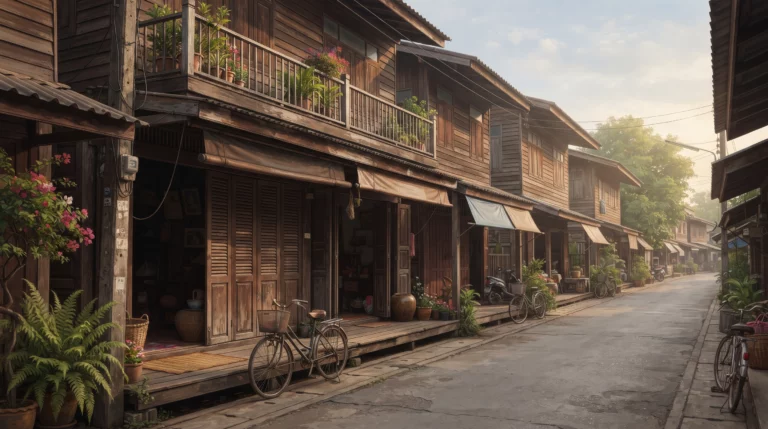
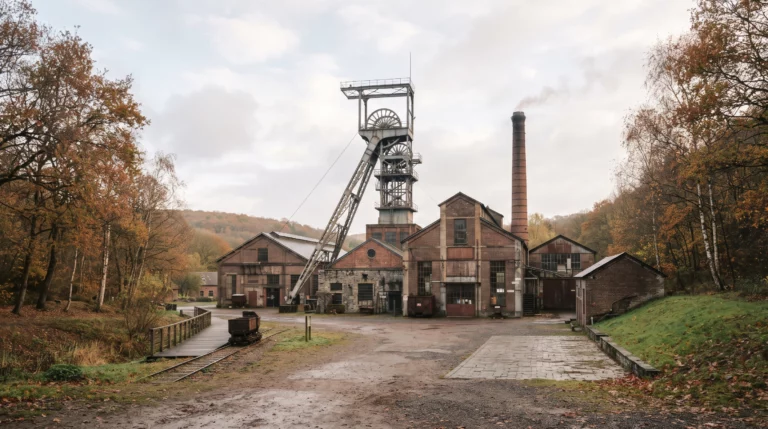
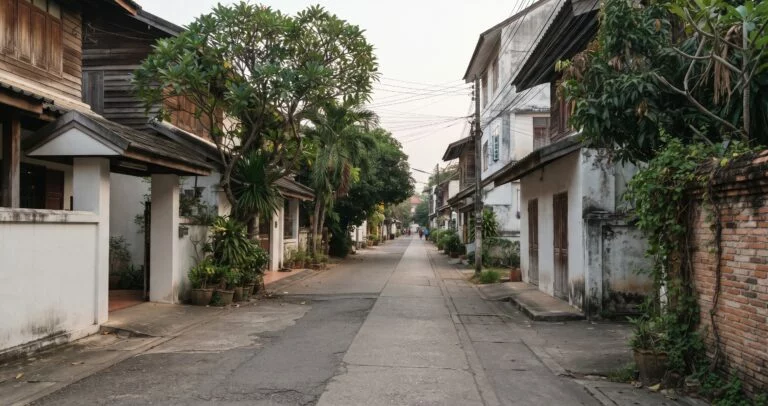
The illustrations in this article include two street evocations with closely related compositions. They should not be treated as measured records of one actual location. They can instead be read as atmospheric variations, considering the role of the ground, frontages and the opening of a perspective. Both were generated using artificial intelligence and cannot establish the condition of a surface or the position of a building. Captions need to keep that distinction clear. Official resources and current information are still necessary for a precise visit. The pictures accompany the written article without replacing practical preparation or claiming that somebody recorded these scenes during a documented walk.
Take photographs without turning the place into a studio
For your own pictures, seek a clear relationship rather than a staged effect: a door with its threshold, a slope with its horizon, or paving beside a frontage. Do not block a street to obtain an empty perspective, and wait when someone uses the entrance you are considering. If a person appears recognisably, obtain the appropriate agreement before sharing the image. A heritage photograph often gains by showing how elements coexist rather than removing every sign of life. Discretion is more than courtesy. It helps reveal that the old town continues in the present, with uses and boundaries that a picture should recognise instead of temporarily erasing.
Leave with a set of relationships
Limbourg may be remembered most clearly through relationships rather than a collection of monuments: higher and lower ground, paving and frontage, opening and landscape, military memory and current uses. Before leaving, choose two or three connections that the walk has made more understandable. Separate personal observations from confirmed information and retain the questions still open. Then check the return journey and allow the place the possibility of another visit. There is no need to summarise everything today. An attentive interpretation, aware of its setting and incompleteness, can be more faithful than a description that claims to exhaust a historic centre within a few hours of walking through it.
Sources for preparing your visit
- Connaître la Wallonie — Place Saint-Georges, ville de Limbourg
- Maison du Tourisme du Pays de Vesdre — Limbourg
- Maison du Tourisme du Pays de Vesdre — préparation du séjour

The book
The Empty Wall is the second book of Oscar’s Notebook, a series of crime novels set in Liège.