Taking the bus in Thailand is the simplest and cheapest way to cross the country, from Bangkok to Chiang Mai, Isan or the piers for the islands. Here is how to choose the right terminal and the right company, and how to combine bus and ferry without any nasty surprises.
Bangkok’s three main bus terminals
Bangkok does not have one bus terminal but three, each facing a different part of the country. Going to the wrong one means losing an hour or two in traffic, so always check where your bus leaves from before you book.
Mo Chit (Northern and Northeastern terminal)
Mo Chit, often called Mo Chit 2, is on Kamphaeng Phet 2 Road, near Chatuchak Market. It is the largest terminal in the country: buses leave from here for Chiang Mai, Chiang Rai and all of Isan (Khon Kaen, Udon Thani, Ubon Ratchathani, Nong Khai), as well as a few routes to the east such as Pattaya or Aranyaprathet. It is not directly on a metro line: from MRT Kamphaeng Phet or BTS Mo Chit, you finish the journey by taxi, motorbike taxi or city bus. Ticket counters are grouped by region, sometimes on different floors; the information desk will point you in the right direction. Avoid taxis that refuse to use the meter.
Ekkamai (Eastern terminal)
Ekkamai is the easiest to reach: it is on Sukhumvit Road, a two-minute walk from BTS Ekkamai. It serves the east coast: Pattaya, Rayong, Ban Phe (for Koh Samet), Chanthaburi and Trat (for Koh Chang). For Pattaya, expect roughly 130 to 200 baht depending on the company.
Sai Tai Mai (Southern terminal)
The Southern terminal, known as Sai Tai Mai or Sai Tai Taling Chan, is on Borommaratchachonnani Road, on the Thonburi side, in Taling Chan district. It serves the south and the west: Kanchanaburi, Hua Hin, Chumphon, Surat Thani, Phuket, Krabi, Trang, Hat Yai. It is far from any rail line: the easiest option is a metered taxi, around 100 to 150 baht from the Khao San area, more from Sukhumvit. Ticket counters are on the first floor.
To reach these terminals, my article on getting around Bangkok (BTS, MRT, boat) will help you pick the most convenient line. Note that since 2025 the Ministry of Transport has been studying a plan to bring the bus terminals together around Krung Thep Aphiwat Central Terminal. Nothing has been decided so far, but check before you travel.
Public company, private operators, VIP: which to choose?
The public company is called Transport Co., Ltd., in Thai บขส., pronounced “Bor Kor Sor”. It runs many routes alongside licensed private operators such as Nakhonchai Air or Sombat Tour, which also leave from the official terminals with numbered-seat tickets.
Classes vary a little between companies, but broadly:
- Standard or 2nd-class bus: air-conditioned, ordinary seats, frequent stops. The cheapest.
- 1st class: more comfortable, fewer stops, often a toilet on board.
- VIP (24 to 32 seats): large reclining seats, three seats per row, a blanket, a small snack or a bottle of water.
For Bangkok to Chiang Mai, for example, allow about 9 to 11 hours on the road and, as a rough guide, 500 to 1,100 baht depending on class and company. For night journeys, VIP is really worth the difference: you sleep better and arrive in better shape.
Minivans: fast, but use them sensibly
Minivans with around fifteen seats were long the fastest way to cover journeys of two to four hours. Since 2016 they no longer leave from the Victory Monument roundabout but from the bus terminals, and the authorities are gradually replacing them with safer minibuses on many routes. They are still common for medium trips (Bangkok to Kanchanaburi, Rayong, Hua Hin). Their drawbacks: little room for luggage and sometimes jumpy driving. For long distances, I prefer a full-size bus.
Bus and ferry: reaching the islands on one ticket
For many islands there are combined bus and boat tickets, very handy when you do not want to manage the connections yourself. If you are still unsure about your destination, read which island to choose in Thailand.
- Koh Tao, Koh Phangan, Koh Samui (Gulf of Thailand): Lomprayah runs day and night buses from the Khao San area, with a transfer to its catamaran at Chumphon. For Koh Tao, expect roughly 850 to 1,550 baht depending on the boat (slow or fast) and the bus class. Other combined tickets go via Surat Thani and Donsak pier, with Seatran or Raja Ferry boats to Samui.
- Koh Samet: bus from Ekkamai to Ban Phe, then a boat. I have described the journey in detail in Koh Samet from Bangkok.
- Koh Chang: bus or minivan to Trat, then a ferry from the Laem Ngop area. Combined tickets are available from Ekkamai.
- Phuket, Krabi, Koh Lanta, Koh Phi Phi: night bus from the Southern terminal, then a boat or a minivan depending on the island.
A comfortable alternative for the Gulf: the night train to Chumphon or Surat Thani, followed by the boat. Keep an eye on the weather too: from October to December the sea can be rough in the Gulf and boats can be suspended for a day or two.
Booking your ticket
Three options:
- At the terminal counter: the traditional way. On most routes you can find a seat on the day, except during holidays.
- On the official Transport Co. website (transport.co.th) and through its approved resellers, including some 7-Eleven counters: useful for securing a VIP seat several days ahead.
- On a platform such as 12Go: English interface, card payment, very practical for bus and ferry combinations. Double-check the departure terminal shown.
During Songkran (mid-April), New Year and long weekends, Thais travel home to their provinces in huge numbers: book several days ahead. Keep your passport with you, as it may be requested when you buy a ticket.
Safety: the right reflexes
The major companies are generally reliable, but the roads remain the country’s weak point, among the deadliest in Asia for accidents. A few reflexes:
- Choose buses leaving from the official terminals rather than the very cheap “tourist buses” sold by street agencies, especially around Khao San: thefts from the luggage hold have often been reported on them.
- Keep your passport, cash, phone and bank card in a small bag on you, never in the hold.
- Fasten your seat belt when there is one, especially at night.
My practical tips
- Check the departure terminal first: Mo Chit for the north and Isan, Ekkamai for the east, Sai Tai Mai for the south.
- Arrive at least 30 minutes before departure: finding the right platform takes time at Mo Chit.
- Bring a jumper or a light jacket: the air conditioning is often turned up very high.
- To follow your route and let your accommodation know when you will arrive, a local SIM card helps a lot.
- Keep some cash in small notes for the stops and the taxi on arrival.
- In the rainy season, leave a margin if you have a boat or a flight to catch afterwards.
Frequently asked questions
Is the bus better than the train in Thailand?
The bus is often faster and serves many more towns. The night train is more comfortable for sleeping.
Should I book my bus in advance?
Normally, buying your ticket the day before or on the day at the counter is enough. During Songkran, New Year and long weekends, book several days ahead, especially for VIP seats.
Are combined bus and ferry tickets reliable?
Yes, when they are sold by the boat company itself or by a recognised platform. Just leave a margin in case of rough seas.
Can I travel by bus with large luggage?
Yes, full-size buses have a luggage hold. Minivans, on the other hand, have very little room: with a large suitcase, choose a bus or a minibus.
To go further
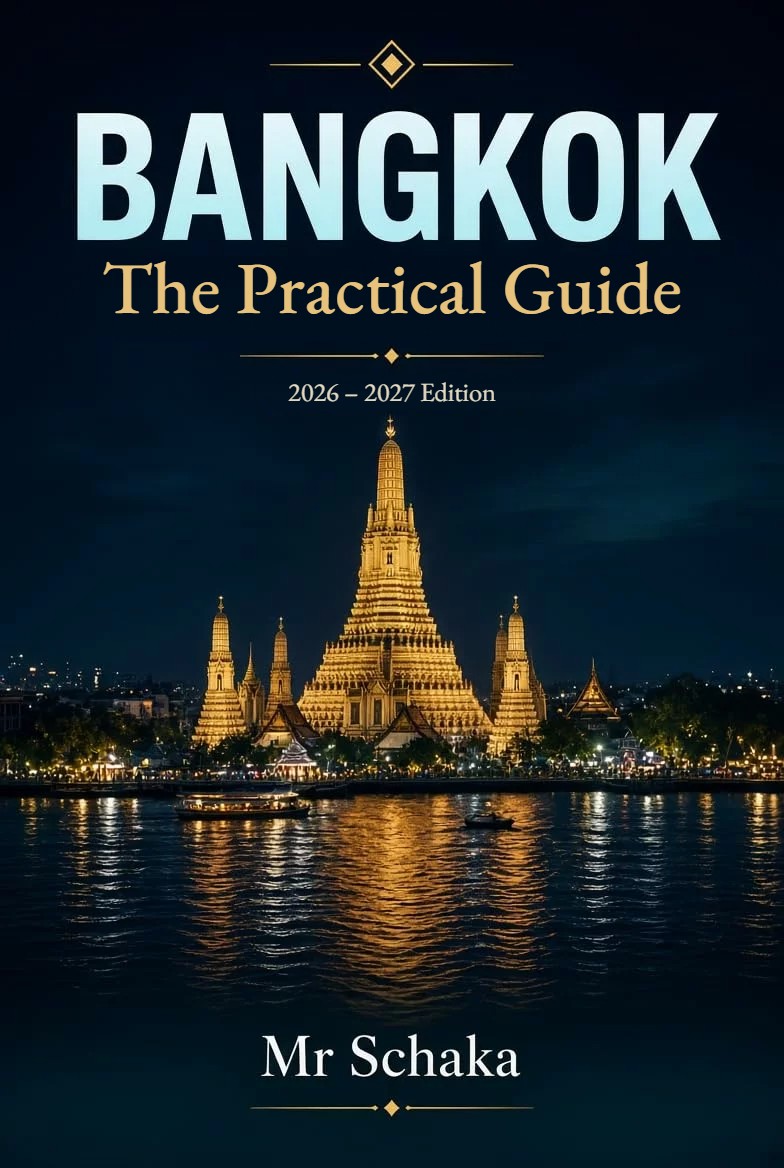
Mr Schaka’s guidebook, Bangkok – The Practical Guide, covers the essentials: transport, neighbourhoods, addresses, food, etiquette and safety, updated for 2026–2027.