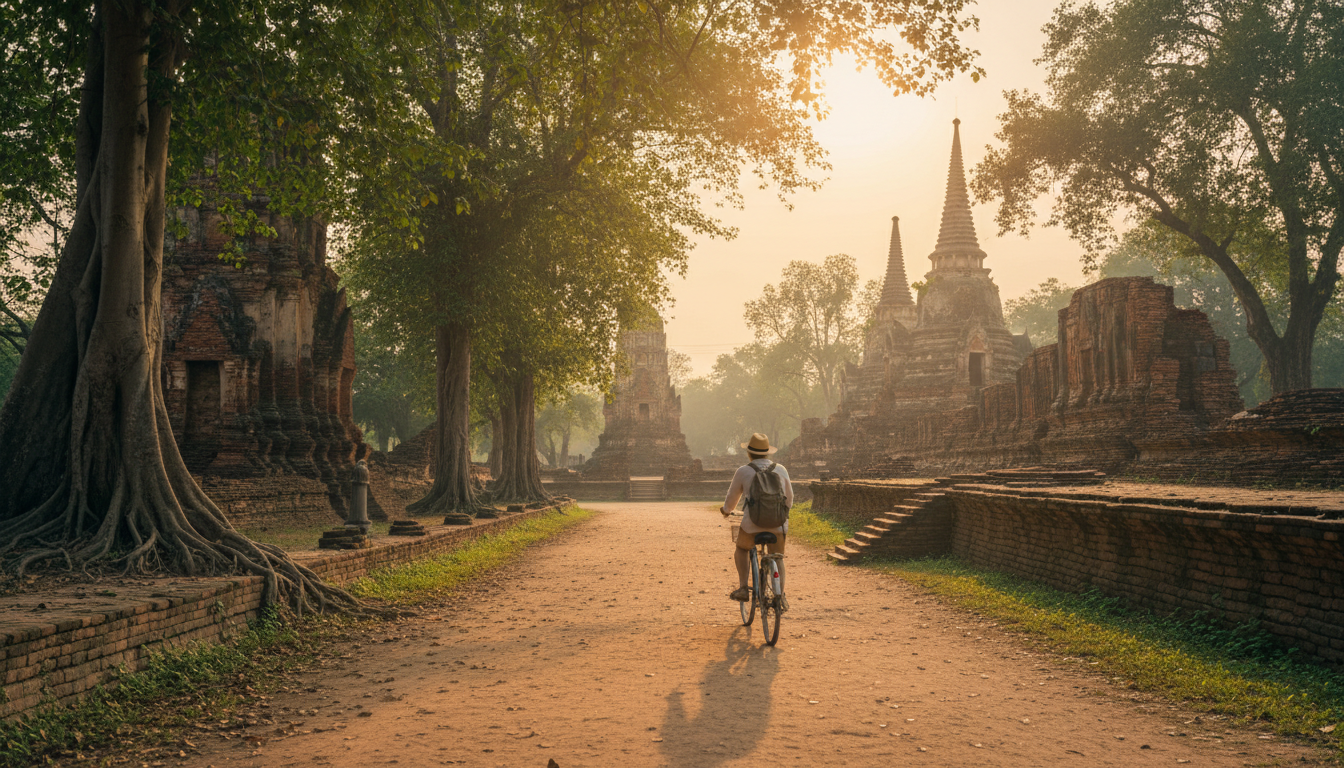
Phanom Rung is one of those places never mentioned in the usual Thailand guides, and it leaves a stronger memory than many famous sites. A Khmer temple built on the rim of an extinct volcano, in Buriram province in the east: a processional walkway, stairways, sandstone towers, and the Isan plain stretching to the horizon.
What it is
Prasat Phanom Rung is a Hindu complex dedicated to Shiva, built between the tenth and thirteenth centuries, when the Khmer empire dominated much of Southeast Asia. The temple sits on the edge of a crater at about four hundred metres.
It is often called a ‘Thai Angkor’: fair, because the architecture and religion are the same; reductive, because the site is smaller, quieter, and takes an hour and a half without crowds.
Some history
The region belonged to the Khmer world. Phanom Rung went through successive building phases, restorations, then abandonment as Khmer power receded. It was rediscovered and restored in the twentieth century, and is now one of the best-kept monuments in the country.
The architecture
The route is classic in Khmer art: a causeway, a cross-shaped terrace, stairways lined with nagas, then the enclosure and the central sanctuary. Towers are sandstone and laterite, carved with plants and divine figures.
What strikes you is the state of conservation and the quality of light: sandstone turns warm at sunrise and sunset.
The symbolism
The temple represents the world: the causeway is the path of the profane, the stairs the ascent towards the sacred, the sanctuary the centre. Its fifteen aligned doorways produce a solar alignment several times a year, usually in April and September.
How to get there
In Buriram province, five to six hours by road from Bangkok. The most practical base is Nang Rong, forty minutes away, with hotels and transport. From Bangkok, reach Buriram by night bus or plane, then rent a car or take a songthaew.
When to go
November to February is the most pleasant; March to May is hot but workable early; June to October brings monsoon greenery and dramatic skies, with muddy tracks.
Sunrise
Climbing at dawn is the experience not to miss. The site opens early and you watch the plain wake up, often alone with a few Thai visitors. Bring a lamp and a windbreaker.
The surroundings
About ten kilometres away, Muang Tam is the natural complement: flatter, more intimate, surrounded by pools and walls. Many visitors prefer it.
A typical day
Leave Nang Rong before dawn, climb for sunrise, visit the carvings in morning light, then Muang Tam late in the morning. Local lunch, return in the afternoon.
Where to stay
Nang Rong has simple, cheap hotels; Buriram has more choice and an airport.
What to budget
Park entry is modest; car rental and fuel are the main cost.
Mistakes to avoid
Coming at noon. Visiting only Phanom Rung and missing Muang Tam. Believing public transport handles the return. Coming in April without checking alignment dates.
FAQ
Do I need a guide?
Useful for the iconography, not essential.
How long on site?
An hour and a half, plus an hour for Muang Tam.
Can I bring children?
Yes, but stairs are steep and there is no shade at noon.
Is the site accessible?
Partly: causeway and terraces yes, stairs no.
Toilets and café?
At the entrance, not inside the temple.
Also read
To go further
Mr Schaka’s guidebook, Isan – The Practical Guide, covers the essentials: transport, neighbourhoods, addresses, food, etiquette and safety, updated for 2026–2027.