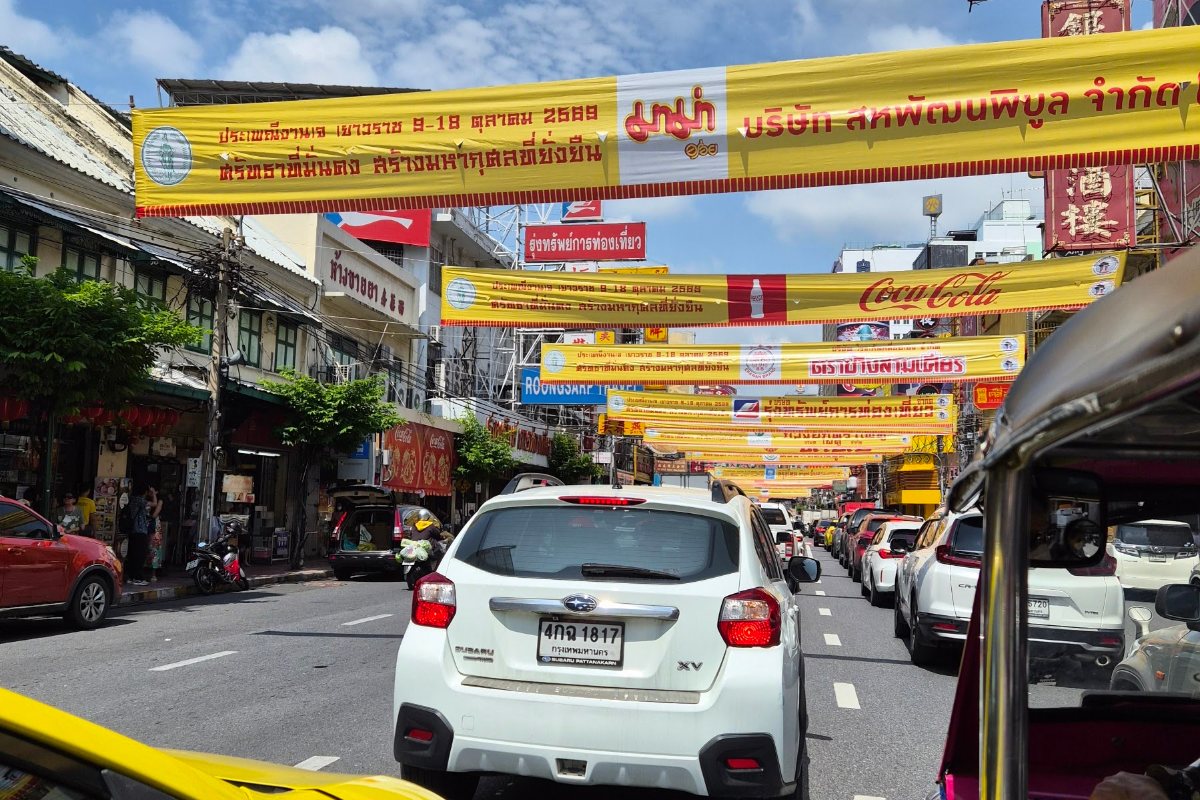
Chinese merchants have been in Bangkok since the city was founded. Moved out in 1782 to make room for the Grand Palace, they settled a little further south, along the river, in the Sampheng district. It became Bangkok’s Chinatown, one of the largest and liveliest in the world: dense, noisy, fragrant with incense and roast duck. People come here as much to eat as to wander.
Yaowarat, the main artery of Bangkok’s Chinatown
The main street, Yaowarat, winds like a dragon. That’s deliberate, or so they say. By day, it’s the street of goldsmiths: dozens of red-and-gold shops sell 96.5% gold, weighed and priced at the day’s rate, under the watchful eye of families who’ve come to buy a dowry or an investment. You’ll also find herbalists and dealers in bird’s nest and ginseng.
At night, from around 6 p.m., Yaowarat lights up with neon and becomes one of the great food streets of Asia. Dozens of stalls set up on the sidewalks, and lines form in front of the most famous ones. It’s the perfect place for a roving dinner, from stall to stall.
Tip: come on a weekday rather than the weekend, and get there around 6:30 p.m. Chinese restaurants and stalls often close one day a week, and many take Monday off.
Getting there: MRT Wat Mangkon, in the heart of the district, or Hua Lamphong; orange-flag boat to Ratchawong.
The Golden Buddha and the neighborhood temples
Wat Traimit houses the world’s largest solid gold Buddha: more than 5 tons of gold, 3 meters tall. Its story is extraordinary. For centuries, the statue had been covered in plaster, probably to hide it from Burmese invaders. Only in 1955, during a move, did a fall crack the plaster and reveal the gold. The temple also houses a small museum on the history of Chinatown. Admission: about 100 THB, the museum is extra.
Wat Mangkon Kamalawat, founded in 1871, is Bangkok’s most important Chinese Buddhist temple. It’s always hazy with incense from worshippers who come to pray to the deities of luck, health and longevity. During Chinese New Year and the Vegetarian Festival, it’s the epicenter of the celebrations. Free entry.
Sampeng Lane and Little India
Running parallel to Yaowarat, Sampeng Lane (Soi Wanit 1) is a narrow alley turned into a vast covered wholesale market: costume jewelry, toys, fabrics, decorations, stationery, all sold in bulk. You’ll be elbowing your way between porters and carts. Go on a weekday morning for the atmosphere.
To the west, around Chakkraphet Road, Pahurat is Bangkok’s “Little India,” the heart of the Indian and Sikh community. Fabric, sari and dance-costume merchants, Indian grocery stores, and the magnificent golden-domed Sikh temple, Gurdwara Siri Guru Singh Sabha, which welcomes visitors and serves free meals. Several small restaurants serve excellent, cheap North Indian food.
Talat Noi, the secret Chinatown
South of Chinatown, on the riverbank, Talat Noi (“the little market”) is a maze of alleys lined with old mechanics’ workshops piled high with engine parts and scrap metal. Over the past ten years or so, cafés, galleries and guesthouses have moved in, without erasing its working-class soul. Don’t miss:
- So Heng Tai Mansion, a 200-year-old Chinese mansion built around a courtyard, where the owners have put a diving pool right in the middle. The same family has lived there for generations; you can admire the architecture from the adjoining café.
- The Chao Mae Thapthim Shrine, a small Chinese temple by the water.
- Holy Rosary Church (Kalawar), the oldest Catholic church on the east bank, built by the Portuguese in the 18th century and rebuilt in neo-Gothic style in 1897. Gorgeous blue-and-gold interior.
- The street art murals, scattered through the alleys.
Close by, Song Wat Road runs along the river. Its warehouses, once home to spice, rice and coffee traders, now house specialty cafés, designer boutiques and galleries, while the wholesalers carry on loading their sacks of chili. A lovely late-afternoon stroll.
To the north, near MRT Sam Yot, the Ong Ang Canal has been revamped into a shady pedestrian promenade decorated with murals. From Friday to Sunday, roughly 4 p.m. to 10 p.m., a small night market sets up there, with street food and sometimes live music.
A late-afternoon itinerary
Here’s the route suggested by the guide, from Talat Noi to Yaowarat:
- 2:30 p.m.: MRT to Hua Lamphong, then Wat Traimit and the Golden Buddha (closes around 5 p.m.).
- 3:30 p.m.: wander the alleys of Talat Noi and Song Wat.
- 5 p.m.: coffee in a restored warehouse, or a break by the river.
- 6:30 p.m.: Yaowarat by night, a roving dinner from stall to stall.
- 9 p.m.: head back by MRT from Wat Mangkon, or catch one last view from a Chinatown rooftop.
Want to go further?
Mr Schaka’s practical guide, Bangkok – The Practical Guide (“Bangkok – The Practical Guide,” in English), covers Chinatown and every other Bangkok neighborhood, with the best times to go, temple prices and a whole chapter on food. The English edition is out now as a PDF ebook: buy it here →