Taking the train in Thailand means agreeing to slow down: you watch the rice fields roll by, fall asleep in a berth and wake up in the North. In this article, I explain everything I have learnt about the Bangkok–Chiang Mai night train, Bangkok’s two stations, the classes, official booking and the small details that make a difference to a journey.
Why I choose the night train
A Bangkok–Chiang Mai flight is faster, I know. But between getting to the airport, waiting and checking in, the difference shrinks. With the night train, I leave at the end of the day, have dinner, sleep and arrive in the morning without paying for a hotel night. It is also a calm moment that I enjoy: no screen required, landscapes, and Thai people travelling as families.
I will not lie to you: Thai trains are not always on time, and the jolts sometimes wake light sleepers. If you have an important appointment on arrival, leave a margin. If you are travelling without pressure, it is one of the loveliest ways to reach the North.
Krung Thep Aphiwat or Hua Lamphong: which station?
This is the first source of confusion. Since 19 January 2023, long-distance trains have left from the new central station, Krung Thep Aphiwat, in Bang Sue, north of the centre. That is where the night trains to Chiang Mai depart from. The station is connected to Bang Sue MRT station (Blue Line) and to the SRT Red Lines.
The old Hua Lamphong station, with its beautiful hall, has not closed: it still handles ordinary and commuter trains, as well as the Eastern line trains. But if your ticket shows a rapid or express train to the North, that is not where you need to go. I always check the name of the departure station on the ticket and allow plenty of time to get there: my article on getting around Bangkok by BTS, MRT and boat will help you choose the right line.
Trains between Bangkok and Chiang Mai
Several trains link the two cities every day, by day and by night. The best known among travellers is Special Express No. 9, which leaves Krung Thep Aphiwat at around 6.40 pm and arrives in Chiang Mai at around 7.15 am the next day, a journey of about 12 hours 30 minutes. Other night trains exist (No. 13, No. 51, No. 109), as well as a day train (No. 7) for those who want to see the scenery.
Generally allow between 11 and 13 hours depending on the train, sometimes more in case of delays. Timetables change from time to time, so I always check them on the official SRT website when booking. Chiang Mai station is a few kilometres from the old city; you leave it by taxi, songthaew or ride-hailing app. For the rest of your stay, I have written a guide on what to do in Chiang Mai, where to stay and how many days to spend there.
The classes: first, second, berth or seat
On a night train, you mainly choose between three options:
- Air-conditioned second class, berth: this is the most common choice. During the day these are facing seats; in the evening, staff turn them into beds with sheets, a pillow and a curtain. The lower berth is wider and has a window; the upper one is a little cheaper and narrower. For train No. 9, allow roughly 900 to 1,050 baht.
- First class: closed two-berth cabins with a lockable door. Allow roughly 1,450 to 1,650 baht per person, or roughly 2,400 to 2,500 baht to book the whole cabin for yourself.
- Seats: cheaper, but a twelve-hour night sitting up is long. I keep them for daytime journeys.
These prices are benchmarks observed for train No. 9; they vary by train and may change. The exact price is shown when you book.
Booking on the official SRT D-Ticket website
Tickets are booked on the official State Railway of Thailand system, called D-Ticket, available on the dticket.railway.co.th website or through the app of the same name. You create an account with your email address, choose the departure station, the destination and the date, then the train and the seat. The name and, for foreigners, usually the passport number of each traveller are requested. Payment is by bank card.
The e-ticket contains a QR code that the conductor scans on board: I keep it on my phone and as a screenshot, in case there is no signal. Under SRT rules, long journeys such as Bangkok–Chiang Mai can be booked up to about six months in advance, shorter journeys over shorter periods. You can also buy your ticket at station counters or ask the SRT call centre on 1690.
Be wary of websites that resell the same tickets with a hefty commission. They are not necessarily dishonest, but the official website remains the reference for prices and timetables.
On board: the night, meals and the cold
The air conditioning is often very strong, especially in second class, so I take a jumper and socks. Meals and drinks are offered on board, but I also like to bring some fruit and water bought before departure. The toilets are basic; a small packet of tissues and hand gel come in handy.
Staff make up the beds early in the evening and fold them away in the morning, before arrival. The corridor lights sometimes stay on: an eye mask and earplugs are my two best allies. Keep your valuables with you, in the berth.
My practical tips
- Book early for Thai holidays (New Year, Songkran) and long weekends: berths go quickly.
- Check the departure station on your ticket: Krung Thep Aphiwat for long-distance trains to the North.
- Choose the lower berth if you want the window and more space.
- Arrive at the station at least 30 to 45 minutes before departure: it is large and you need to find the right platform.
- Bring a jumper, an eye mask, earplugs and a power bank.
- Leave a margin on arrival: delays of one or two hours are not unusual.
- Fit the train into your route: my Thailand itinerary for 2 or 3 weeks shows how.
Frequently asked questions
How long does the Bangkok–Chiang Mai train journey take?
Roughly 11 to 13 hours depending on the train. Night train No. 9 takes about 12 hours 30 minutes, with a scheduled arrival at around 7.15 am.
Which station do trains to Chiang Mai leave from?
From Krung Thep Aphiwat central station, in Bang Sue, since January 2023. Hua Lamphong still handles ordinary, commuter and Eastern line trains.
Where can I book train tickets in Thailand?
On the official SRT D-Ticket system (dticket.railway.co.th website or app), at station counters, or through the 1690 call centre.
Should I choose first or second class?
Second-class berths are comfortable and sociable. First class is worth it if you value the privacy of a closed cabin.
To go further
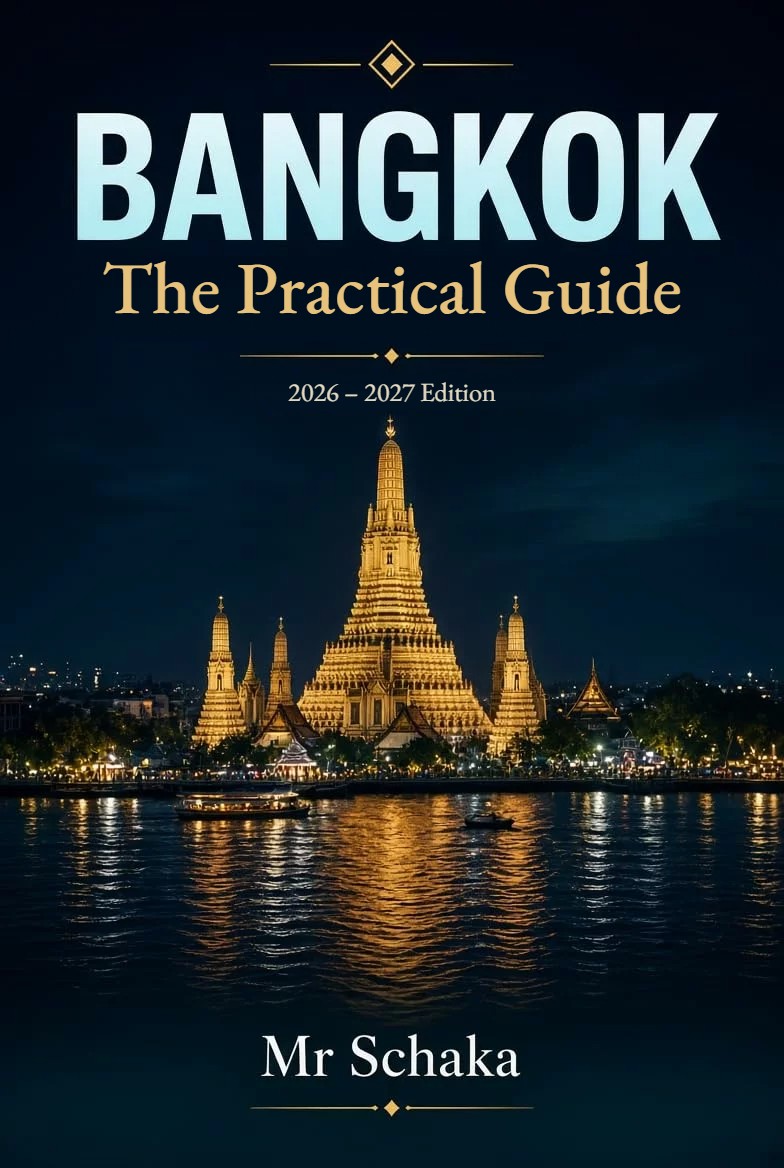
Mr Schaka’s guidebook, Bangkok – The Practical Guide, covers the essentials: transport, neighbourhoods, addresses, food, etiquette and safety, updated for 2026–2027.