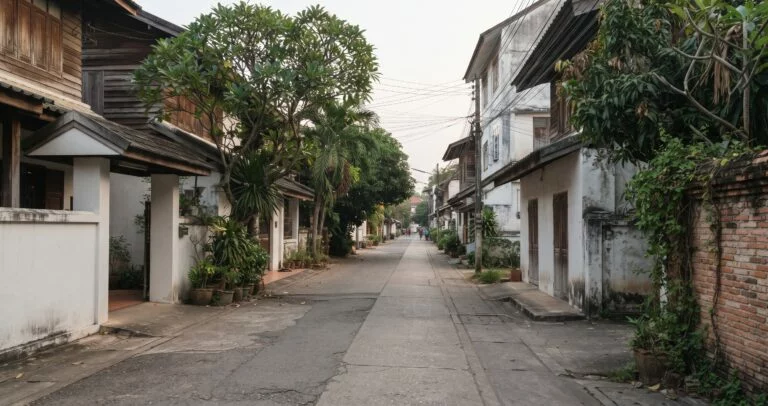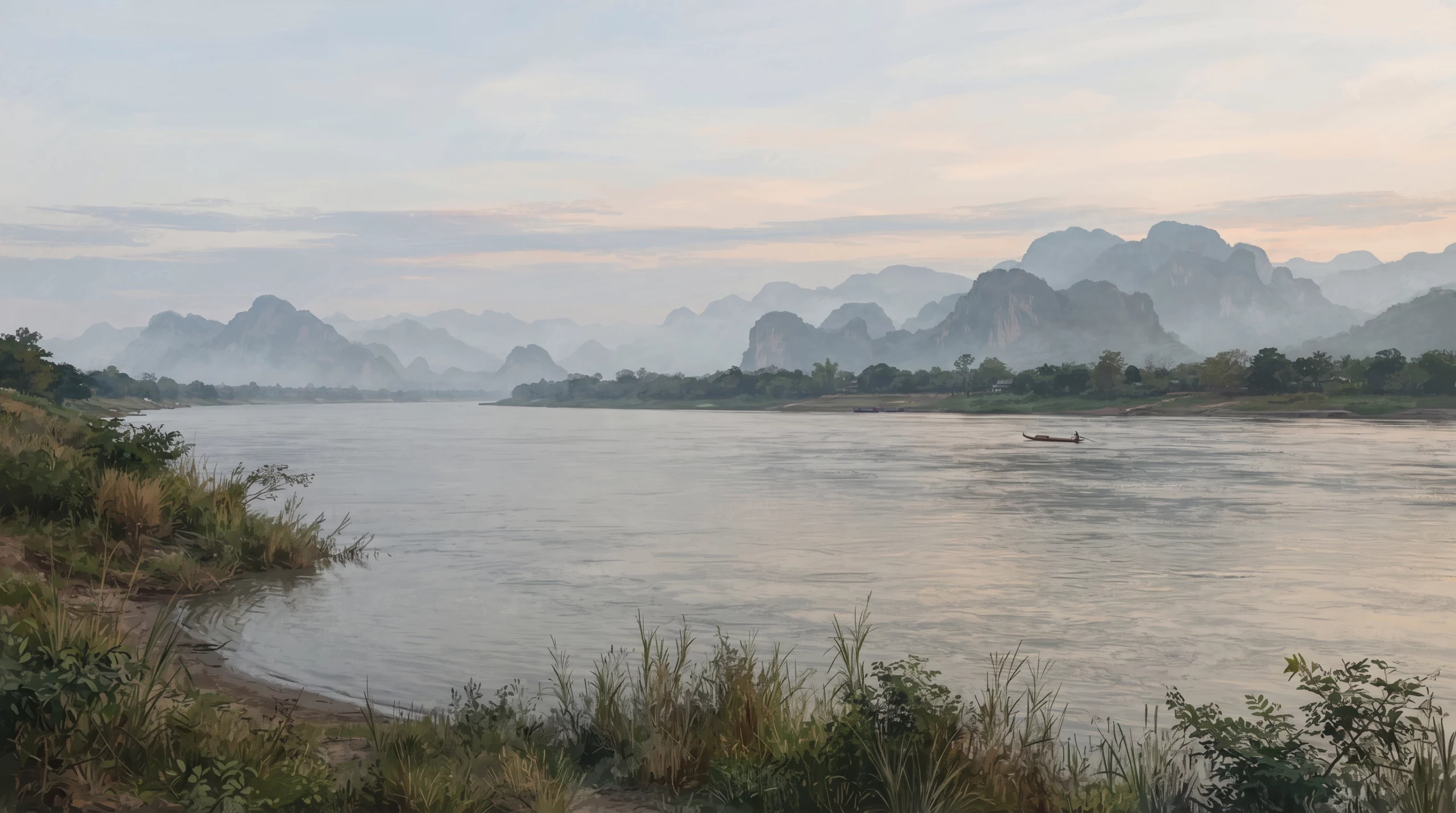
In Nakhon Phanom, your gaze first crosses the Mekong. From the Thai bank, the town looks towards Thakhek and the landscape of Laos. This setting explains part of its attraction, but a view alone cannot tell the town’s story. To discover more, turn back towards the streets, observe how the waterfront is used and leave room for ordinary encounters. A rewarding walk alternates a broad horizon with details encountered at the pace and height of somebody moving through a lived-in town.
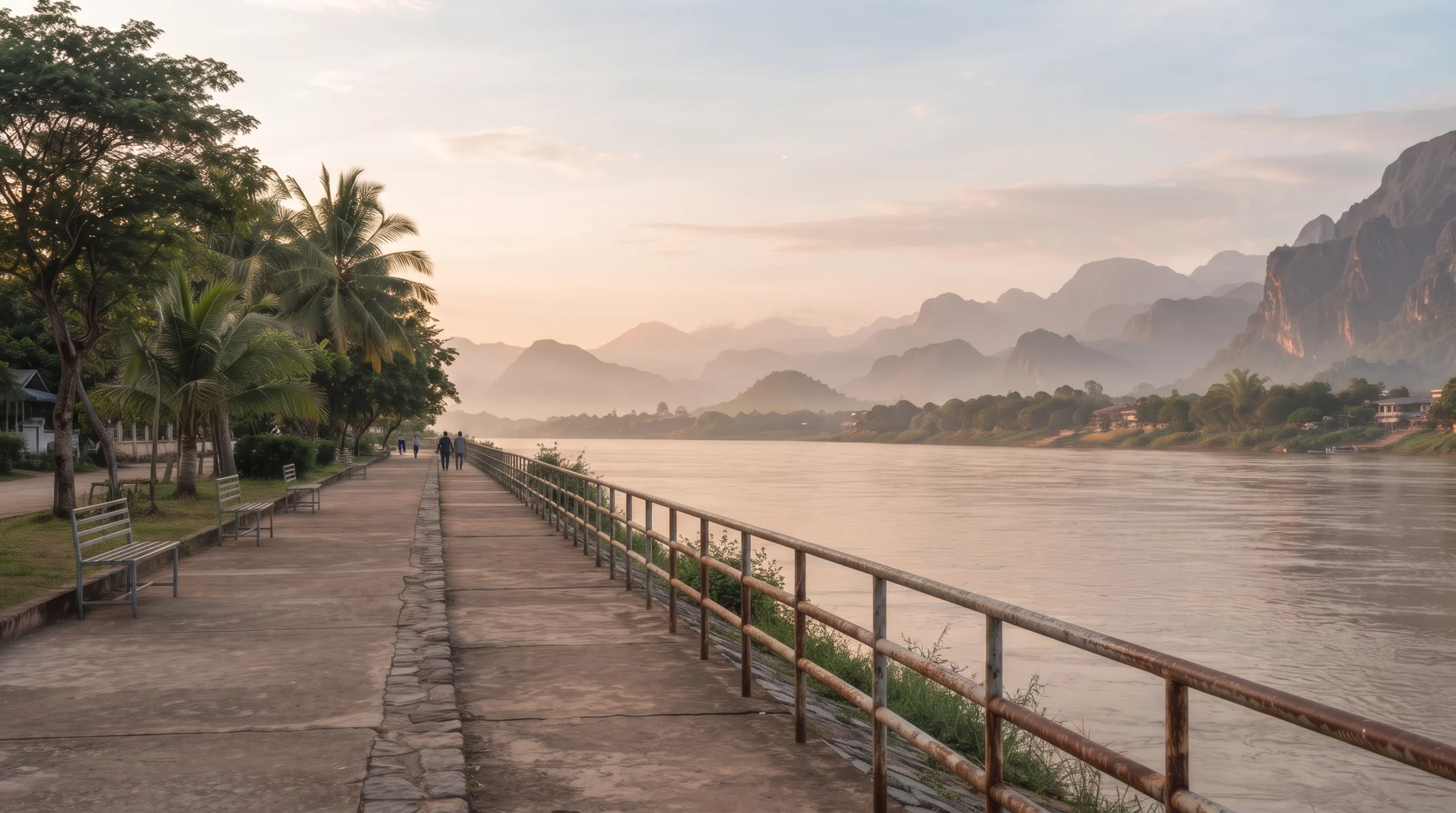
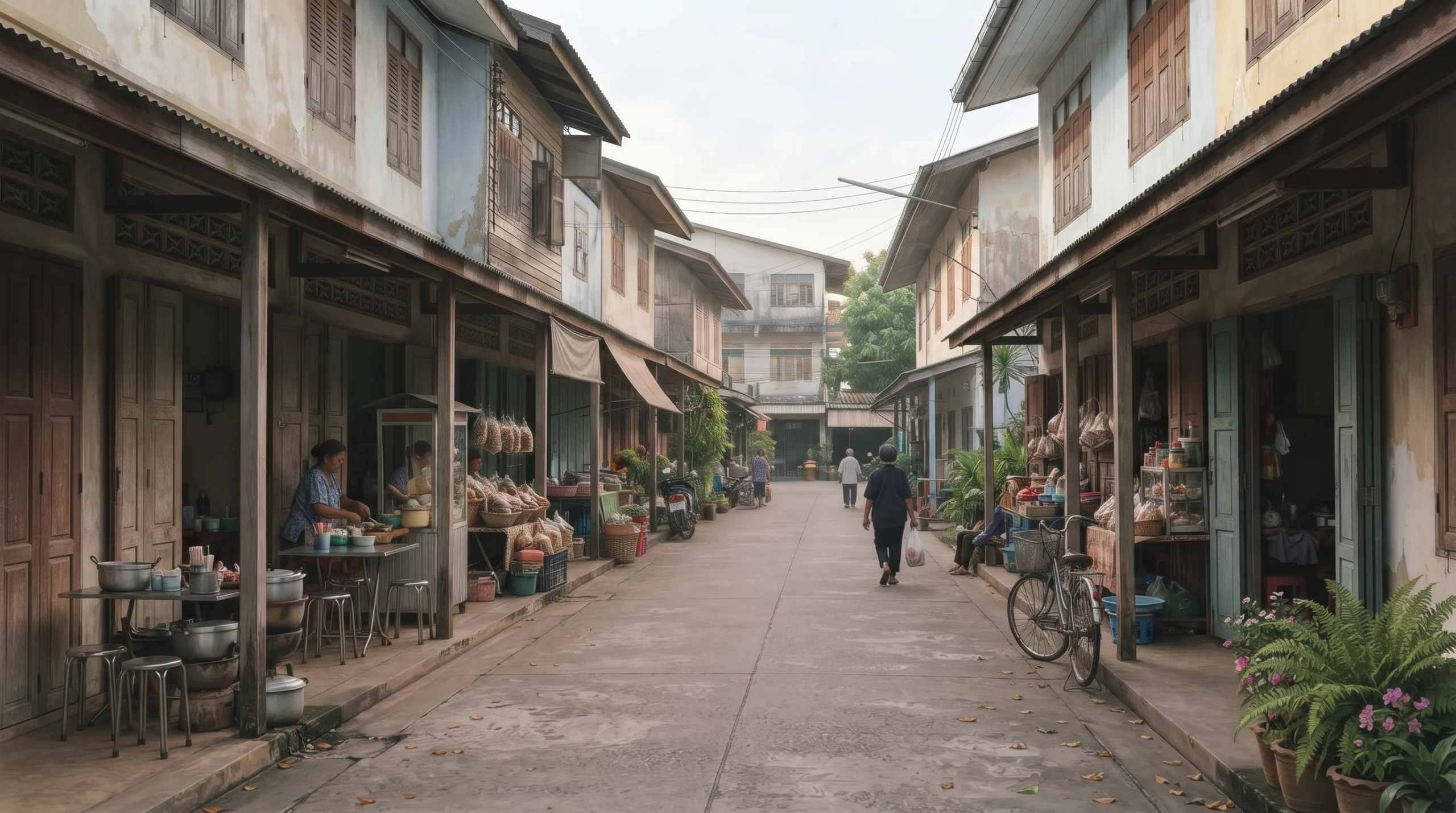
This guide introduces the central riverside without confusing it with a tour of the entire province. It offers a way to choose a manageable area, read the landscape and prepare a comfortable outing. The accompanying pictures are AI-generated illustrations: they suggest a setting rather than document the exact condition of banks, houses or mountains. Access and services need checking for your actual day. A modest plan grounded in current information is more useful than an ambitious itinerary built around images and assumptions.
Place the town within its setting
Nakhon Phanom lies in northeastern Thailand, within Isan. The Tourism Authority of Thailand places the town on the western bank of the Mekong, looking towards the Thakhek area of Laos. The distinctive mountains in the panorama are beyond the river on the Lao side. Keep this relationship in mind: a dramatic picture should not lead you to search for those same peaks immediately behind the Thai streets you are walking through. Distance and direction are part of understanding the view rather than incidental details. Official source.
Also distinguish the town from other attractions carrying the provincial name. A temple or excursion elsewhere in the province may require a separate journey. Do not automatically join every suggestion into a walking circuit. A first outing can stay with the waterfront and a few nearby streets. That leaves enough time to look, pause and return to an earlier viewpoint instead of spending most of the day transferring between places whose distances were hidden by a short list of attractive names.
Choose a starting point you can find again
Begin at a clear public landmark near your accommodation or a confirmed entrance to the promenade. Save its location and choose a short first section. A simple out-and-back walk may be preferable to a loop with uncertain passages. Read signs before continuing and do not assume an uninterrupted public route along the entire bank. Construction, local uses or changes to access can affect movement. The line on a map is a planning aid rather than proof that every metre is currently available to visitors.
Set an approximate duration that includes breaks and the return. Identify places to sit, shelter or reach a street if conditions change. Such reference points do not remove spontaneity; they make it comfortable. Companions should agree a meeting place and contact method. It is easier to look carefully when a pause for a photograph does not create anxiety about losing the rest of the group. A small amount of coordination gives each person more freedom to follow the details that interest them.
Read the panorama in three layers
Separate near, middle and far distances. In the foreground are the facilities where you stand and the uses of the bank. Next comes the river surface, whose colour and texture respond to light. Beyond it are the opposite shore and distant relief. This simple reading adds depth without requiring the name of every visible summit. It also helps you notice where a camera compresses distance, making elements appear closer together than they feel when standing at the viewpoint and looking across the water.
Do not demand an exact match with promotional imagery. Haze, cloud and diffuse light may make distance look different from what you expected. Instead of declaring the view disappointing, notice what is visible that day: a contrast, silhouette or change across the water. A photograph is only one way to retain that observation. A sentence about the atmosphere and where you stood can be more useful afterwards than a filter added to create colours that were never present during the actual experience.
Treat the waterfront as shared space
A river promenade supports different uses: movement, rest, exercise, work and waiting. Observe that arrangement before setting up a photograph. Leave a route through and avoid occupying the full width with a group or equipment. If cycling, respond to displayed rules and pedestrians. A wide surface does not automatically establish a dedicated cycle route, and a quiet moment does not guarantee the same conditions a few minutes later. Share the available space rather than organising it entirely around your own pace or camera position.
People encountered are not extras placed there to provide scale. Ask before making a recognisable portrait and accept a refusal without repeated requests. Give working activity the same consideration by keeping clear of a task or delivery. A good memory can show the relationship between town and water without exposing private life. Seek a composition that tells something about the place, rather than evidence that you managed to approach every person closely. The way an image is made belongs within the story of travelling responsibly.
Leave the panorama to look at nearby streets
After time beside the river, enter an accessible nearby area with a straightforward route back. The streets bring attention from great distances to materials and uses. Notice entrances, awnings, windows and the way businesses open towards the road. A facade does more than display style: it also responds to circulation, sun and the needs of people working and living there now. This gives a short walk substance even without a sequence of named monuments or a guide identifying every building along the way.
Compare two buildings rather than immediately selecting the most photogenic. How does their relationship with the pavement differ? Where can someone wait in shade? What space is left for entering and leaving? Such questions also discourage assigning periods or influences to every feature without documentation. You can describe a wooden shutter, plastered wall or gallery without claiming to have identified the whole history of a building. Clear observation is a useful beginning, not something that needs to be embellished with unsupported certainty to make a travel account interesting.
Understand cultural connections without reducing people to labels
The official introduction highlights movements of people and the town’s cultural diversity. For a visitor, this encourages careful listening and qualified observation. It does not allow you to infer somebody’s identity from a face, shop or decorative element. Connections between the banks and family histories cannot be reduced to convenient categories for a photograph caption. Treat the idea of a border town as an invitation to learn, rather than a shortcut that explains everyone you encounter without needing to listen to them. Official source.
If an open cultural venue, guided visit or knowledgeable person offers information, retain the names and qualifications actually supplied. Avoid expanding a brief exchange into a grand account of the entire town. A precise question about an object or building may be more productive than a general request for authenticity. Leave room for contemporary uses too. A town beside an international river does not exist only to illustrate its past; it changes with residents’ needs, work and ordinary decisions that a visitor may only glimpse.
Plan a break that does not depend on a market
Itinerary searches can easily blend a street, market and occasional event. Check the current programme and location before making an organised activity the foundation of your outing. A street known for evening trading does not necessarily have the same stalls every day. For this introductory walk, plan a possible break independent of an event. You can then add something confirmed without making the entire visit depend on its opening. This keeps the day useful even when an advertised atmosphere is absent on your arrival.
Choose according to practical needs: shade, a seat, a drink or food at an appropriate time. Ask prices and relevant ingredients when they are not clearly displayed. Carry small notes and avoid ordering excess simply to create more photographs. A pause can also serve to review a note or compare what companions noticed. It becomes a moment of understanding rather than just an interruption before the next location. Rest helps preserve attention, which is often the most important resource on an apparently easy urban walk.
Choose a time without promising particular light
Morning and late afternoon may appeal for their atmosphere, but conditions that day determine actual comfort. Check local forecasts, carry water and retain access to shelter. An ideal photographic moment may not be an ideal walking time for every family member. If heat or a shower makes the route uncomfortable, shorten it or move a section to another time. Waiting for a particular light does not justify remaining in conditions that no longer suit the group, especially when the return still requires a walk.
Do not infer sunset direction from an appealing image. Because the Thai waterfront looks towards Laos, precise positioning matters if planning an early-morning photograph. Check your location and current conditions rather than copying a general promise from somebody else’s account. A successful view does not require the sun to appear in the frame. Water, distance and relief offer subtler relationships outside the spectacular moment favoured by social media. Allow the actual place to determine the image instead of treating it as raw material for a predetermined result.
Match the walk to the group’s needs
River edges require attention to boundaries and surfaces. Stay on open facilities and do not cross protection to approach the water. With children, identify somewhere to look without spreading out. For a pushchair or a visitor with reduced mobility, ask about precise access points. A few steps or a break in the surface can make a short route difficult. A digital map rarely supplies all those details, so a small distance should not be mistaken for a complete description of how easy the walk will feel.
Alternate movement with pauses. Children might compare two colours on the water, draw a roof or describe what looks furthest away. Do not expect uninterrupted concentration on explanations. Adults can choose one thread too, such as the connection between road and bank. When energy drops, returning to the starting point is a sensible decision. The walk is not incomplete because it ends before the final pin imagined at the hotel. An attentive hour can leave a stronger memory than several tired hours spent following an unnecessarily rigid plan.
Confirm transport and the final connection
Search for services operating on your dates and confirm the exact arrival point. A town name on a ticket does not explain how to reach your accommodation or the promenade. Check interchanges, booking conditions and the final leg. Do not turn a travel time from an older account into a rule applying to every departure. Save the address in Thai and a contact who can help resolve uncertainty without a series of random attempts. Sound logistics protect the time you intend to spend looking around after arrival.
For a same-day departure, decide when to return to luggage and the departure point. A margin allows a calm ending instead of a chase for one last photograph. On a longer stay, separate the centre from outings elsewhere in the province. Seeing another country across the water also does not make an international crossing an improvised activity from any quay. An excursion or border journey needs separate preparation and current official information. Keep it outside this walking plan unless arrangements have actually been checked and made.
Choose accommodation that supports your rhythm
A Mekong view may be appealing, but it does not answer every question about a stay. Check room access, arrival procedures, noise and the services you genuinely need. Ask whether the walk to the bank is straightforward rather than inferring it from a balcony photograph. A practical property may give you more comfortable time outside than one chosen only for a spectacular panorama. Priorities vary, so turn a general desire for a pleasant stay into specific questions that the accommodation can answer before you book.
For early photography, arrange to leave without disturbing others and confirm access before normal reception hours. For a late arrival, agree check-in and any necessary transfer. These details create freedom afterwards. They also show why an unhurried visit need not be improvised: logistics can be organised precisely so that looking takes its own time. The calmness of an outing often depends on small decisions made before closing the room door, rather than on finding a destination with no activity or other people around you.
Return to the river with a more precise view
After the streets, return if possible to somewhere already observed. Compare changes in light or activity, and notice what the walk through town now helps you recognise. The panorama becomes part of an inhabited environment rather than merely a distant picture. A short photographic sequence can combine a broad view, a public use of space and a facade detail, with captions separating what you saw from what remains to be learned. Repeating a viewpoint can therefore deepen the visit rather than count as wasted time.
For a further stage, explore Mr Schaka’s Thailand guides and choose another destination without turning this introduction into an exhaustive survey. Nakhon Phanom suits an alternation: look far, return to the streets, then find the river again. The aim is not to bring home the same dramatic light as everybody else. It is to understand a little more about how a town inhabits its bank, and how the landscape across the water becomes part of everyday life for people whose home you have briefly visited.
Sources and planning
Sources checked on 4 November 2026. Confirm practical arrangements with the operators before visiting.
- Tourism Authority of Thailand — Nakhon Phanom
- Thailand Film Office, Department of Tourism — Nakhon Phanom
- Thailand Digital Tourism Center — paysages de Nakhon Phanom
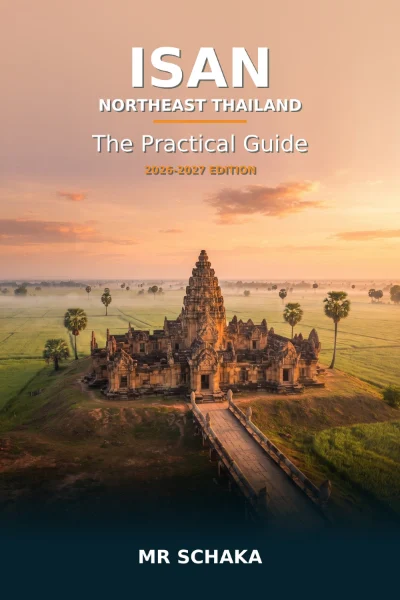
To go further
Mr Schaka’s guidebook, Isan – The Practical Guide, covers the essentials: transport, neighbourhoods, addresses, food, etiquette and safety, updated for 2026–2027.