Taking a tuk-tuk in Bangkok is something of a rite of passage for every traveller: the roar of the engine, the warm wind, the traffic it squeezes through. It is also the form of transport where you are most easily taken for a ride. Here is what I have learnt over my stays: indicative prices, how to negotiate, the classic traps and the moments when it is better to pull out your phone and book a Grab or hail a taxi.
The tuk-tuk: more an experience than a means of transport
Let’s be honest: the tuk-tuk is neither the cheapest nor the fastest way to get around Bangkok. It has no meter, no seatbelt, it is open at the sides and you breathe in exhaust fumes at red lights. But for a short hop between two temples, a ride back from a market in the evening or simply the pleasure of the trip, it remains a little moment of happiness. I take it for the experience, over short distances, and use something else for the rest.
For longer journeys, the Skytrain, metro and boat network is often more efficient. I cover it in detail in my article on getting around Bangkok by BTS, MRT and boat.
How much does a tuk-tuk cost in Bangkok?
There is no official fare: everything is negotiated. Prices vary with the neighbourhood, the time, the weather and how much of a tourist you look. As a rough guide, for a short trip of a few kilometres in tourist areas, expect around 100 to 200 baht. Thais generally pay less, and the price climbs quickly near major sights, luxury hotels or when it rains.
To get a benchmark, open the Grab app before negotiating and check the price of a car for the same journey. A tuk-tuk often costs as much as an air-conditioned taxi, or more: that is normal, you are paying for the experience. But if the driver asks double or triple, you know there is room to talk.
How to negotiate well
- Agree the price before you get in, always. Show the destination on a map and ask how much: “tâo rài?”.
- Confirm the price for the whole trip and for the group, not per person, to avoid misunderstandings on arrival.
- Make a counter-offer calmly, with a smile. The first price is often inflated; offering noticeably less and meeting in the middle is common.
- If it doesn’t suit you, walk away politely. Another tuk-tuk will come along, and sometimes the driver calls you back with a better price.
- Choose a tuk-tuk that is moving rather than those parked in a line outside tourist sights, which are often dearer.
Keeping calm is essential. In Thailand, raising your voice never works. A bit of humour and a few words of Thai open far more doors; my short Thai glossary will give you the basics.
The classic traps to avoid
The cut-price city tour
A driver offers to show you several temples for 20 or 50 baht? It is too good to be true. The tour almost always includes “quick” stops at a jeweller’s, a tailor’s or a souvenir shop where the driver earns a commission. You can lose half a day and a lot of money.
“The temple is closed today”
A very friendly stranger, sometimes near the Grand Palace, explains that the site is closed for a ceremony and just happens to find you a tuk-tuk for another visit. Check for yourself at the official entrance or on the site’s website. This scenario is one of the best-known scams in Bangkok.
The price that changes on arrival
You said 100 baht, now he wants 100 baht per person, or claims he understood 300. Hence the point of being very clear at the start, repeating the figure and, if need be, typing it on your phone.
No change
With a 1,000-baht note, the driver often “has no change”. Keep small notes (20, 50 and 100 baht) in a separate pocket.
When to choose Grab or a taxi instead
The tuk-tuk has its moments, but other options are often more comfortable:
- Grab (or Bolt): the price is shown before you book, the journey is tracked in the app and there is nothing to negotiate. Ideal for medium or long trips, in the evening, or when you are tired.
- Metered taxis: air-conditioned and often cheap if the meter is running. In Bangkok it starts at around 35 baht. Ask for the “meter” before getting in; if the driver refuses and quotes a flat fare, take the next one.
- MuvMi electric tuk-tuks: in some neighbourhoods these small electric tuk-tuks are booked through an app, with a price set in advance. A good way to enjoy the experience without haggling.
- In heavy rain or at rush hour, the tuk-tuk quickly becomes a chore: you get wet, stuck in traffic jams and at the level of the exhaust pipes. The metro or an air-conditioned car is then far more pleasant.
Safety and comfort on board
A tuk-tuk has no doors and no seatbelts. Hold on to the bar, especially on bends, and keep your bags inside, on your lap or between your feet: bag snatching by motorbike passengers has been reported. If the driver goes too fast, ask him to slow down: “cháa cháa nòi”. And if you are travelling with children, choose an enclosed vehicle for trips along the main roads.
My practical tips
- Check the Grab price for the trip before negotiating: it is your best benchmark.
- Always keep small notes, and check whether the driver accepts QR code payment.
- Show your destination on a map or written in Thai, as many drivers do not read the Latin alphabet.
- Politely refuse any detour to a shop, even “just five minutes”.
- Keep the tuk-tuk for short trips and for fun, preferably in the evening when it is cooler.
- Avoid it in a heavy downpour and during the morning and late-afternoon rush hours.
Frequently asked questions
Is a tuk-tuk cheaper than a taxi in Bangkok?
Rarely. A metered taxi or a Grab car often costs as much, or less, for an equivalent trip. People take a tuk-tuk mainly for the experience.
Can you pay for a tuk-tuk by card?
Generally not. Bring cash in small notes; some drivers also accept Thai QR code payment, but it is not guaranteed.
Should you tip?
It is not compulsory. Rounding up the agreed price is an appreciated gesture if the driver has been fair and careful.
Do tuk-tuks run at night?
Yes, you can find them late around busy areas, but prices often rise in the evening. To get home late, Grab or a metered taxi is simpler.
To go further
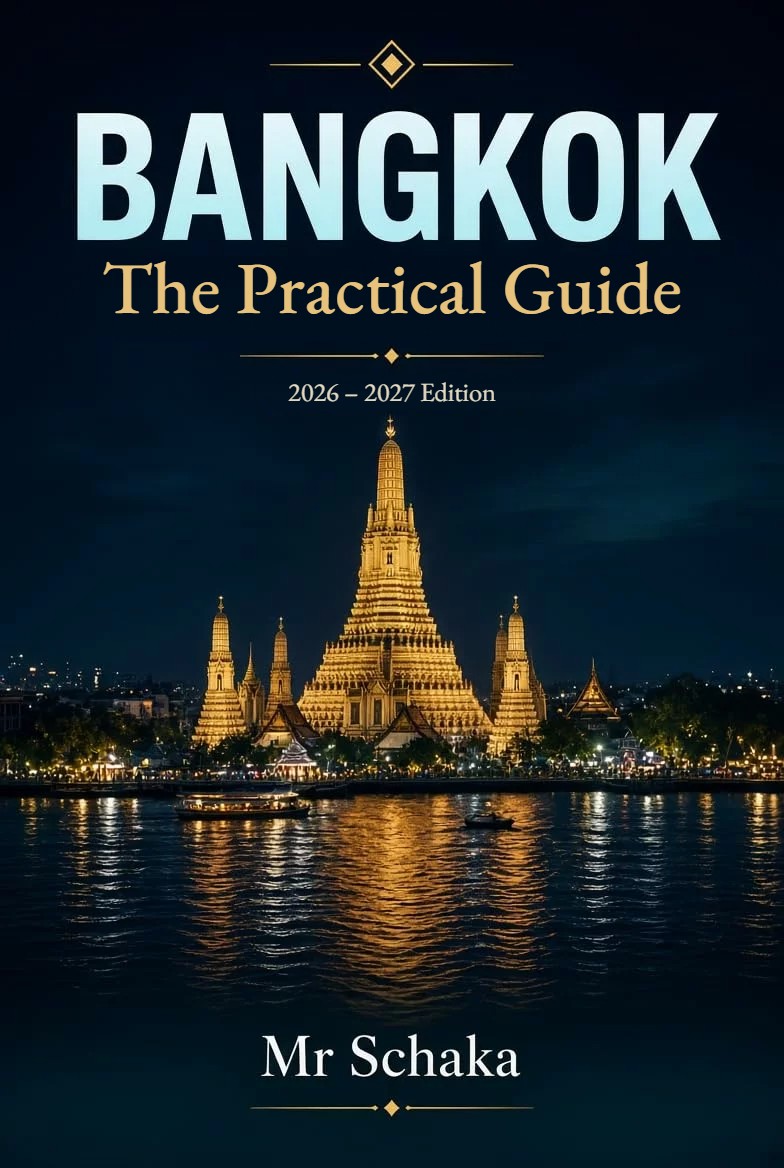
Mr Schaka’s guidebook, Bangkok – The Practical Guide, covers the essentials: transport, neighbourhoods, addresses, food, etiquette and safety, updated for 2026–2027.