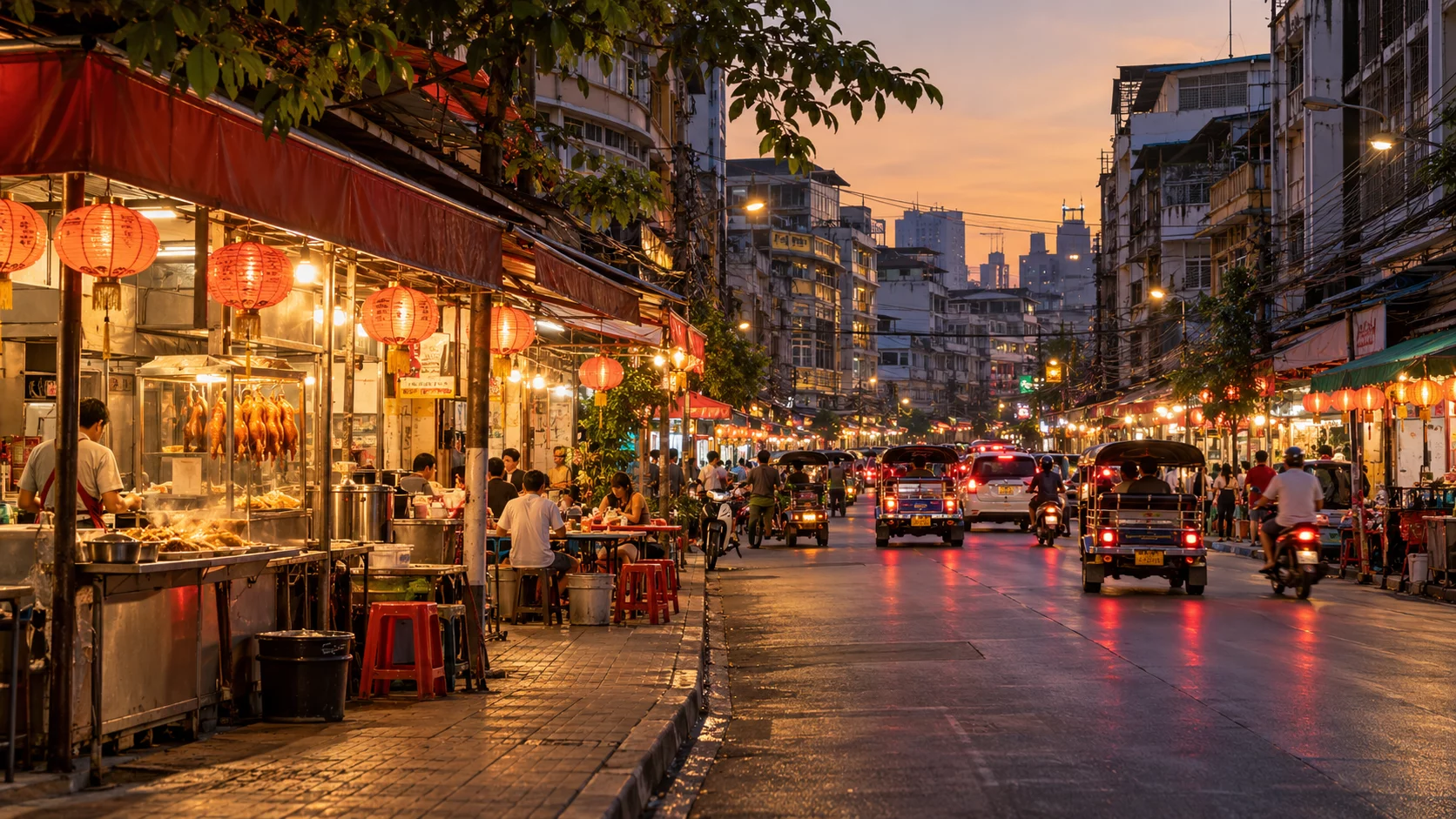
In Yaowarat, your attention may move from a sign to food being prepared at a counter, then to a small street whose name you do not know. Those changes are part of the neighbourhood’s interest. To retain more than a sequence of dishes and photographs, look at how activities coexist: selling, cooking, delivering, passing, waiting and living. The walk becomes an encounter with an environment that works, rather than a list of scenes to obtain. You can enjoy its visual energy while noticing the practical arrangements that make everyday exchanges possible.
This guide proposes an approach for exploring on 2 November 2026. Publication at 19:00 does not guarantee that a business will be open, a stall present or a particular activity taking place. Check an establishment directly for your intended time. Nothing here claims to recount the author’s personal experience, recommends a specific restaurant or promises a price. The observation prompts are editorial suggestions to adapt to the actual situation and instructions from people on site. They are meant to make an outing more attentive, not to turn one moment into a permanent description of the whole area.
Set a few reference points without enclosing the neighbourhood
Official descriptions locate Chinatown around Yaowarat and Charoen Krung roads and highlight its commercial and food activities. Those names provide reference points, rather than a boundary making everything behind them invisible. Identify your arrival point and a clear return point. If considering MRT Wat Mangkon station, check access suited to your walk and current network information. A station name is not a substitute for preparing the path to the street you intend to explore. Knowing where an outing begins also makes it easier to change its shape without losing your bearings.
Then choose a question to guide the outing. How is a shop recognised from the pavement? How does a counter organise work? What changes when you move from a major street to a side road? You do not need to answer everything. A question lets you connect two scenes without assigning a general meaning too quickly. It also leaves you free to pause when something becomes interesting instead of mechanically following a route prepared elsewhere. Your own attention can determine part of the walk, provided it remains compatible with the place’s actual uses.
See a business before looking for a backdrop
A frontage may attract you with colour while belonging to an activity whose organisation you have not understood. First identify the entrance, waiting area, goods and staff movements. A placed carton, a passage kept clear or a brief exchange can help you recognise working circulation. Observe without deciding people’s identities or histories from appearance alone. A visible scene does not provide its own biography. What you can describe accurately is the arrangement before you, while questions about ownership, family history or personal experience require information you have actually received.
If you want to study a window longer, stand where access remains open. Entering a shop should have a comprehensible intention: viewing an offer available to customers, requesting information or buying. Do not assume the business offers tours of storage areas. If asked to move, do so simply. An attentive relationship with a neighbourhood develops through concrete adjustments like these. It does not require every exchange to become a major cultural encounter. Ordinary politeness allows the shop to continue functioning while you decide whether its offer is something you want to explore further.
Read signs without inventing translations
Signs may combine writing systems, names and information you cannot read. Begin with layout: what is large, what repeats and what seems to announce a product or name. These are visual observations, not translations. If a recognition tool proposes a result, treat it as help to check. A proper name, commercial expression or partly obscured word can be misread, especially with reflections or an awkward angle. A confident result on a screen does not establish that the meaning has been correctly understood in the particular context of that business.
To keep useful information, associate a permitted photograph of the sign with an address or precise point. Avoid publishing an approximate translation as if the owner confirmed it. You can honestly record a shape or colour without knowing every word. A travel notebook does not need to display complete understanding to be interesting. It can preserve a question and help you find the exact name later. That distinction leaves space for curiosity and correction instead of turning a guess made during a walk into a statement passed to other visitors as reliable information.
Approach a cooking counter as a workplace
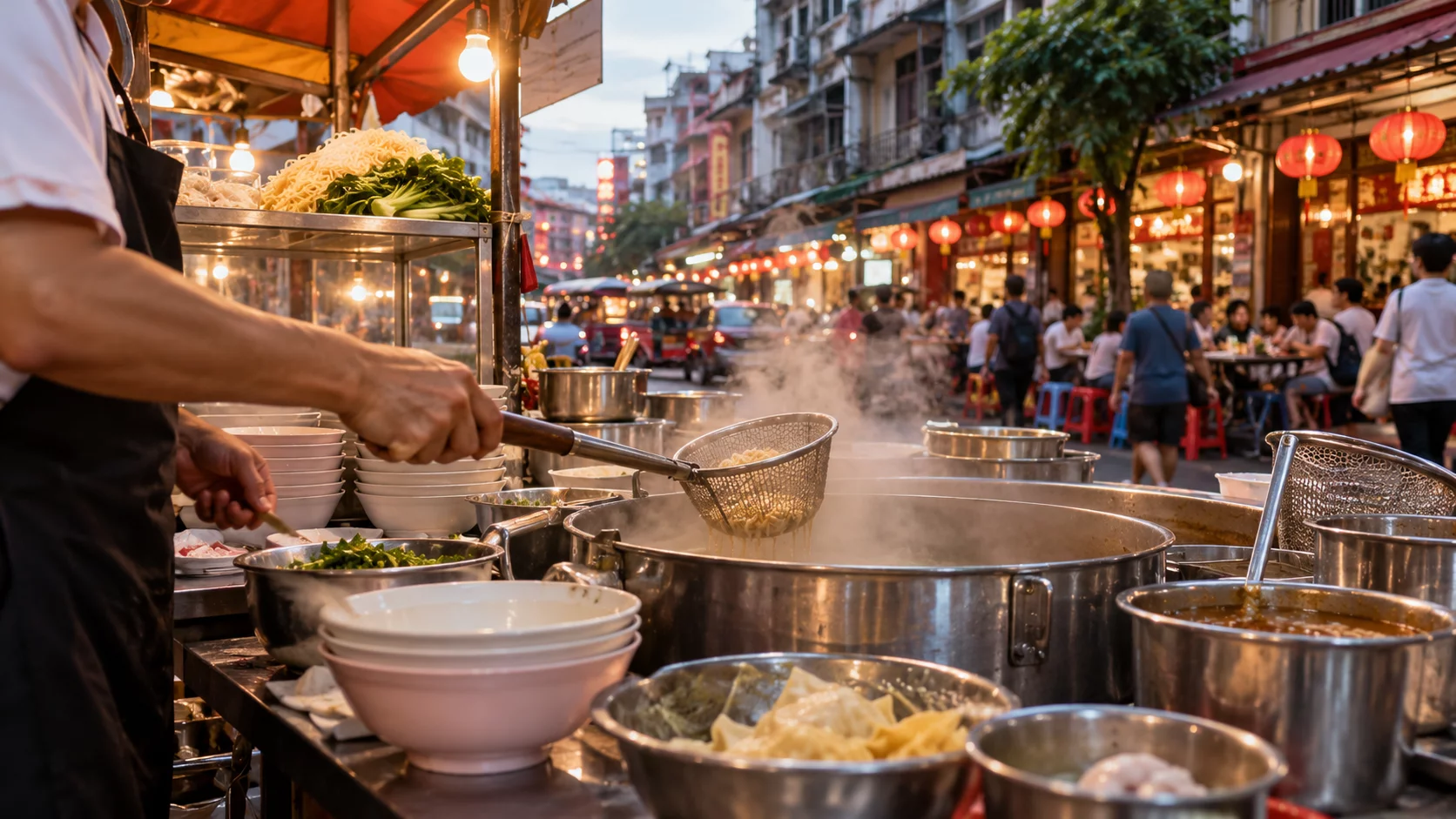
When a preparation attracts curiosity, look at where customers approach and where the people cooking need to move. The best viewing angle is not necessarily the best place to remain. Do not put belongings on a work surface or extend a phone above utensils. To watch a gesture, wait for a moment when your presence does not interfere. You can admire a skill without obtaining close access to every stage. Some parts of a process may remain out of view, and the absence of a clear photograph does not make the observation less worthwhile.
Preparation is not a demonstration arranged for your camera. Staff may answer a question or be too busy. A brief response should not be interpreted as a judgement on the visitor. You can thank them and leave room. If conversation opens, start with a simple question about what is offered or how to order. This lets the other person choose the time and content of the exchange rather than imposing an interview during service. A useful conversation may be very short, and it can remain meaningful without producing a complete account of a business’s history.
Order something you have actually understood
Before ordering, identify the dish, portion and possible additions. A photograph can show a presentation without explaining everything included. Ask about details that matter and the price applying to your selection, rather than assuming a figure displayed nearby covers your order. If the offer remains unclear, take time to choose something else or wait. Hunger does not oblige you to accept a transaction whose parts you do not understand. A short clarification before payment is easier than trying to reconstruct an order after it has already entered the preparation process.
In a group, say whether you are sharing or ordering separately. Confirm where you may eat what you buy. Nearby seats do not necessarily belong to the same business or accept every purchase. Once the order is placed, keep the reference needed for collection and free the space required by following customers. You can enjoy tasting more calmly when the practical rules are understood before dishes arrive. These questions are ordinary parts of a purchase, and asking them clearly need not become a lengthy negotiation or an attempt to redesign the way the counter operates.
Describe a taste without making it a universal truth
You can discover a flavour without loving it immediately or presenting it as evidence of an entire culture. For notes, choose precise words about your perception: texture, felt temperature, contrast, intensity or combination. Separate what you observed from what someone explained. If you do not know the exact name, keep the order reference and try to verify it. A personal description gains value when it does not claim to speak for every visitor. Different responses can coexist, and your own enjoyment does not need to establish a ranking for everybody else.
Avoid inferring origin, age or a family recipe from a counter’s appearance. Such information needs a source or a conversation in which it was actually supplied. Calling something authentic does not remove the need to explain what you appreciated. Describe a particular gesture, a clear exchange or a flavour combination without deciding that one business represents the whole neighbourhood. That preserves diversity instead of reducing people and cuisines to a label. It also makes your memory more specific: another reader can understand the experience you had without being asked to accept an unverified cultural conclusion.
Ask a clear ingredient question
If an ingredient or preparation does not suit you, state the requirement before paying. Prepare one simple sentence rather than stacking several questions into a long translation. Ask whether the answer applies to the chosen dish and additions. A translation tool may facilitate exchange, but it does not verify a recipe or preparation process. If the answer is not clear enough for your need, you can decline the order without asking the business to promise something it cannot confirm. Recognising the limit of a conversation is part of making an informed choice.
This approach cannot guarantee that a food suits every person. It helps identify what you have and have not understood. If your circumstances require particular precautions, prepare the outing accordingly rather than expecting to resolve everything in a queue. Keep ordinary choices equally simple: ask, listen and decide. Declining an order can remain polite and brief. It needs neither a judgement on the business nor an argument that someone has performed badly. The point is to choose according to your requirements while allowing the other person to describe their offer accurately and continue working.
Understand a queue before joining
A cluster of people does not always reveal who is waiting to order, pay, collect or simply pass. Observe the movement briefly and ask where the queue for your purpose begins. If accompanying someone ordering, avoid occupying the passage as a whole group. A lighter presence leaves room and makes the exchange easier. Meet at an agreed place instead of forming a small wall around the counter. Everyone can still participate in the outing without standing in the same narrow space at the same moment or repeatedly asking the person serving what happens next.
Do not treat waiting time as an automatic judgement on what is served. It may reflect circumstances you do not know. Decide how much time to spend according to your outing. You can leave a queue and choose another activity without missing the essence of Yaowarat. If you have a booking elsewhere, consider remaining time rather than hoping service accelerates at the moment convenient to you. A flexible walk needs permission to change direction, including when a famous address becomes less suitable than a simpler option you can understand and enjoy now.
Enter a side street with a different kind of attention
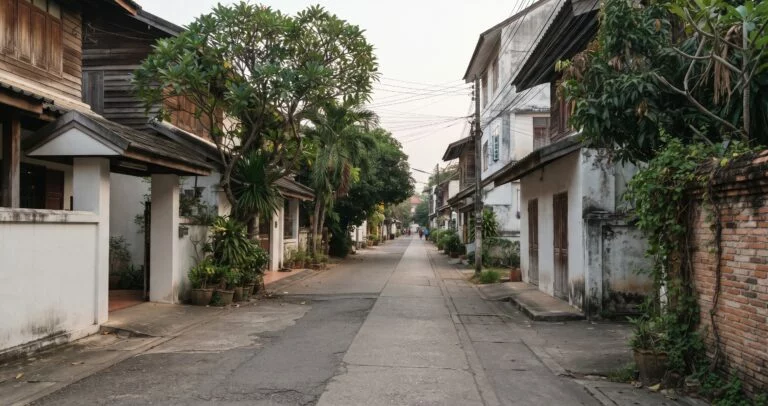
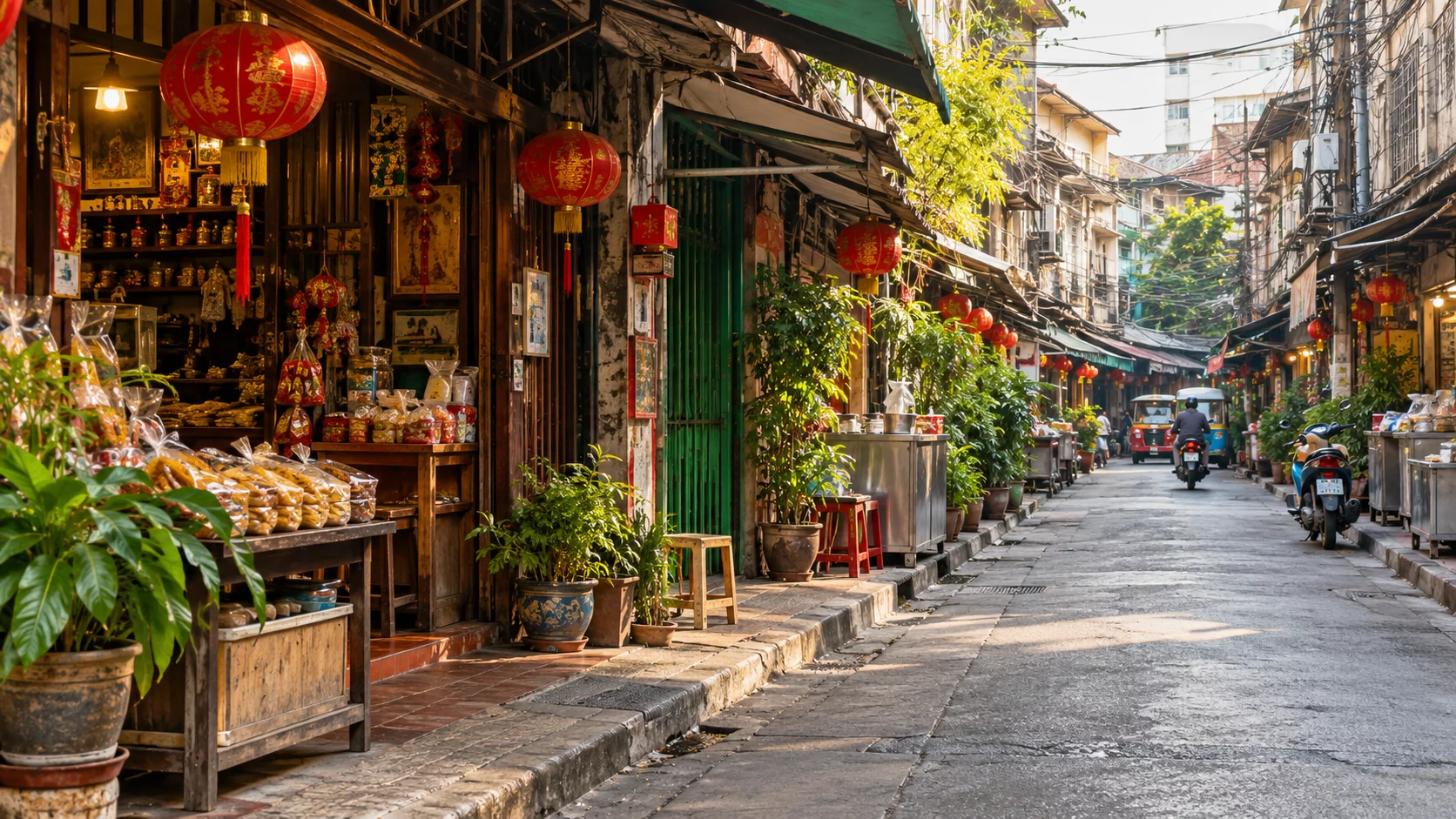
A narrower road can change proportions: less viewing distance, closer thresholds and a more direct relationship between passage and activity. Look for where you may circulate without entering private space. An open door or visible courtyard is not an invitation to visit. Before moving closer for an angle, ask whether you remain in an accessible public passage. If unclear, stay on a route you understand or request guidance. The wish to observe does not require resolving every uncertainty by walking farther into a space whose use you have not established.
Compare this sequence with the main street without declaring it more real because it is less spectacular. Visual intensity and cultural value are not measured the same way. Record a precise difference instead: perceived height, use of a threshold, sound or movement rhythm. People living or working there need not play a hidden neighbourhood to enrich your walk. Attention is enough; discovery does not require intrusion. You can retain a contrast that changes your understanding while respecting the fact that some activities are not organised for visitors and some spaces are not part of the outing.
Let religious places retain their own purposes
If the route includes a religious place, check that visiting is possible and follow instructions on entry, dress and photographs. A nearby commercial street does not make the interior a freely accessible continuation of the walk. Read requirements before following someone. They may be entering for a practice different from your visit. If unsure where to stand, a discreet staff question is better than an approximate imitation of a gesture you do not understand. You do not have to reproduce an action merely because another person has done it before you.
Participation is not required to respect the place. Observe from permitted space, let people practise and avoid photographing worshippers as scenery. In your account, describe what you actually saw instead of generalising one scene to every tradition in the district. Encountering a religious space can open a question for later exploration. It need not produce an immediate complete explanation of beliefs whose visible expressions you have only begun to encounter. A limited but accurate observation leaves more room for learning than an expansive description built from assumptions you cannot substantiate.
Photograph activities with genuine permission
For a close portrait or scene making someone the main subject, ask permission. Show your intention simply and accept refusal without insistence. Buying food does not automatically provide a right to a staff portrait. If permission is given, do not turn it into a long staged session while work waits. An image can be made briefly, then conversation or circulation resumes. Respect is visible in what you do after receiving the answer, not only in asking. Permission to one photograph should not be silently expanded into permission to direct the person’s work or surroundings.
For street views, stand where passage still functions and keep belongings close. This article’s illustrations are AI-generated and do not prove a particular stall will be present on your visiting day. When publishing your own photographs, avoid captions promising hours or assigning an unchecked history to a business. A photograph shows a moment. Information intended to help someone return deserves separate checking and a date. Keeping those functions distinct makes the record more useful and prevents an attractive image from being mistaken for a current service announcement or a guarantee of availability.
Share a walk without making eating compulsory
Groups can have different wishes: one person wants to taste, another study frontages and a third mainly sit down. Choose a small common core and one optional stage. This prevents everybody adding a dish or street until the programme becomes too heavy. Sharing observations can be more enjoyable than satisfying every list in one outing. Nobody needs to order to prove participation or respect for the experience. An agreed pause also gives people a chance to say what they actually want next, rather than following a growing programme they no longer recognise.
With children, offer a looking task that does not disturb work: recognise a sign’s shape, notice a tool from the passage or compare two colours. Do not ask for secret photographs of people to complete a mission. Set a precise meeting point if temporarily separating. A neighbourhood name is too broad for a rendezvous. This organisation leaves everyone some freedom without making the search for companions the evening’s main activity. Keep the task compatible with actual access, and let the child retain a question if the interesting object cannot be approached safely or appropriately.
Keep a notebook separating experience from information
After a pause, note three things: an observed scene, an exchange actually heard and a question still open. These categories prevent interpretation being blended into a business owner’s words. A sentence can begin with “I noticed” rather than claiming to explain a street’s entire history. If adding official information, retain the source. The notebook becomes a tool for refining attention, not a collection of decorative assertions intended to make every photograph sound learned. It can develop after the walk as names are corrected and questions become more precise.
Before leaving, find the chosen return point and check the connection you will actually use. Do not infer present service from an article’s publication time or an old walk. You can leave Yaowarat with one clear observation rather than every address recommended elsewhere. Later, that observation may prompt another question: a trade to understand, a sign to identify or a street to see from a different angle. The neighbourhood remains a living place whose uses one outing cannot exhaust. Returning with a particular curiosity can be more rewarding than treating the first visit as a complete account.
Sources and checks
Tourism Authority of Thailand — ถนนเยาวราช; Tourism Authority of Thailand — The adventure through Bangkok’s Chinatown; Bangkok Metropolitan Administration — Yaowarat area. Reference points checked on 31 October 2026. General descriptions do not confirm a particular business opening on 2 November; verify visits and transport for the actual intended time.
#Yaowarat #Bangkok #Chinatown #Thailand #MrSchaka

To go further
Mr Schaka’s guidebook, Bangkok – The Practical Guide, covers the essentials: transport, neighbourhoods, addresses, food, etiquette and safety, updated for 2026–2027.