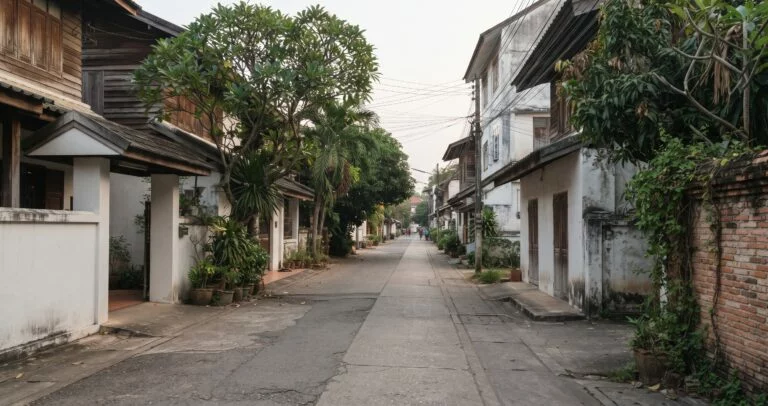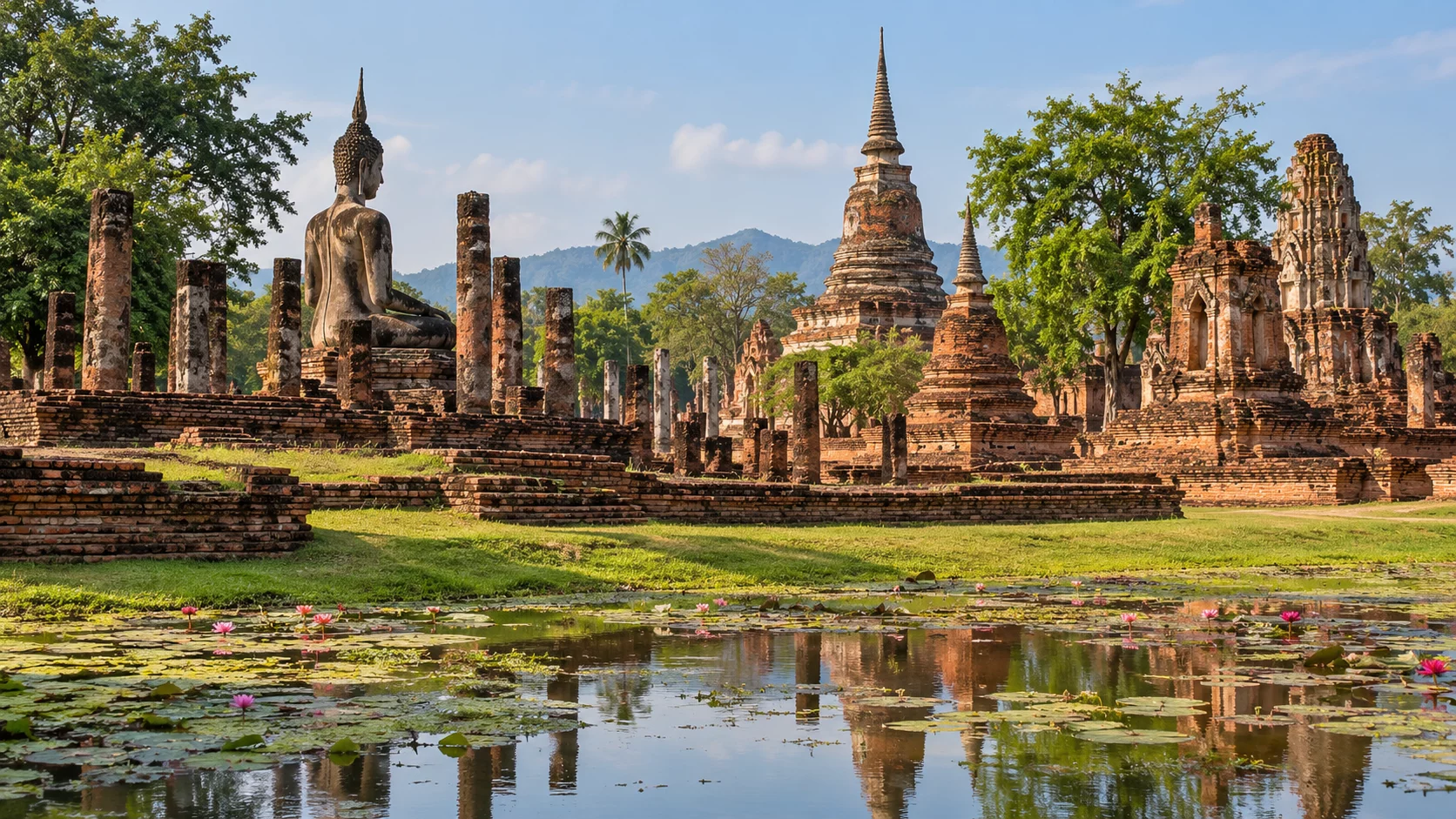
A photograph of Sukhothai often brings a monument, grass and water together in a calm frame. Preparing a visit means looking beyond that frame: the ancient town’s limits, entrances, ensembles outside them and the route back to your starting point. The park is not simply a garden to cross without making choices. Its geography can help compose the day, provided an attractive view is not confused with a complete map. Understanding the scale first leaves more attention for the place when you actually arrive.
This guide is scheduled for 2 November 2026 at 22:00 to prepare a later visit. That publication hour does not signal night opening. Check prices, operating times, permitted transport and access for the actual day. Nothing here describes the author’s personal stay. Suggested routes are editorial methods, without promises of duration, an absence of crowds or available equipment. Choose what suits the people present and conditions confirmed on site. A plan becomes useful when it supports decisions, rather than requiring the day to resemble a photograph or an itinerary somebody else completed.
Separate three map scales
Begin by distinguishing Sukhothai Historical Park, the town where you stay and the UNESCO property. The last associates Sukhothai, Si Satchanalai and Kamphaeng Phet. The other two historic towns are not sectors to add as a short detour while walking through Sukhothai’s park. They require separate preparation. This difference in scale prevents an impossible programme assembled from names that genuinely belong to the same heritage. A historical relationship is not an immediate practical connection for your day, and a shared designation does not make all its places one compact visitor area.
On your own map, keep the accommodation’s exact address and the point where you intend to begin. Sukhothai can appear in addresses that do not identify the same place. Ask your accommodation which entrance you are considering and how to reach that precise point. Do not replace the question with a broad request to go to the temples. You can then prepare the internal visit without simultaneously resolving an unclear arrival and a string of scattered stages. An accurately named start is often more useful than a detailed list of monuments whose entrances remain unknown.
Understand the old centre and outside ensembles
Official descriptions distinguish monuments in the old town’s heart from those outside its enclosure. Wat Mahathat is a central reference. Wat Si Sawai lies south of that ensemble; Wat Si Chum stands outside, towards the northwest. These positions do not form an automatic itinerary. They invite you to group stages by location and check actual connections instead of treating monuments like neighbouring rooms in one building. Direction helps you read the map, but it does not by itself establish how you will move or which access is available that day.
Locate the names on a current plan and draw two separate things: movement within your initial sector and any possible outside extension. Write where the extension begins, which entrance it uses and how it ends. If an answer is missing, keep it as an option to confirm. This drawing makes visible the decisions hidden by a sequence of photographs. It also helps explain the programme to a companion or provider without inventing precise travel times. Everyone can understand what the plan includes even while variable details remain clearly identified for checking.
Build a first loop that works by itself
A first visit can focus on one sector and a few ensembles without covering every direction. Choose an entry point, a principal monument, a second interest and an understandable return. The second point may answer a different question: relationship with water, the experience of open space or a change of silhouette. It need not be another prestigious destination. A loop becomes coherent when you know why you are making it, not when it fills the entire map. Its value lies in the experience it makes possible between a clear beginning and ending.
Choose somewhere to decide whether to continue. Make that decision while attention and a return option remain, rather than waiting for tiredness to impose a hurried departure. You might pencil an extension into the notebook as a reminder that it is optional. If the first ensemble interests you longer than expected, the visit retains its value. A well-designed programme allows a real question to replace a stop added merely to create the impression of using every possibility. It gives your attention somewhere to go without making curiosity compete against an inflexible series of obligations.
Use Wat Mahathat as an orientation point
Official tourism information highlights Wat Mahathat’s principal chedi with a lotus-bud form. Use that reference to orient observation without assuming one detail summarises the ensemble. From permitted space, look at the distribution of volumes and where you stand while approaching them. Then choose a detail to explore with available interpretation. The order helps: understand where you are before looking for the architectural term that names something. A recognisable feature can begin the visit without becoming the only thing you notice or the measure by which every later stop is judged.
To prevent image hunting, retain one simple question here. How does a dominant form relate to surrounding elements, for example? Describe what you see before seeking an explanation. A level change, opening or alignment can be noted without immediately assigning a historical function. When you read an answer on site, you will know which observation it concerns and why it enriches your understanding. That relationship between looking and explanation makes information easier to retain. It also helps you avoid attaching a familiar historical phrase to a feature simply because the phrase sounds plausible.
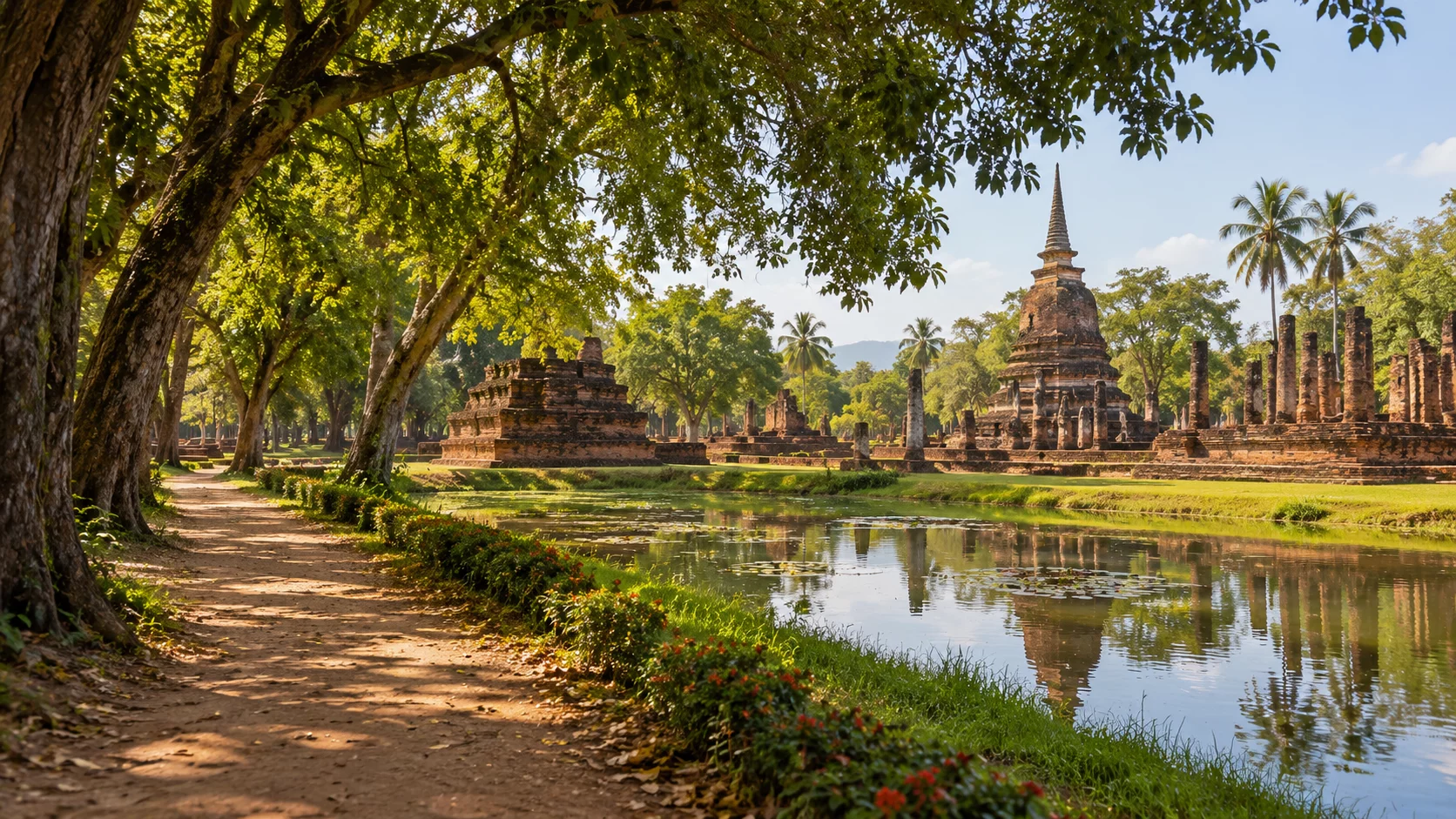
Read water as part of the historic landscape
UNESCO emphasises water management in the historic towns associated with Sukhothai. During a visit, that idea invites you to see water beyond a surface for reflections. Observe an edge, a relationship with a path or the distance water creates between landscape elements. Do not independently infer every visible pond’s ancient function. Use site interpretation or competent cultural accompaniment for that explanation. A broad historical theme can guide attention while leaving specific conclusions open, especially when what you see today also reflects the work of maintaining and presenting a heritage landscape.
Official tourism sources present Wat Sa Si as an ensemble connected with a large body of water in the old centre. If you select it, compare the approach with your previous stop. Look from accessible paths instead of seeking an angle by leaving a permitted passage. Keep two notes: your impression of the landscape and verified historical information. Bringing them together is fruitful; confusing them can turn personal emotion into an explanation sources may not provide. You can appreciate the composition strongly without claiming that every element’s original purpose has become clear to you.
Choose walking, cycling or a transport service
Choose transport from the selected route, current rules and each person’s confidence. A bicycle may be an option to examine rather than an obligation attached to every Sukhothai visit. Check where it is allowed, where to leave it and the terms of the intended hire. Someone who does not want to travel this way should be able to say so before departure. The group gains more from understanding its needs than from selecting a vehicle to reproduce a travel image. A convenient idea for one person is not automatically a comfortable arrangement for everybody.
When comparing options, include stopping, leaving the vehicle and finding belongings again. If booking a service with a driver, clarify route, waiting and meeting point. A quoted price does not by itself explain which part of the outing is included. When walking, prepare a tighter loop instead of copying a programme intended for another mode. These are two ways of organising attention, not two levels of tourism achievement. The meaningful comparison is whether each option lets the chosen people visit the chosen places under conditions they have actually understood and are willing to use.
Prepare an extension to Wat Si Chum
If you want Wat Si Chum, treat the movement beyond the old centre as a second sequence. The provincial presentation describes a large seated Buddha in a building called a mondop. That reference can supply a precise intention: observing a relationship between figure, opening and built space. It guarantees neither entry nor access to every part shown in images. Check actual conditions and how to reach and leave the ensemble before adding the sequence. The purpose is to give a desired visit a workable shape, rather than letting a recognisable image conceal its logistical requirements.
Decide what will be removed if choosing the extension. Adding without replacing can produce a day whose logic is no longer clear. Keep fewer initial stages or reserve the outside ensemble for another visit. The preference depends on your starting question, not a universal rule about essential sights. An acknowledged decision lets you enjoy what you choose without continually calculating everything else you might have seen. You can retain interest in an omitted place without treating it as evidence that the current day has failed or that the group needs to move faster.
Check each sector as a concrete visit
Do not assume confirmed access gives identical conditions throughout all intended spaces. Ask what the selected ticket covers, which passages are open and how to organise movement between sectors. Distinguishing heritage information from service information matters. A page presenting a monument may be reliable about location while not confirming arrangements for your date. Keep the origin of information and check variable elements before paying or travelling. This allows you to benefit from historical material without mistaking a longstanding description for a current answer to a practical question it never addressed.
For preparation, use a small card separating confirmed choices from optional ones. Include the principal sector, selected entrance, transport and return. You do not need approximate numbers to make it appear precise. A clearly recorded question is easier to resolve than a forgotten assumption. If an answer changes on arrival, you can alter a defined stage instead of discovering the whole day depended on an unchecked condition. The card should simplify decision-making, not create another complicated document that demands attention at every stop. A few accurate distinctions are enough to make it useful.
Prepare pauses without promising them everywhere
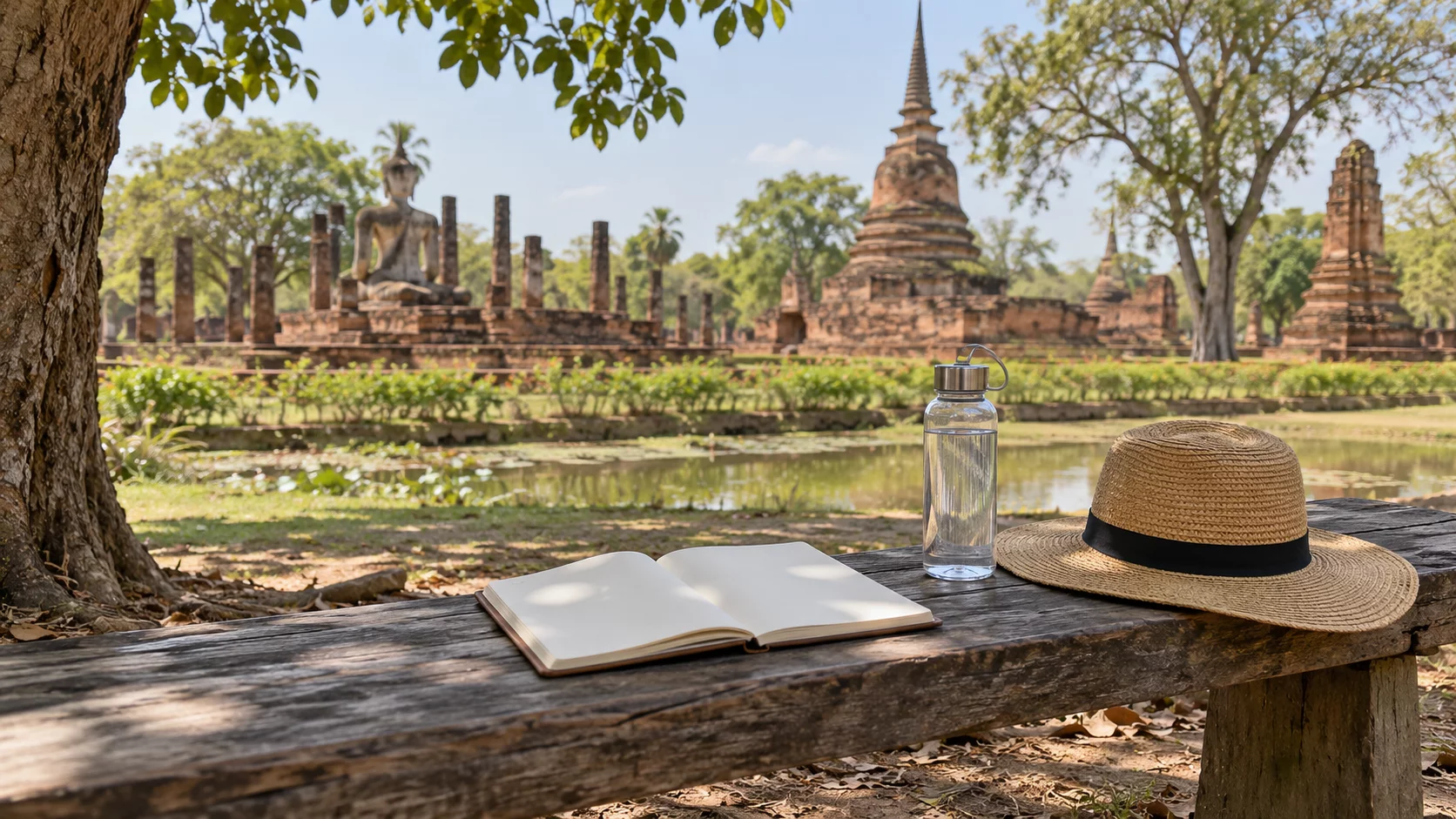
Open space and trees in an image guarantee neither shade at your position nor seating during your visit. Identify where a pause is genuinely possible and prepare simple items you need, such as water, a hat and a notebook. Adapt the choice to the day’s conditions and personal comfort. The goal is not complicated equipment but avoiding reorganising the outing whenever an ordinary need arises. Keep things usable rather than packing so much that every stop requires searching through several layers of belongings to retrieve one object.
During a pause, ask whether the next part still appeals to everyone. Someone may enjoy monuments while no longer wanting the same kind of movement. Hear that signal before irritation replaces observation. Finish the principal loop, change the return method or remove an extension. These are decisions already provided for by a flexible visit. The initial programme does not have more authority than the people it was prepared for. Responding to them preserves the reason for planning: creating a shared opportunity to experience the park, rather than proving that a document can be followed unchanged.
Give the notebook and camera different jobs
A camera can retain an overall view or a relationship between monument and water. A notebook can keep what the image does not explain: route followed, question asked, verified name and reason for a choice. The tools complement each other when neither tries to do everything. An image cannot confirm a circulation rule, while descriptive notes do not replace directly seeing the place. Leave some moments without collecting anything, simply to perceive space and perspective changes. Those moments can later explain why a particular view mattered more to you than another technically better photograph.
This article’s illustrations are AI-generated. They document neither monument conditions on 2 November nor a currently accessible path. For your own photographs, remain in permitted spaces, avoid leaning on remains and let other visitors pass. In captions, separate the place’s name from your proposed interpretation. A feeling of calm belongs to one moment and person; it should not become a promise that another visitor will find identical conditions. Practical information needs its own dated verification. Keeping this distinction makes images more honest without reducing their ability to convey an experience or inspire curiosity.
Share a map when visiting together
Before separating, ensure everyone recognises the meeting point. A monument name may be insufficient if the side or entrance is unspecified. Choose somewhere permitted, identifiable and compatible with the agreed time. Share a plan copy or offline note. This becomes particularly useful when people use different transport or want different amounts of time at an ensemble. You can leave room for individual interests while retaining a clear shared arrangement. Nobody needs to spend the entire visit monitoring messages to discover where the others have moved since the last photograph.
With children, suggest finding a form in the landscape, comparing a view with its map position or drawing the route actually followed. The task must fit boundaries and permitted paths; it is not a race towards a hidden point. For someone with particular mobility requirements, ask about intended passage characteristics rather than assuming large space is easy space. A shared map should make choices visible, not hide different needs behind one route. The same destination may be experienced through different arrangements, provided those arrangements have been checked and understood before people depend on them.
Give associated towns another scale of travel
Si Satchanalai and Kamphaeng Phet can extend curiosity about Sukhothai’s heritage, but that extension is prepared as another outing. Choose which one you want to understand and why. Then investigate its own access, visiting conditions and connections. Do not count it as a missed sector of a park you failed to cover. A UNESCO property’s name expresses a heritage relationship; it does not define the size of a single uninterrupted walk. Understanding that distinction allows the designation to enrich future travel instead of making today’s visit feel permanently incomplete.
Keep a question arising now for later: spatial organisation, relationship with water or the presentation of a monument. It gives a cultural reason to continue without demanding an exhaustive collection. Today, finish with the sector actually selected and the return prepared. Your notebook will retain an understandable route, checked reference points and a reserve of curiosity. These are reusable elements, more useful than a list whose names were all ticked without understanding how they connect in space. The visit can end coherently while still leaving the wider heritage open for another journey.
Sources and checks
UNESCO — Historic Town of Sukhothai and Associated Historic Towns; Tourism Authority of Thailand — Sukhothai Historical Park; Sukhothai Provincial Tourism and Sports Office — historical park. Reference points checked on 31 October 2026. Heritage descriptions do not replace current confirmation of access, times, tickets and transport for your visit.
#Sukhothai #Thailand #Heritage #Travel #MrSchaka
To go further
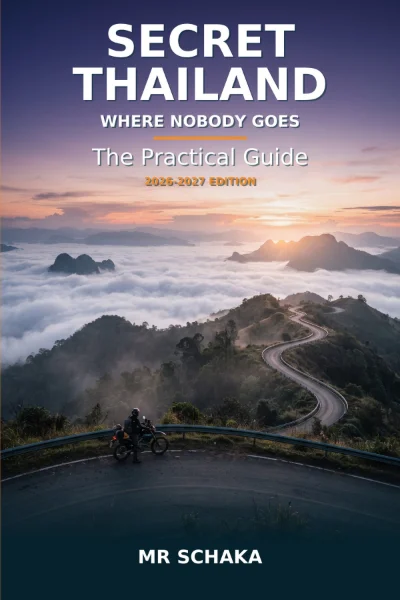
Mr Schaka’s guidebook, Secret Thailand – Where Nobody Goes – The Practical Guide, covers the essentials: transport, neighbourhoods, addresses, food, etiquette and safety, updated for 2026–2027.