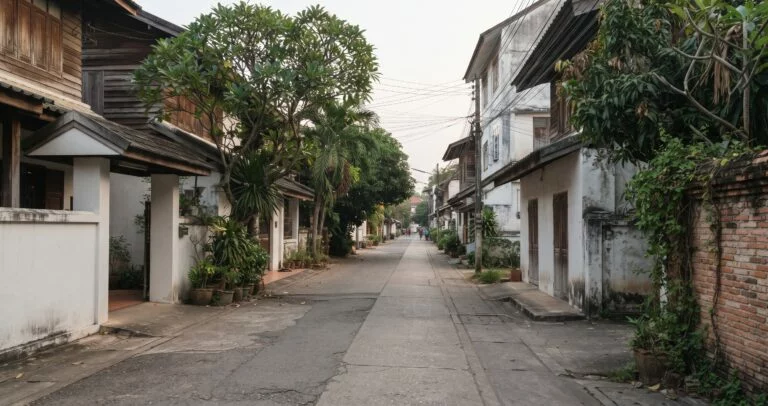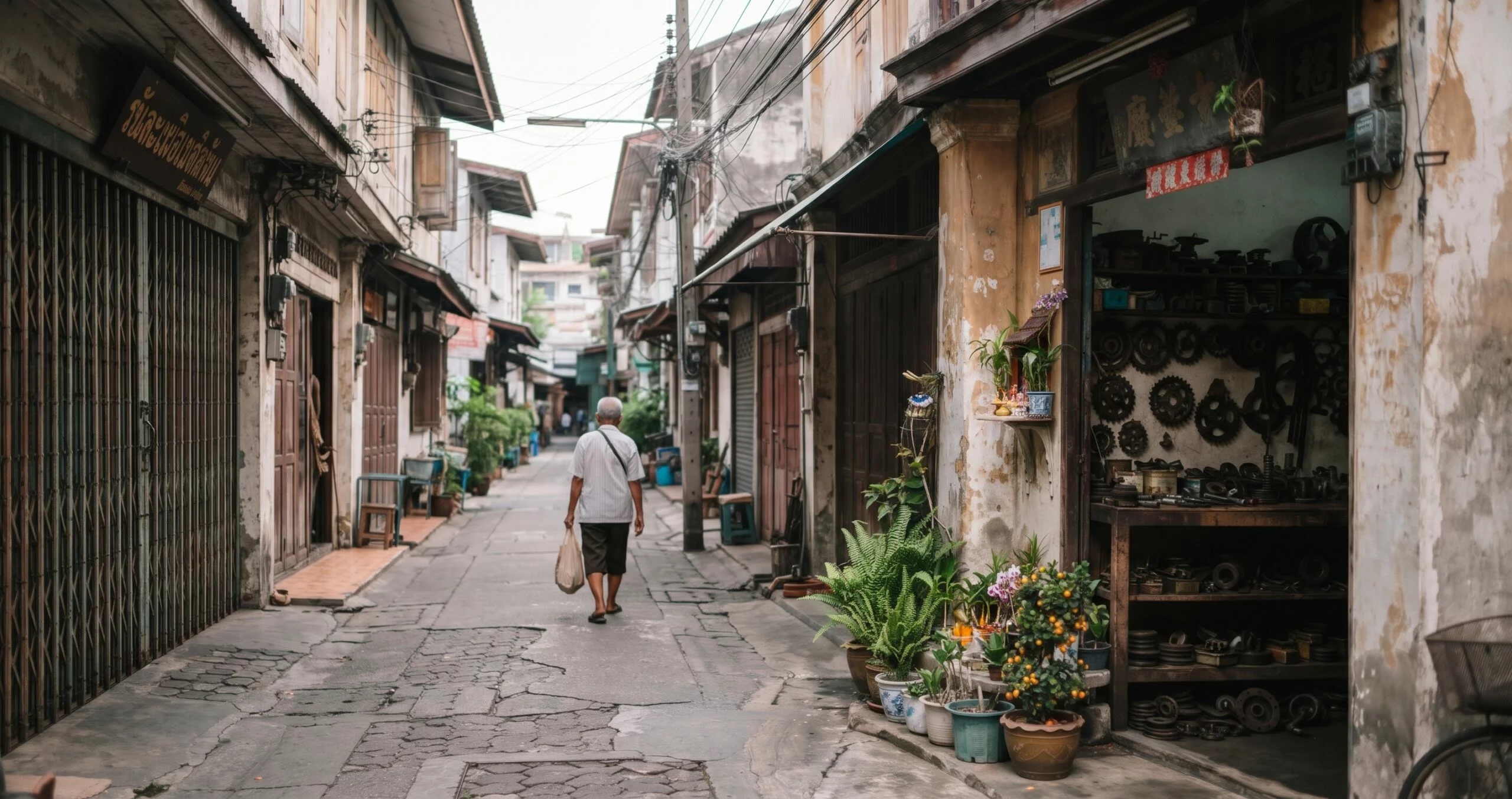
In Talat Noi, the most useful first action is to slow down before raising a camera. A narrow lane may serve a workshop, a home entrance, a delivery route and a visitor trying to find the way. This mixture makes the neighbourhood interesting, but it calls for a different kind of attention from a setting arranged for tourism. The purpose of this walk is not to collect picturesque frontages. It is to understand how work, habitation and memory meet within limited space. You can leave with few photographs and a very precise impression, provided that the places have been given enough time to reveal their differences.
Locate Talat Noi without treating all Chinatown as one walk
Talat Noi lies in Bangkok’s Samphanthawong district. It belongs to an urban fabric whose continuities extend beyond the boundaries of a neighbourhood described in a guide. During preparation, mark the streets and access points you actually intend to use rather than assuming that all of Chinatown forms one obvious route. The name Talat Noi is a starting point for research, not a guarantee that any appealing lane leads towards your destination. An offline map and a clearly identified return point often make exploration more relaxed. You know where to come back to without forcing a rigid line onto every turn or making each detour feel like a mistake.
Follow gestures and the traces they leave
A useful thread is the relationship between objects and actions. Components arranged outside a workshop, a bench visible from the street, a shutter opening or a package being carried provide clues about what happens here. They do not tell the whole history and should not become improvised evidence of an older activity. First observe what is taking place, then distinguish it from what reliable sources explain. This prevents an ordinary metal part from being turned into an oversized symbol. It also recognises present work, which deserves no less attention simply because an imagined past might seem more photogenic to somebody passing through the neighbourhood.
Let the museum give context to the clues
Talad Noi Museum presents the neighbourhood through its history, economy and culture. Its own description recalls the former machine workshop associated with the site, including parts for boats and machinery. That background helps give objects a more precise meaning. A spare part may belong to a chain of repair, exchange or reuse rather than to an attractive collection of old things. Check current information directly before planning to enter the museum. Temporary closure notices have been published, so an older travel article cannot establish that admission will be available on your chosen day. The cultural reference remains useful even when the practical visit needs a separate confirmation.
Understand a workshop without turning it into a performance
When a workshop is open, keep clear of tools, working areas and people moving through it. Work requires concentration, and the arrival of a camera may interrupt that concentration. If someone welcomes a conversation, ask a simple question and let that person decide how much time to give. A walk does not lose its value when no exchange takes place. Observation from public space can be enough, without demanding a demonstration or a personal history. This attitude separates attentive interest from consuming a scene of labour. The neighbourhood should not have to perform its identity in order to confirm the picture a visitor arrived expecting to find.
Worn materials do not necessarily mean abandonment
Weathered metal, old timber and marked plaster naturally attract the eye. Yet a worn surface may belong to somewhere well maintained and actively used. Avoid language that automatically turns patina into ruin or modest surroundings into poverty. The relationship between older material and current activity is more revealing than that shortcut. Look at how components are arranged, circulation kept clear or objects repaired. These are limited observations, but they describe an inhabited environment more honestly than a vague claim that a neighbourhood has remained outside time. Talat Noi belongs to contemporary Bangkok, including the choices, pressures and ordinary practical arrangements that shape the present day.
Know when to make room
Lanes do not always provide generous width for every use. A delivery, a person pushing a trolley or a vehicle may require you to clear the way. Stop somewhere visible, look before stepping backwards and do not assume that a group has priority because it is following a tourist route. A guide or map does not suspend the ordinary workings of the street. When walking together, return to single file where necessary and choose stopping places that can actually accommodate everybody. Attention to movement is not a distraction from discovery. It reveals how carefully everyday activities are negotiated in spaces where several needs have to coexist.
Read doors and thresholds with restraint
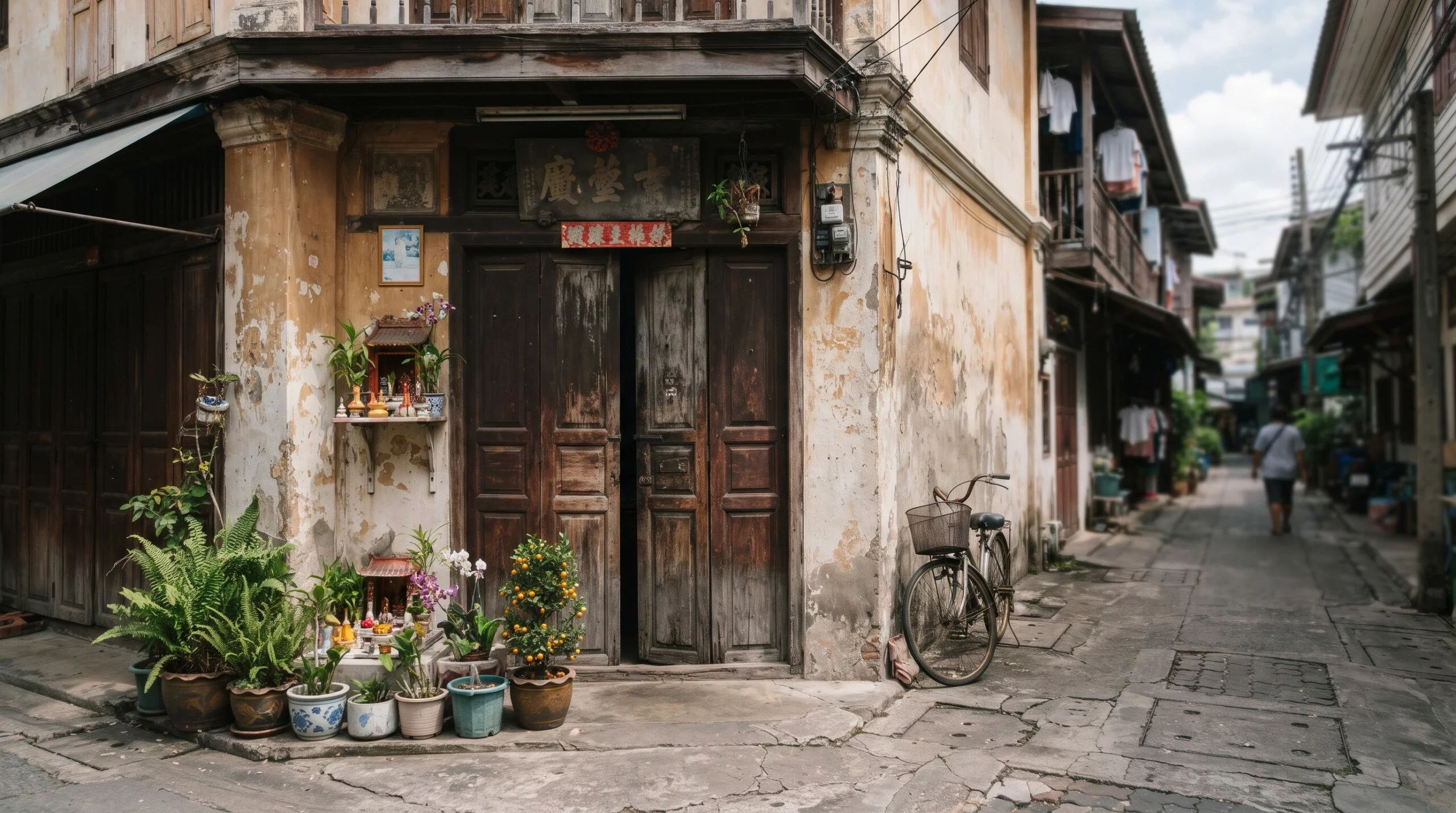
An open door may offer a glimpse of depth, a domestic shrine or a courtyard. Being able to see inside does not grant permission to enter or photograph an interior. Remain outside, look for an explicit welcome and ask when the situation requires it. There is already much to observe in the transition between street and building: a change of surface, a step, a curtain, plants or storage. Such elements show how a boundary can be created without becoming a closed wall. Understanding them makes the neighbourhood more legible. The best photograph is not necessarily the one that crosses the greatest number of private boundaries in search of an unusual view.

The river provides context, not an automatic itinerary
The community’s relationship with the Chao Phraya appears in resources about its history and activities. It encourages a view of exchange, movement and work that reaches beyond the streets immediately visible. It does not mean that every opening between buildings leads to a public waterfront promenade. Piers have functions, conditions and boundaries of their own. If a river service is part of your day, verify the actual departure point and current operation with the operator. The river can deepen an understanding of the neighbourhood without becoming a promise of a journey that has not been checked. Cultural geography and practical transport planning are related, but they are not interchangeable.
A place of worship is more than a decorative subject
Places of worship mentioned in neighbourhood guides call for more than architectural attention. Before examining a detail or taking a picture, observe instructions and the activity taking place. Somebody praying is not an available photographic subject simply because the building receives visitors. Dress appropriately, keep your voice low and allow practices to continue without interruption. When a rule is unfamiliar, asking is better than copying a gesture seen somewhere else. Local resources can explain the significance of a shrine without reducing different traditions to a single general image of Thai spirituality. Respect begins with recognising that the meaning of a place does not depend on the visitor’s interest in it.
Notice change without inventing a simple opposition
Cafés, cultural spaces and visitors can alter how a street is used. That change does not need to be described as a struggle between an automatically authentic past and an automatically artificial present. A recent business may participate in local life, while an old building may have accommodated several different functions. For the walk, it is more useful to notice coexistence and ask specific questions. Where can someone pause? Who needs to move through? What kind of welcome is actually offered? Such questions make transformation visible without pretending to speak for residents about the future they want or assigning the same opinion to an entire community.
Choose a café for an actual pause
A café can provide a useful rest, but its value should not be measured only by photographic opportunities. Read the menu, admission conditions and any guidance about pictures before settling in. A small order does not permit blocking access, moving furniture or monopolising a table for a portrait session. If the room or terrace is full, change plans without deciding that the neighbourhood visit has lost its purpose. A pause can remain straightforward: have a drink, recover your bearings and choose what to do next. The place will continue to exist even when you leave without owning a photograph from a fashionable establishment or reproducing the view most often shared online.
Give objects the context they deserve
To describe a material through a photograph, include a little of its setting: the edge of a workbench, an opening towards the street or the arrangement of a shelf. An isolated close view may be attractive but can easily erase an object’s function. Do not touch, move or clean a component to improve the frame. Avoid presenting a reproduced street artwork as your own creation, and follow the rules of any venue you enter. Before sharing, check for people, documents or private information that the image may reveal. Good urban photography depends as much on what you choose to leave out as on what you decide to show others.
Heat changes the amount of attention available
A Bangkok walk should account for the body even when distances look short on a map. Heat, humidity, noise and the concentration required by unfamiliar streets may tire someone faster than a much longer quiet route. Carry what allows you to drink regularly, choose suitable pauses and shorten the loop when necessary. There is no need to set a performance target or promise an ideal hour valid on every day. Consider the actual conditions and the people walking with you. A short, attentive visit often leaves more useful memories than continuing after details have stopped registering, merely so that the entire planned route can be claimed as completed.
Let rain make the programme smaller
A shower can change surfaces, circulation and the ability to stop comfortably. Prepare a reduced version of the walk rather than assuming that any interior will welcome visitors without conditions. A workshop is not a tourist shelter, and a home’s entrance is not a collective waiting area. If a public venue offers refuge, follow its rules and leave access clear. In the lanes, watch where water gathers and adapt the pace accordingly. The neighbourhood does not become less interesting because the day’s route is shorter. It is being observed in different conditions, and responding to those conditions is part of paying attention rather than a failure to keep a promise.
With a child, follow one simple transformation
A family can choose a concrete subject: how might a worn component be sorted, stored or repaired? The aim is not to handle objects or request a demonstration, but to learn to notice organisation. Compare a shiny surface with a weathered one, a closed shutter with an active business, or a narrow lane with a more open space. Keep instructions limited so that a child can also notice something independently. A notebook with three observations may be enough. Curiosity works best when it remains compatible with the neighbourhood’s boundaries and the group’s energy, instead of becoming an ambitious lesson that demands attention long after interest has naturally faded.
Prepare accessibility through precise questions
Nearby points on a map reveal little about steps, thresholds, surfaces or available width. If these affect your journey, ask about the specific access points before setting out. A general answer about Bangkok, or even about the neighbourhood, cannot replace checking an actual entrance. Explain the requirement and prepare a suitable meeting or transport pickup point. Deciding against a narrow passage on arrival does not mean abandoning Talat Noi. Careful observation from selected spaces, supported where possible by an accessible cultural resource, can provide a rich understanding without multiplying difficulties. The value of a visit should not depend on overcoming obstacles that could have been avoided through better information.
Read the dates attached to online advice
Travel features often combine lasting background with exhibitions, events or addresses described at the moment of publication. Read the date and separate these categories. An older official presentation can illuminate a neighbourhood without confirming a current appointment. Do not turn a past exhibition into a permanent attraction or a market announcement for a particular calendar into a guaranteed event on the day of your visit. Consult organisers directly when that information matters to the outing. This kind of reading does not remove the pleasure of preparation. It simply prevents an expectation being built around something that belonged to another moment and was never intended as an enduring practical promise.
Allow purchases without forcing a personal encounter
Buying something can support an activity you value, but it is not an obligation that justifies your presence. When you do want to buy, ask the price clearly, accept the business’s conditions and understand what is being offered. Do not automatically assign handmade origins or heritage value to an object because its surroundings look old. Conversation may provide useful information without requiring a seller’s intimate life story. The relationship remains more balanced when each person retains a choice about the exchange. A neighbourhood can be appreciated without turning its residents into suppliers of an authenticity that someone else has decided must be available as part of the visitor experience.
Illustrations accompany the article; they do not prove it
The three images accompanying this article were generated with Gemini using artificial intelligence. They evoke a lane, a workshop and a frontage compatible with the intended atmosphere, but they are not documentary photographs of identified businesses. They cannot establish an address, an opening or the present location of an object. Captions make that distinction explicit. Official sources and information from the community remain necessary when preparing precise access or investigating a specific local history. An illustration can invite someone into a subject without becoming testimony from a walk that has actually taken place. Keeping that boundary clear is part of treating both the reader and the neighbourhood fairly.
Gather what the walk has changed
At the end, ask a modest question: do you now look at a component, a doorway or a passage differently from when you arrived? If so, the walk has already achieved something. Record an observation, a confirmed piece of information and a question that remains open. Keeping those categories distinct prevents a felt atmosphere from becoming confused with historical knowledge. There is no need to conclude on behalf of every resident or predict the neighbourhood’s future. A personal discovery remains interesting when it acknowledges its own scale and leaves others free to have different uses, memories, concerns and expectations within the same streets and buildings.
Leave without removing the place’s living character
Before leaving Talat Noi, confirm the return journey and allow one final reading of the route. What you crossed was not simply a collection of remarkable points. It was an environment of work, homes, culture and movement. That combination asks for unobtrusive choices, from stepping aside for a delivery to deciding not to photograph an interior. It also makes the visit more memorable. What remains may not be the most spectacular image, but a stronger attention to the way ordinary gestures give a particular depth to one part of Bangkok. Such attention can travel with you into other neighbourhoods, without assuming that their stories or boundaries will be exactly the same.
Sources for preparing your visit
- Talad Noi Museum — site officiel et actualités
- Tourism Authority of Thailand — 1 day in Talat Noi, 30 January 2025
- Treasury Department — Talad Noi Museum

To go further
Mr Schaka’s guidebook, Bangkok – The Practical Guide, covers the essentials: transport, neighbourhoods, addresses, food, etiquette and safety, updated for 2026–2027.