A city that rewards an unhurried look
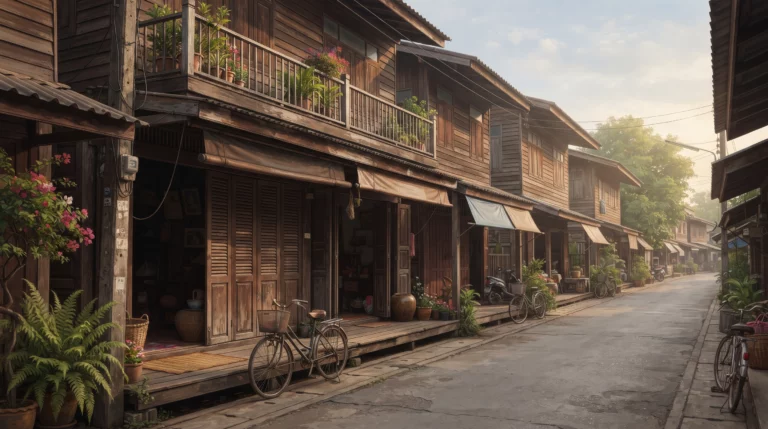
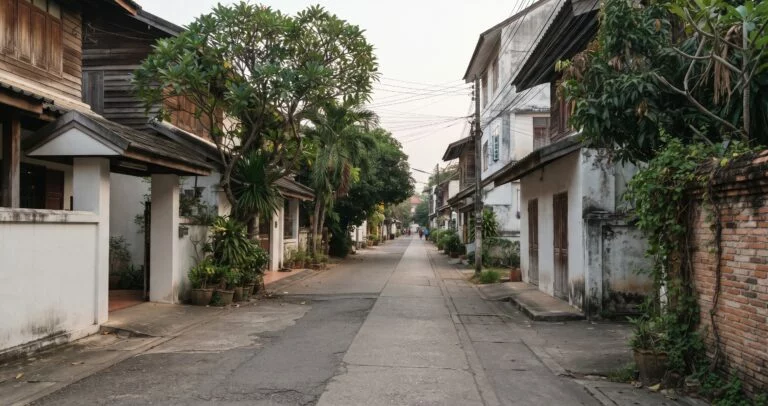
Lampang can be approached through a street rather than a programme. A wooden façade, the space beneath a gallery, an open shop entrance and changing light on a wall already provide enough to observe. This does not mean ignoring familiar attractions. It means allowing the trading neighbourhood to establish a rhythm of its own instead of treating it as a corridor between monuments. Choose a few features and, if convenient, retrace a short section to notice what escaped the first glance. Interest often emerges on that second passage. A detail stops being an isolated curiosity and becomes part of a sequence of buildings, activities and thresholds whose relationships are easier to read. The visit acquires shape without needing a succession of spectacular discoveries to justify the time spent there.
Locate the neighbourhood before explaining its history
Tourism Authority of Thailand resources describe Kad Kong Ta as an older trading area in Lampang, close to the Wang River and Ratsadaphisek Bridge. They emphasise the varied influences visible in its architecture. These points help orient a visit without assigning a precise origin to every façade encountered. The present street cannot be reduced to one period or a single community. Recent changes may coexist with older elements, while a shop may occupy a building whose function has shifted. Before describing a particular house, seek information specific to it rather than relying on a rapid deduction from appearance. The general historical frame explains why looking is worthwhile; it does not remove the need to identify what you are looking at or to acknowledge when identification remains uncertain.
Distinguish the district from its busy market
An old trading neighbourhood exists beyond its busiest moments. Official pages distinguish exploring the area from the activity associated with its weekend walking street. The publication date or hour of this article is therefore not an opening announcement. If stalls or entertainment motivate your visit, check current information with organisers or the tourist information service. A quieter period can offer another way to examine façades and their relationship with the street. Neither the empty street nor the lively market alone summarises the place. They reveal different uses of the same environment. Deciding what you want to experience prevents an expectation of permanent activity where events follow their own calendar and conditions, and makes a modest visit less likely to be judged against an outing that was never actually available that day.
Take the façade as a starting point
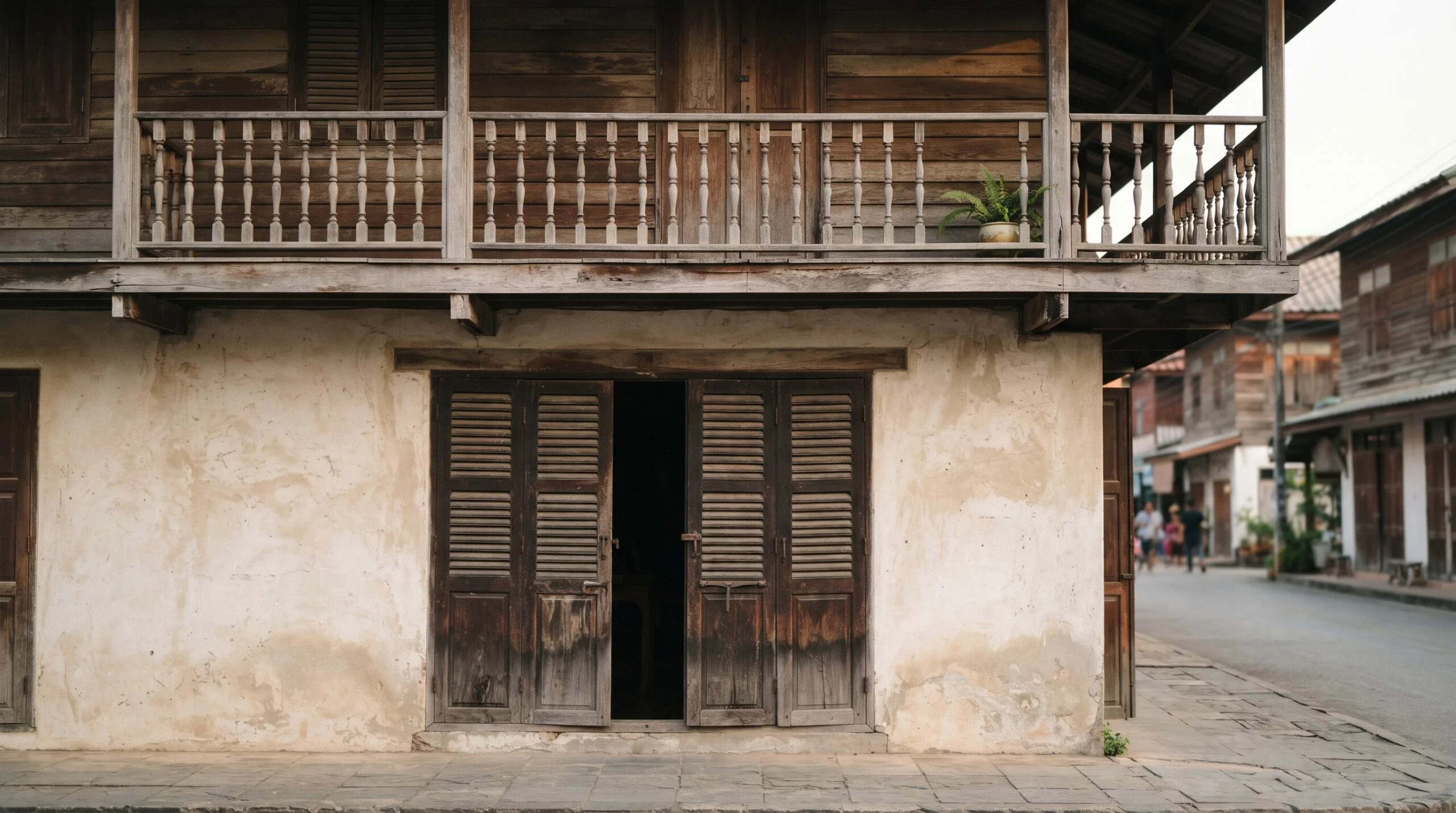
A façade can be read in layers. Begin with the overall volume, then notice its gallery, openings, protective features and relationship with the ground floor. Decoration can attract attention so quickly that the organisation of the building disappears behind it. Yet the width of a passage or depth of an overhang may reveal more about potential uses than a striking ornament. You do not need to make an architectural diagnosis from the pavement. Simply describe what distinguishes two neighbouring houses and consider what connects them. Careful observation remains useful without specialised vocabulary. Saying that an upper floor sits behind a gallery is more informative than listing uncertain style names. It also leaves room to check an interpretation afterwards instead of making confidence a substitute for evidence on the spot.
Follow materials through the light
Wood, masonry and plaster respond differently to light. Looking at a corner from the front and then slightly from one side can reveal texture, repair or depth that initially went unnoticed. Weathered timber should not automatically become evidence of an untouched past. It may have been replaced, treated or combined with recent components. Differences in colour suggest questions rather than answering them alone. When recording an impression, note relationships between materials instead of merely calling a house old. A base, shutter and gallery can form an interesting whole precisely because they do not all represent the same moment of change. Attention to their connection produces a richer memory than an attractive surface described without any attempt to understand the practical structure supporting it.
See a threshold as a working space
Between street and interior, a threshold organises exchange. It may hold an activity, protect goods or allow movement into a depth the visitor cannot see. Observing this edge requires respect for its present purpose. An open door does not authorise entry, and a display is not a convenient support for a camera bag. Part of the neighbourhood’s interest lies in these modest places where building history meets a current use. You can notice how a business occupies its frontage without claiming to know the proprietor’s family story. If somebody chooses to explain an activity, listen to the particular account they offer. It should not be turned into a general portrait of everyone in the district, nor treated as a complete explanation of the building in which the conversation happens.
Allow mixtures without inventing labels
The architectural variety mentioned in official descriptions of Kad Kong Ta suggests how exchange can leave multiple traces. It does not mean every feature immediately identifies a cultural influence. Forms travel, acquire new uses and may be reinterpreted long after first appearing. A visit benefits from retaining that complexity. Rather than distribute labels with confidence, look for information provided locally and separate documented explanations from features that merely look familiar. This avoids reducing encounters between people and techniques to a catalogue of decorative motifs. It also opens more productive questions. How does a house combine several uses? Which elements still help make those uses possible? A practical relationship can sometimes explain more about an occupied building than an uncertain classification based only on a short view from the street.
Connect the street with the river
The nearby Wang helps place the trading quarter within a larger setting than its line of façades. A map can clarify that relationship, but a river view alone does not prove a particular building’s former role. Keep the scales distinct: district, street and house. Changing viewpoint during a visit may reveal an orientation or distance hidden by the succession of shopfronts. This does not require extending the outing indefinitely. A short movement followed by a return to the street can be enough to reorganise its meaning. The neighbourhood ceases to be a series of old objects and becomes a place connected to landscape and circulation. That understanding can remain modest and still be valuable, without requiring a detailed reconstruction of historical trading patterns that your available sources do not establish.
Choose a few details and compare them
To avoid the fatigue of endless observation, select three elements to compare from house to house. Shutters, protection from sunlight and the way a ground floor opens provide an accessible starting point. At each pause, ask what changes, what stays similar and what becomes easier to see through that comparison. This gives looking a structure without enclosing the visit inside an academic grid. It also helps prevent photographing the same effect repeatedly. After several buildings, stop and summarise what has emerged. There is no requirement to reach a conclusion about the whole city. A partial discovery already becomes productive when it identifies relationships rather than simply collecting resemblances. Comparisons can reveal variations that an isolated photograph misses, while keeping the scope of your observations clear and manageable.
Let shops retain their own rhythm
A business is not a permanent exhibition merely because it occupies a heritage street. Visitors may arrive during a delivery, stock arrangement or concentrated work. Avoid blocking an entrance for a photograph, ask before photographing an interior and move when someone needs access. A conversation may begin with an object, but it is not owed to the visitor. Accepting a brief answer or somebody’s lack of time keeps the encounter in proportion. If you buy something, choose it for its use or visible qualities without manufacturing an authenticity story that nobody has explained. Respect for commercial rhythm belongs to understanding the district. It recognises that the street’s appeal comes partly from activities continuing there, rather than expecting those activities to stop whenever a traveller wants an uninterrupted view.
Look at ceramics as objects
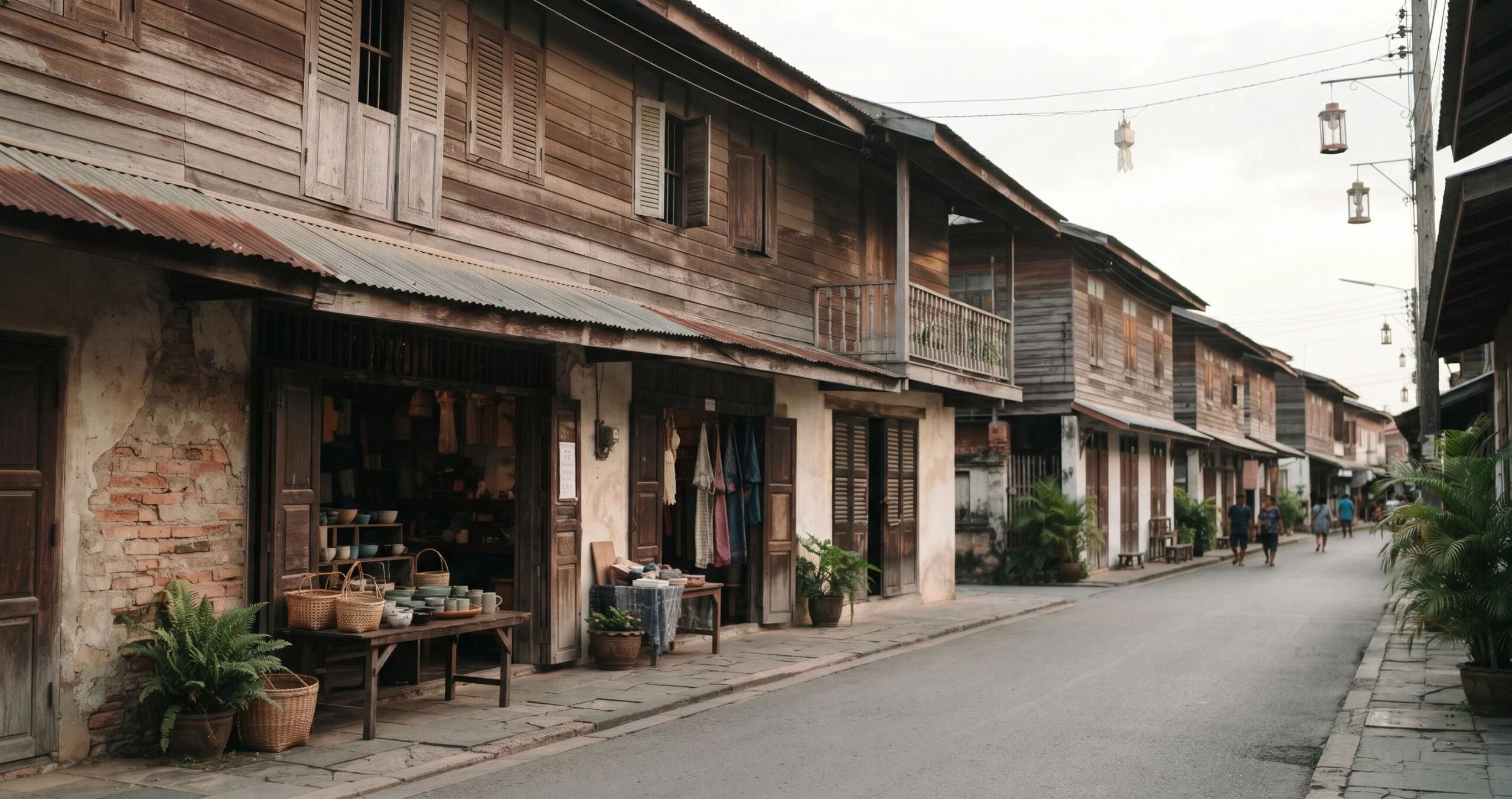
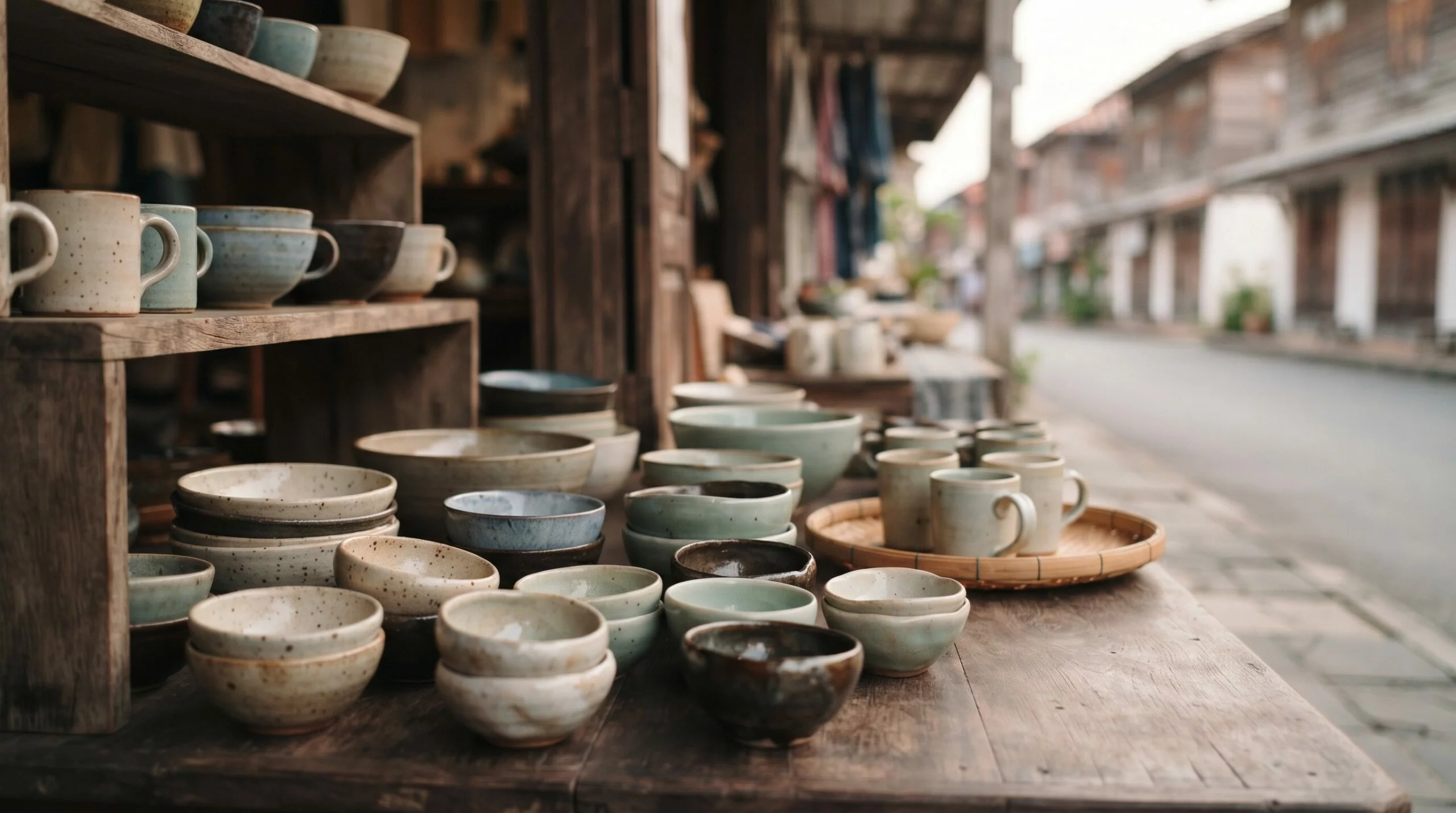
Tourism descriptions of Lampang give ceramics an important place. That encourages attention to bowls, cups and available forms without establishing the precise origin of every displayed piece. When considering a purchase, ask about manufacture, material and intended use rather than relying only on decoration. Weight, rim, grip and stability also shape the encounter with an object. A piece can be chosen for everyday service instead of being asked to represent an entire region. When information is unavailable, preserve that limit in your account rather than turn an ordinary souvenir into certified craft evidence. Enjoyment does not depend on an added legend. Sometimes a well-balanced bowl whose purpose is understood offers a more lasting connection with a visit than a complicated story attached after purchase to justify bringing it home.
Begin a purchase with a real need
Before examining a group of bowls, consider what you would actually like to take home. A table object, a small gift and the memory of a conversation involve different criteria. Checking dimensions, transport conditions and usage advice can prevent disappointment after the journey. For a fragile purchase, wrapping matters as much as appearance. It is equally reasonable to buy nothing when nothing fits. Appreciation of a shop’s work should not be measured by the number of bags carried away. Respectful looking, a relevant question and a polite decision leave both parties room to choose. That freedom makes an eventual purchase more consistent with what you genuinely want to keep, instead of allowing the pressure to acquire a souvenir to determine both the object and the meaning later assigned to it.
Photograph relationships rather than trophies
A street view, a façade detail and an object can describe three complementary scales. Multiplying photographs without intention may produce interchangeable images. Before using the camera, decide what matters: gallery depth, light on shutters or the relationship between a display and the passage beside it. Keeping some context gives a detail its place. Conversely, a tight composition can show a material effectively, provided it is not made to carry historical information absent from the frame. Readers should understand what is visible and what is merely suggested. A precise caption is more useful than language that turns every photograph into an extraordinary discovery regardless of the observation behind it. This is not a demand for technical perfection, but for a clear connection between the reason for looking and the image eventually shared.
Understand what the illustrations do
The images accompanying this article were generated with artificial intelligence. They evoke an older street, a façade and ceramics within the context of Lampang. They are neither architectural surveys nor proof of a shop’s condition on a particular date. Their captions maintain that distinction. Do not use them to announce that a named workshop exists, that a particular object was made locally or that a business will be open. Transparency still leaves the images a useful role: inviting attention to materials and relationships of scale. Practical information and specific identifications require appropriate evidence. The same care applies when a personal photograph replaces an illustration. Its context should remain accurate, and its attractive appearance should not be used to support claims that were never confirmed during the actual visit.
Plan pauses and a workable return
The appeal of a street does not remove ordinary travel needs. Heat, circulation, finding a starting point and sustained concentration can all be tiring. Allowing a pause and a margin for the return prevents the final buildings from being seen in a rush. In a group, discussing preferred rhythm can reduce friction between someone photographing every detail and someone who wants to keep moving. Accessibility must be considered through specific conditions rather than a general impression of an easy small city. Surfaces, steps and places to stop vary between sections. Such preparation does not weigh down the discovery. It frees the available time for something worth attention instead of avoidable practical difficulties, and permits a shorter outing to remain satisfying rather than feel like an unfinished version of an unrealistic plan.
Review notes without filling gaps at random
Afterwards, a few lines help preserve the most precise observations. A difference between two façades, a question asked in a shop and a relationship understood with the river provide enough to begin. You can then verify a name or historical detail. Research supplements the walk without transforming it into an all-knowing experience. If an origin has not been confirmed, do not present it as established in a shared account. Images and notes can remain interesting while retaining their limits. They then reveal a process of discovery rather than a voice claiming complete knowledge. This also provides a useful basis for a return visit: unanswered questions become directions to pursue, instead of being replaced by plausible but invented answers that make the first account sound smoother at the expense of accuracy.
What remains from Lampang
A visit to the trading quarter may leave less of a site list than a new attentiveness to buildings still in use. Behind the phrase old houses are maintained materials, working thresholds and activities that continue. Lampang gains little from being confined to the idea of a city stopped in time. Its interest emerges through the coexistence of traces and present uses. Taking that understanding away can change how another street appears elsewhere, even near home. You begin to notice what is repaired, transformed and still useful. A memory does not need spectacle to last. It can rest in a relationship that has become readable between a façade, an activity and the person willing to spend time looking, without needing to turn that single observation into an explanation of the entire city.
Sources for planning the visit
- Tourism Authority of Thailand — Kat Kong Ta
- Tourism Authority of Thailand — Lampang
- Thailand Tourism Directory — Kong Ta Night Market

To go further
Mr Schaka’s guidebook, Chiang Mai and the North – The Practical Guide, covers the essentials: transport, neighbourhoods, addresses, food, etiquette and safety, updated for 2026–2027.