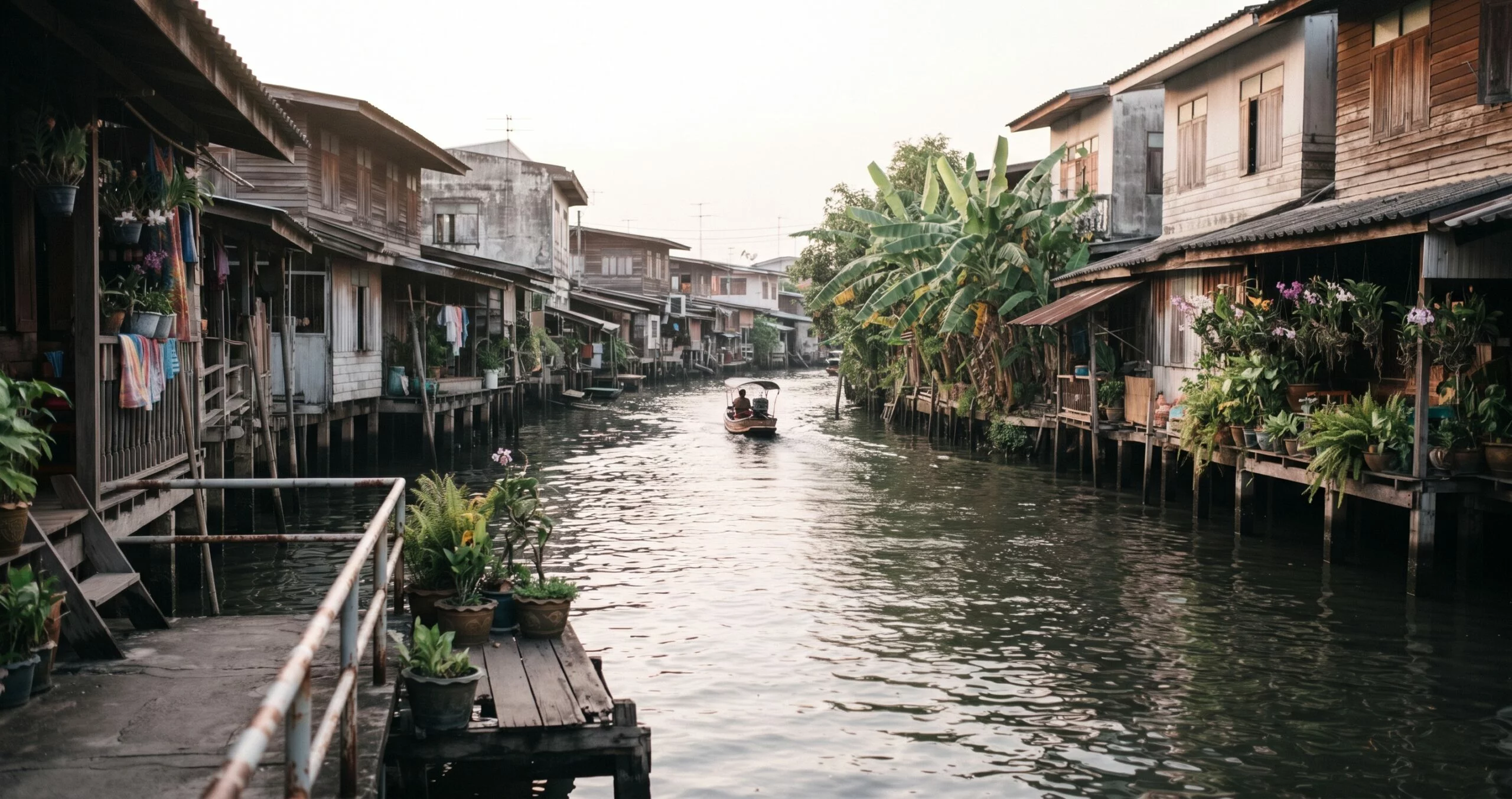
Begin with a different idea of a canal
In Bangkok, a canal can initially seem like a line on a map, a boat journey or a promise of scenery unlike the streets around your hotel. On the Thonburi side, it offers another possibility: noticing how homes, activities and movement relate to water. The subject is not simply a sequence of attractive façades. It is the relationship between a doorstep and a landing, a gallery and a garden, or a bank and the work needed to maintain it. That approach changes the visit. Instead of waiting for a spectacular scene, you can recognise why an ordinary detail deserves attention. The canal becomes an inhabited water street, with private spaces, practical limitations and visible changes, rather than a decorative channel arranged for the visitor.
Use the name without flattening the neighbourhoods
Travel writing often uses Thonburi broadly for Bangkok’s western side and its neighbourhoods. That convenience should not suggest a single uniform district or a network that can be explored in one effortless sweep. Different canals, residential areas, roads and administrative districts form an extensive urban territory. Before setting out, locating the particular place you want to reach is more useful than memorising a broad label. The name of a canal or a destination lets you ask a specific question locally. It also helps distinguish a riverside walk, a crossing of the Chao Phraya and a privately arranged canal excursion. These experiences can complement one another, but they do not provide the same access, the same viewpoints or the same understanding of what lies between the places you see.
Consider what the water connects
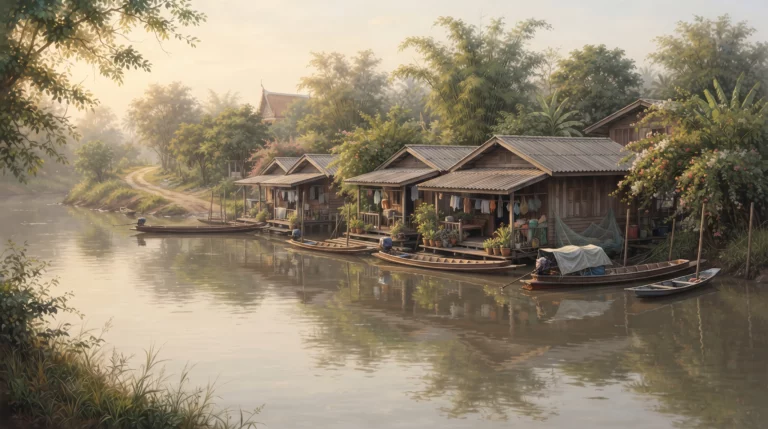
Tourism Authority of Thailand material presents Khlong Bang Luang as a place where traditional waterside housing contributes to an understanding of Bangkok. That gives a starting point without making every house an unchanged survival from the past. Buildings change function, materials are replaced and different uses overlap. Looking at their relationship with water is often more revealing than trying to date a façade from a passing boat. Does a stair lead towards a small landing? Do pots define a domestic edge? Is an opening directed towards the bank rather than the road? Such questions produce observations you can actually support. They avoid attaching historical labels to buildings when neither the view nor the information available is enough to establish their age or original purpose.
Choose one question for your outing
A visit gains depth when it follows a simple question. You might consider how a home adapts to the water’s edge, how different forms of movement meet or how building materials weather in this setting. A question is not a rigid programme. It provides a thread when several scenes compete for attention. Notice three details and consider what connects them: a shelter, a step, a mooring line, a planter or a protective barrier. The method works during a short visit as well as a longer one. It gives coherence to a handful of observations instead of demanding an exhausting list of stops. You leave with an idea you have developed, even if you have explored only a small part of a much larger area.
Read a façade with restraint
Weathered wood readily attracts attention, but a façade cannot tell you everything about the people living behind it. A gallery may provide shade, serve as circulation space or answer several needs accumulated over time. A visible repair indicates maintenance, not necessarily a lack of resources. New materials may improve a building’s use without erasing every connection to its past. Description is usually more reliable than immediate interpretation. You can describe boards, railings, plants and the direction of shade. Assigning a profession, family tradition or precise age requires further evidence. Restraint does not make the visit less interesting. It encourages closer attention by separating what you observe, what a reliable source explains and what remains a possibility rather than a demonstrated fact.
Recognise the boundary of looking
Canals sometimes bring a visitor surprisingly close to someone’s home. An open window or a terrace within view is not an invitation to inspect a private life. Keep visual distance, lower the camera when somebody is occupied and avoid lingering over domestic scenes. Ask before making a portrait and accept a refusal without trying to negotiate it away. Even an image without a recognisable face may disclose something private. You can preserve an impression through a reflection, a material or the relationship between two structures instead. The strongest image is not always the one that reveals the most. It may be the one that retains enough context to make sense while allowing residents to decide what, if anything, they wish to share with a passing stranger.
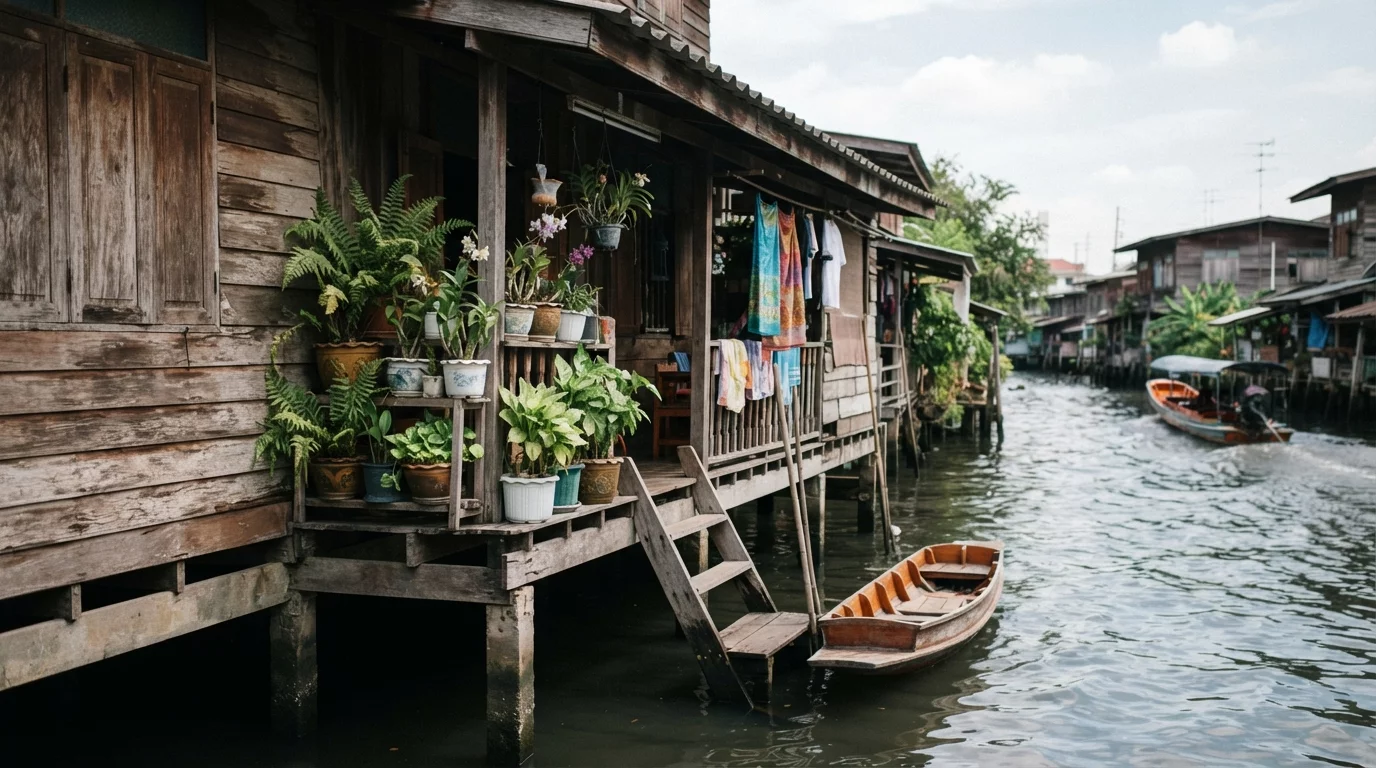
Notice plants and small adjustments
Potted plants, lightweight coverings and objects beside a threshold can reveal everyday adjustments to limited space. Their interest is not that they form an exotic collection. It lies in the way they help organise a working environment. A pot may define an edge, a cover may provide shade and a shelf may use depth that would otherwise be wasted. These are individual observations, not a basis for describing every household in the neighbourhood. They nevertheless encourage you to see buildings as living arrangements rather than scenery. Understanding these solutions can require more patience than admiring a large façade. Follow the edges, consider possible uses and accept that some of the practical relationships will remain beyond what a brief view from public space can explain.
Distinguish the river from the canals
Crossing the Chao Phraya and exploring a canal involve different arrangements. A river transport service does not automatically become a neighbourhood excursion, while a private outing is not the same as a scheduled public journey. Before paying, establish the departure point, destination, stops and kind of service being offered. Asking somebody to show the route on a map can prevent confusion between a place name and a commercial package. Work out the return before leaving as well. A landing seen along the way is not necessarily available for your own return journey. Clarifying these practical details frees attention later: you can observe what surrounds you rather than spend the whole outing trying to resolve a basic uncertainty about where you will finish.
Agree clearly on a boat outing
For a private service, duration alone does not define what you are buying. Understand whether stops are included, whether the boat waits, where the outing ends and what happens if a passage cannot be used. Price and arrangements should be clear before boarding. This need not become a theatrical negotiation. A calm conversation and an agreement both sides understand are more useful than an extended discussion of an attractive but vague promise. Examine the available equipment and the operator’s instructions too. Do not infer a safety rule from a photograph or from another passenger’s behaviour. If an essential point remains unclear, choosing a more understandable arrangement is a reasonable way to protect the quality of the visit rather than a failure to be adventurous.
Watch movement instead of collecting views
From a boat, scenes appear and disappear quickly. Trying to capture all of them can make an experience more mechanical than memorable. Another approach is to follow one changing feature: a transition from dense construction to more vegetation, the height of thresholds or the distribution of materials. A short note after the journey may preserve that progression better than dozens of images. Movement also reveals distances between elements that photography separates. Two façades next to one another in an album might belong to different stages of the outing. Keeping that context prevents an imaginary neighbourhood from being assembled later. The memory becomes a reading of connections and interruptions, rather than an inventory of pictures whose relationship has been lost in the effort to photograph everything.
Do not assume a continuous waterside walk
A visible bank is not necessarily a public path. Routes may stop, narrow or join a road. Before extending a walk, check that the passage is accessible and respects private boundaries. A map may suggest that two points are close without showing a fence, a level change or a temporary obstruction. When planning for somebody with particular mobility requirements, practical details matter more than a general impression of ease: steps, surfaces, room to pass, resting places and a workable return. This article therefore does not promise a verified itinerary. It offers a way to choose a visit and frame the questions needed before deciding its sequence. A shorter route whose conditions are understood can be much more satisfying than an ambitious line drawn through uncertain access.
Make room for sounds and smells
A canal is not experienced only through its appearance. An engine fading into the distance, voices exchanged across water, a moved object or a sudden quiet interval can alter the perception of space. Smells also vary from one location to another. There is no need to turn them into a judgement about an entire neighbourhood. Recording them as situated impressions produces a more accurate description. Compare a busy stretch with a quieter one without declaring either representative of all Bangkok. Sensory attention creates room for pauses as well. Briefly stop hunting for a composition and you may notice relationships the camera cannot reproduce: rhythm, waiting, distance and the direction in which different activities are oriented around the water.
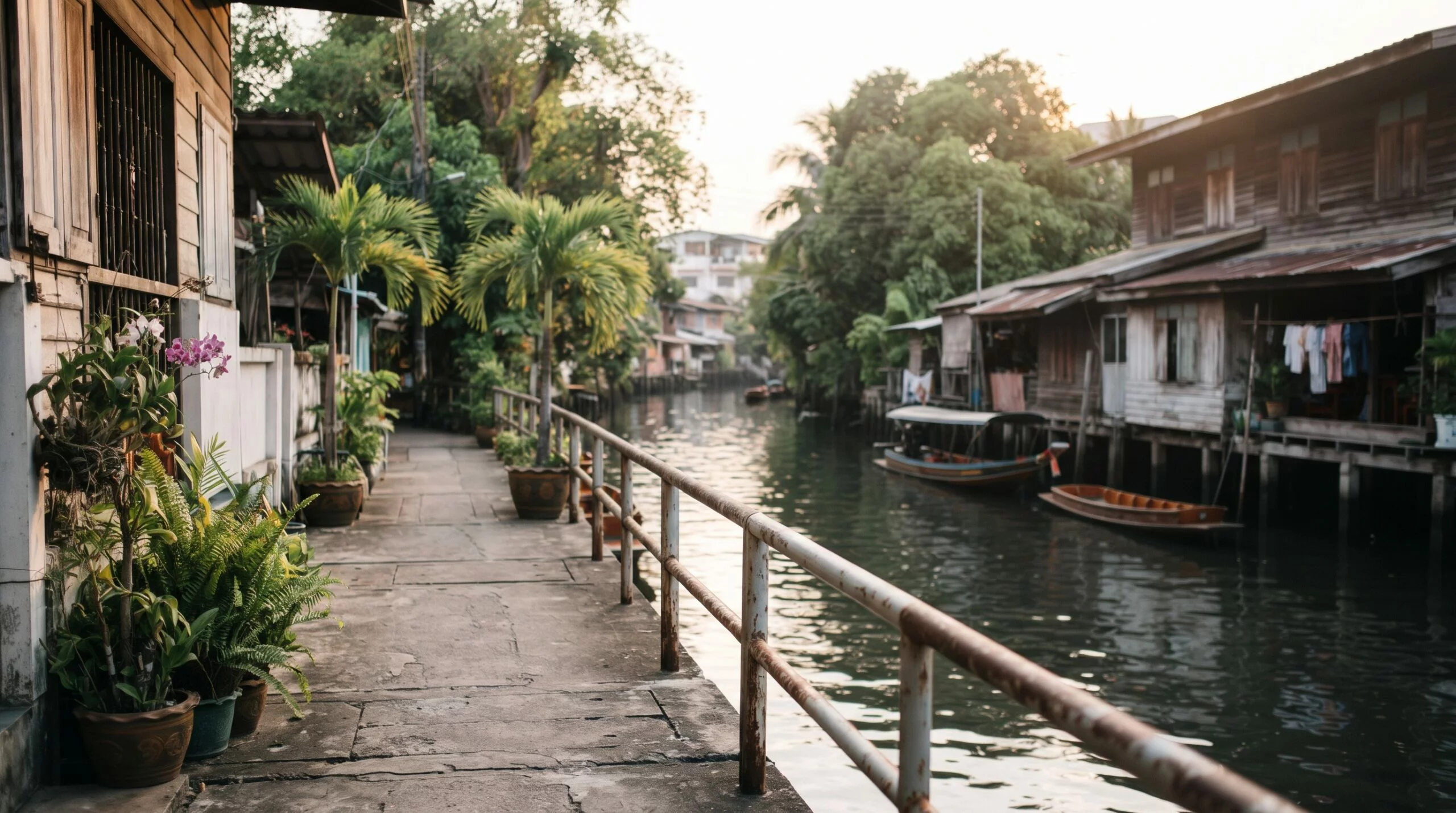
Photograph without manufacturing a story
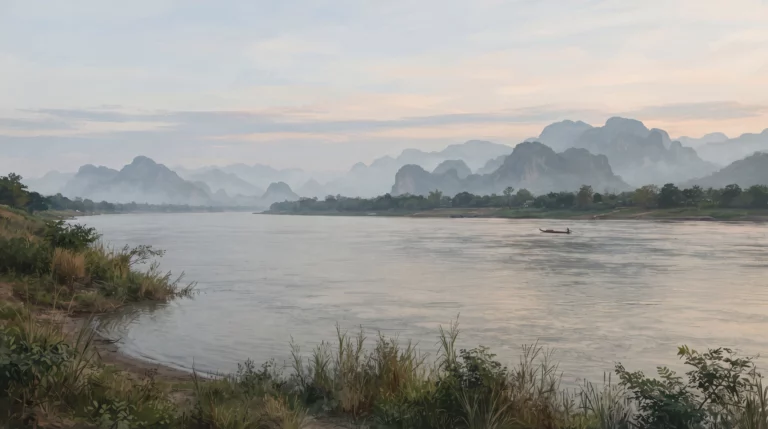
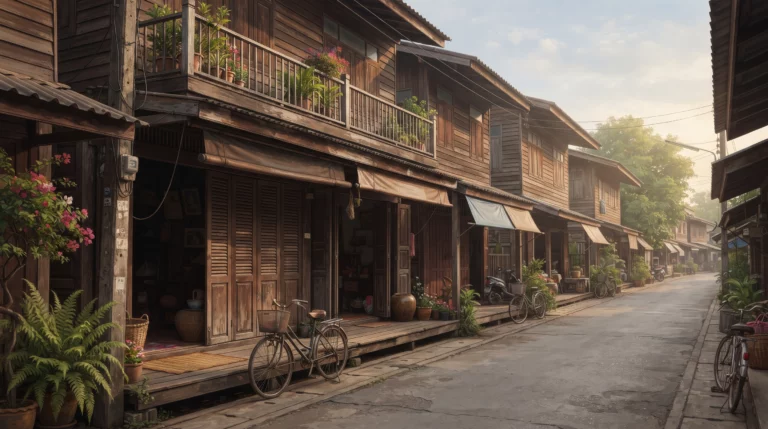
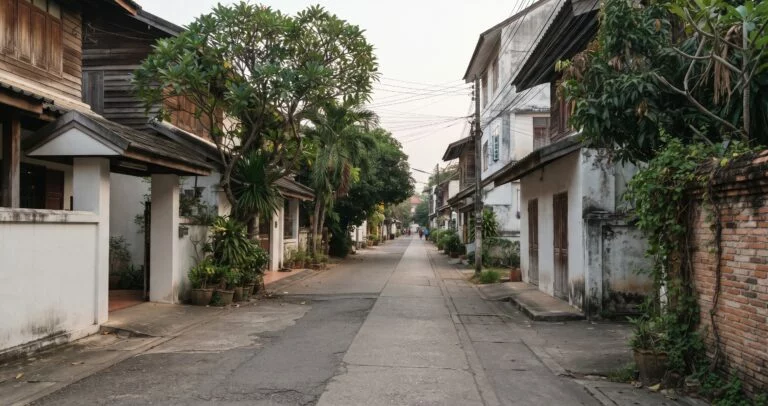
The three illustrations accompanying this article were generated with artificial intelligence. They evoke an inhabited canal, a relationship between housing and water, and a waterside passage. They do not document a verified address or a guaranteed access point. The captions should keep that distinction visible. The same demand for accuracy applies to personal photographs: do not name an unidentified location or use a view to prove a fact it does not show. Framing can remove a nearby road or a recent building. Giving context avoids presenting a fragment as a world separate from modern Bangkok. Images can invite closer reading, but they should not replace the practical and historical information needed to understand the limited portion of the city they display.
Plan an outing that fits your energy
Heat, noise, movement and the attention required by unfamiliar travel can be tiring even when an outing looks short on a map. Allowing margin and a possible break helps you enjoy the area without an obligation to see everything. Choosing one sector and leaving another for a different occasion is entirely reasonable. For a group, discuss what each person hopes to do: observe, walk, photograph or simply spend time by water. Those aims can coexist, but they may require different rhythms. A decision made beforehand prevents pauses from becoming a source of frustration. The quality of discovery depends less on the number of destinations than on the attention still available when you reach them and on the practical comfort of getting back afterwards.
Pause without taking over the space
Stopping can reveal more than passing continuously, provided you do not block a path or someone’s activity. Choose a place where a pause is clearly possible, move the group when somebody needs to pass and avoid placing bags on a private threshold. In a business, ordering or asking before using an area avoids assuming that every terrace is a free observation platform. A conversation with an available person need not ask them to represent a whole neighbourhood. A specific question about an object or a use makes room for an individual answer. It is often more productive than a broad request to explain how local people live, which places a heavy generalisation inside the question before the conversation has properly begun.
Return to the details afterwards
Reviewing a few notes after the visit helps distinguish what you understood from what you merely glimpsed. Three precise observations, one question and a changed impression are enough to extend the work of looking. You can then consult a source to locate a name or clarify a historical relationship. Research afterwards should not rewrite the outing as though everything had been known on the spot. It supplements a limited experience. When sharing an account, describe its conditions: from a boat, during a partial walk or within a particular sector. A modest frame makes the account more useful because readers can understand what it shows and what it cannot establish, instead of mistaking one visitor’s route for a complete description of the city.
Keep the neighbourhood within the city
Thonburi is not an unmoving interval set against a modern Bangkok elsewhere. Canals, roads, homes and activities belong to the same city and change together. Searching only for what appears old can remove the current uses that give places their meaning. An attentive visit allows a recent repair, a wooden gallery, an engine, a plant and a new building to coexist. It does not require each scene to confirm an image formed before the journey. Perhaps that change of expectation lasts longest: understanding that an inhabited landscape cannot be reduced to beauty or age. It is also read through the adjustments that make living there possible today, including the ordinary decisions that a passing visitor may notice without ever fully knowing their history.
Sources for planning the visit
- Tourism Authority of Thailand — Bangkok, Khlong Bang Luang
- Tourism Authority of Thailand — informations officielles
To go further
Mr Schaka’s guidebook, Bangkok – The Practical Guide, covers the essentials: transport, neighbourhoods, addresses, food, etiquette and safety, updated for 2026–2027.