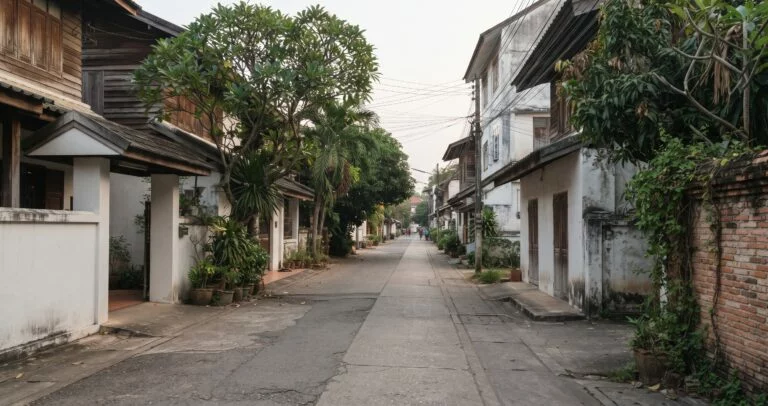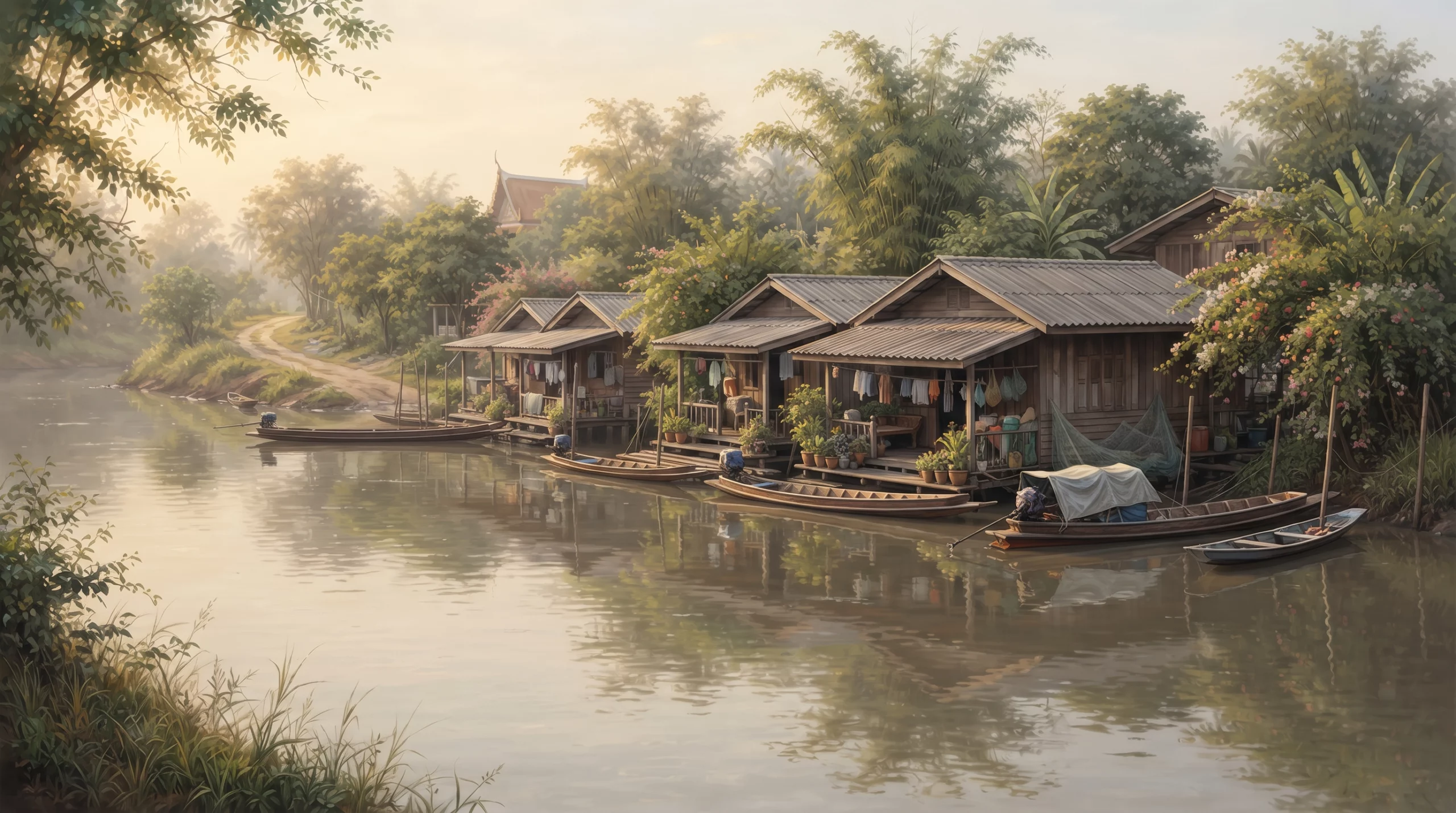
In Uthai Thani, the Sakae Krang River offers a way to understand the town before collecting attractions. Its banks connect places of passage, businesses, a market and homes on the water. Looking at them as spaces used every day reveals more than a photogenic landscape. A bridge primarily helps people cross, a boat may be used for work or transport, and a floating home remains private even when it forms part of a view admired by visitors standing on shore.
This walk begins around the central waterfront, allows time for the market and introduces Wat Uposatharam, also called Wat Bot, when access permits. It does not attempt to cover the entire province. The intention is to understand a few relationships between town and river rather than link too many monuments. Activities, opening arrangements and movement need confirmation for the actual day. A modest plan with room for local conditions can provide a more coherent visit than a route packed with assumptions.
Distinguish the town from the wider province
A search for Uthai Thani may show a temple, forest or excursion well beyond the central area. Check the position of each place before arranging the day. The Sakae Krang waterfront and provincial sights do not automatically form a walkable circuit. Making this distinction avoids advertising a relaxed outing that is mostly spent in transit. Begin with a small area and add a separate excursion only if time and transport genuinely allow it, rather than treating every provincial highlight as a nearby stop.
Save the accommodation address, your arrival point and the beginning of the walk. An offline map can help, but always compare its line with passages actually open on the ground. Access to one part of a riverbank does not imply an uninterrupted public path along the whole river. If a section becomes private or unsuitable, return through a known public space rather than forcing the route to match your screen. Flexibility is something to plan for, not a failure of preparation or an admission that the day has gone wrong.
Start by watching how the bank is used
Pause for a few minutes in a public space before moving on. Which movements connect the road with the water? Where do people stop, and where do they simply pass? This gives the walk an initial structure. It helps distinguish a service access, a residential entrance and an area intended for visitors. Notice where you can wait without getting in the way. A place admired for its apparent tranquillity may still be an important working route for those who live or trade there.
Municipal information presents homes on the water as part of current riverside life. They should not be approached as museum installations. Observe their relationship with the bank and circulation rather than looking into living spaces. An open door or window is not permission to photograph private life. If a conversation develops, let residents determine its length and accept moving on without obtaining every answer. A rewarding encounter does not require turning somebody else’s day into an explanation designed entirely around a visitor’s curiosity. Official source.
Enter the morning market without staging it
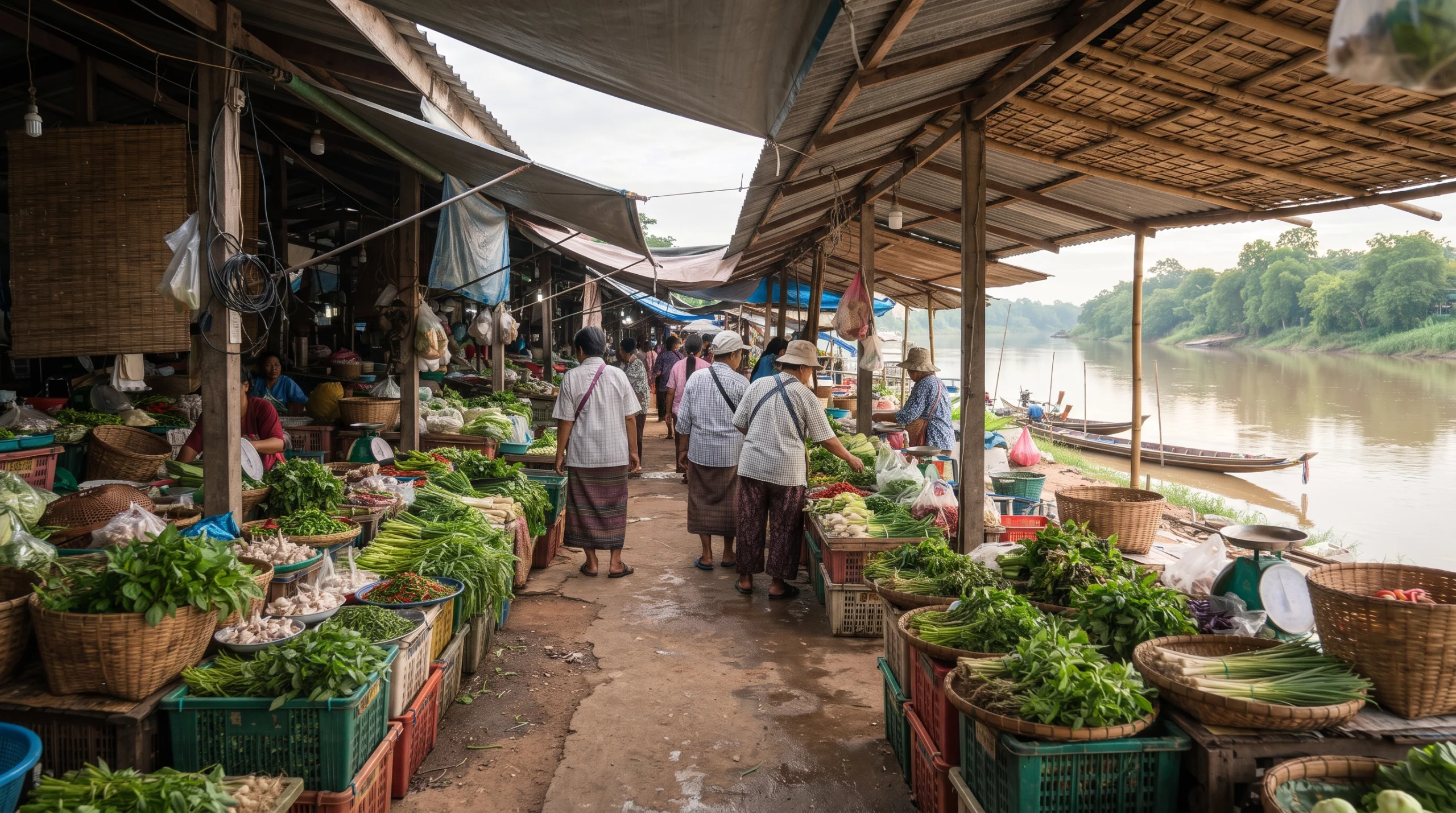
The riverside market is a useful introduction to local rhythms and uses of space. Begin with an aisle where movement remains easy. Let customers order before asking questions and avoid stopping in the middle of a transaction. Baskets, product arrangements and serving gestures can be observed before taking a photograph. This gives you time to understand who uses the space and where your presence fits. It also reduces the temptation to treat a busy workplace as a sequence of ready-made pictures.
If buying food, ask what a preparation contains, its price and how it is eaten when that is unclear. Do not demand a demonstration solely for filming. A seller may welcome a brief exchange while still needing to complete work. Ask before photographing a stall or recognisable person and keep the framing straightforward. Showing the intended picture may clarify your request, but it does not replace a genuine opportunity to refuse. Accept that refusal without repeated bargaining or a photograph taken discreetly afterwards.
Make breakfast a proper stop
An unhurried meal helps turn an external view of the market into a more attentive experience. Choose from what is actually available and order according to appetite rather than trying everything on a checklist. Check ingredients relevant to your needs before ordering. With an allergy, use reliable wording and make sure the message has been understood. A dish’s name alone cannot establish every ingredient, sauce or preparation condition. Allow enough time for an answer instead of treating the conversation as an obstacle to getting served.
Carry small notes and a payment method suitable for the businesses encountered. A comfortable shaded seat may matter more than a widely shared address. Use the break to reconsider the day: tiredness, heat or rain may justify shortening the route. The market does not need to become an eating challenge to remain memorable. Understanding one preparation and appreciating a conversation can already provide a rich entry for a travel notebook, while leaving you more energy to notice the river and the temple afterwards.
Check the current crossing towards Wat Uposatharam
The municipality describes a bridge connecting the market area with Wat Uposatharam on the opposite bank. Nevertheless, check access when visiting. A link shown on a map does not guarantee identical conditions on every date. Follow permitted circulation and give regular users room to pass. If cycling, respond to signs and people rather than assuming that every pedestrian connection is also suitable for riding. The ability to see a destination from one side of the water does not remove the need to confirm a usable route. Official source.
Crossing is interesting because it changes the view back towards town. Notice how the commercial bank appears from another angle. Stop only where doing so does not obstruct movement. Do not lean beyond protective structures for a picture. With children, agree where everyone should remain before beginning the crossing. A calm observation does not require an improvised stop in a narrow passage. Looking back after reaching an appropriate place may provide a better understanding of the relationship between the two banks anyway.
Read the temple before pursuing individual details
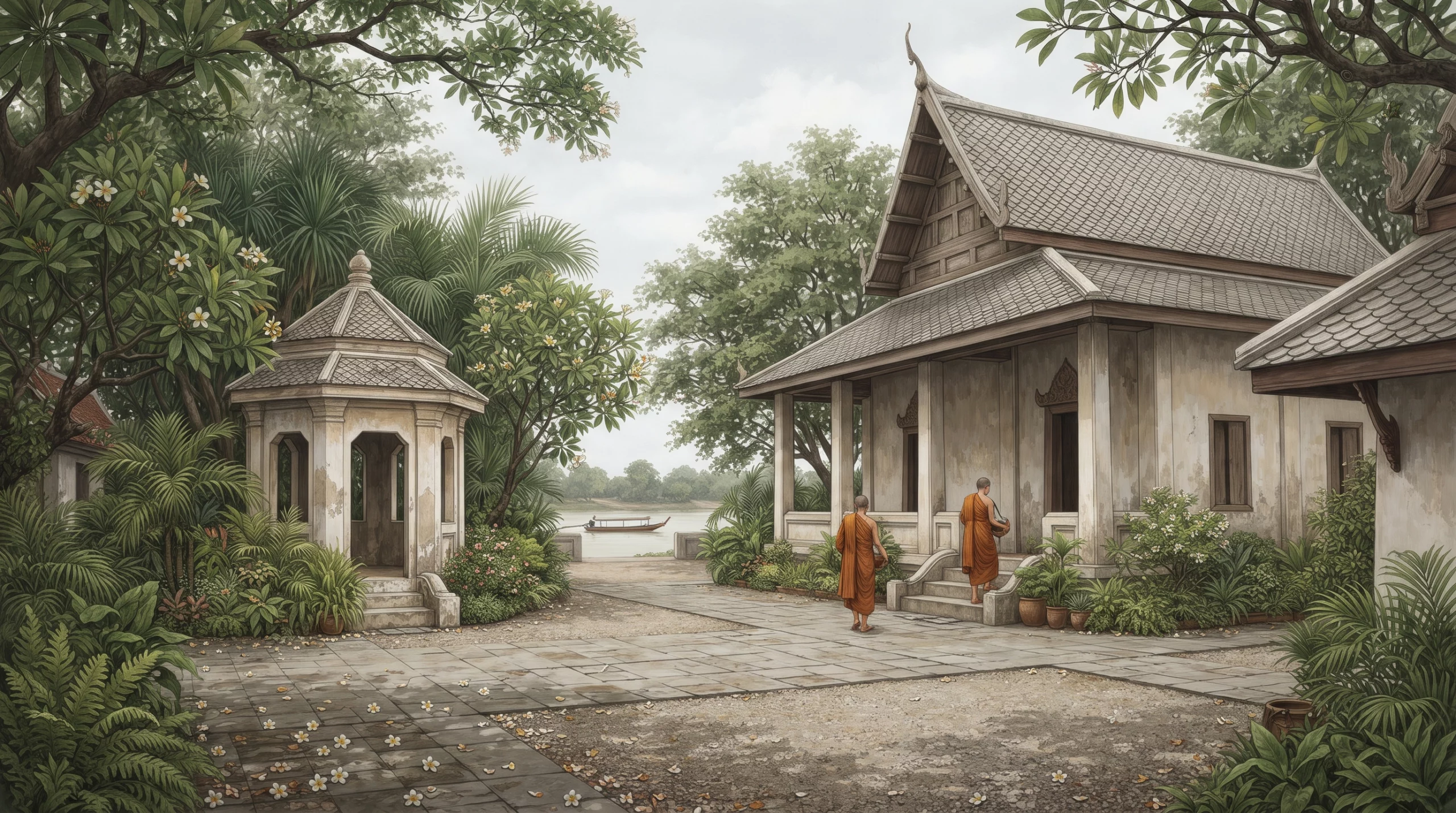
Wat Uposatharam, often called Wat Bot, belongs to the Sakae Krang riverside setting. Official descriptions draw attention to features including paintings and an octagonal pavilion. Begin with the whole: the courtyard arrangement, relationships between buildings and access points. Not every space is necessarily open at the same moment. A closed doorway does not make a visit worthless. It redirects attention towards what can be seen without interfering with the religious functions of a place that exists for more than sightseeing. Official source.
If interiors are accessible, enquire about photography and follow directions concerning clothing and footwear. Observe paintings from a respectful distance without touching them or introducing unauthorised lighting. Do not assign a scene or date immediately on appearance alone. Available interpretation should guide your reading. Where information is missing, recording a colour, arrangement or question is still a valid way to encounter decoration. It leaves room for later learning without making confident statements that the visit itself never established as accurate.
Observe architecture from permitted areas
A pavilion can be understood through its position, openings and surrounding movement. Walk around only where access permits and compare the sides you can legitimately see. A form that seems complicated in a photograph may become clearer after a few steps. Conversely, a visually pleasing frame can hide a significant relationship with another building. Take time to look before deciding which image to keep, rather than attempting to reconstruct the entire place later from an isolated ornamental feature or an attractive doorway.
Avoid assigning every form to a cultural influence simply because it resembles something elsewhere. Where official interpretation explains an architectural combination, retain its qualifications. Otherwise, describe visible elements in ordinary language. A rhythm of openings or difference between materials can be appreciated without turning the walk into a catalogue of styles. This caution does not reduce enjoyment. It preserves real questions to pursue afterwards or discuss with someone knowledgeable, while keeping the record of your actual observation separate from speculation that might be corrected later.
Respect offerings and ordinary boat movements
Municipal sources mention alms offered to monks travelling by boat as part of riverside practice. That does not guarantee an observer a particular scene at a fixed time every day. If you witness it, keep a respectful distance and do not request poses or repeated gestures. The route, action and quiet belong to participants. Before participating yourself, ask for local guidance on appropriate conduct. Watching without intervention can be both the most respectful choice and the best way to learn what is happening. Official source.
Apply the same care to ordinary boats. Do not assume they provide tourist services because they are moored near a visiting area. Arrange an excursion separately with an identified operator, confirming destination, duration, price, equipment and return conditions. Without that information, remain on shore. Discovering a town shaped by water does not necessarily require boarding a boat. A walk already reveals meaningful connections between the banks and allows you to choose suitable viewpoints without converting every working activity into a potential visitor experience.
Keep Friday separate from the Saturday walking street
Municipal information describes Trok Rong Ya walking street as a Saturday activity. Since 6 November 2026 is a Friday, this article should not promise that market for publication evening. The streets can be explored at another time, but the atmosphere will not necessarily resemble an organised shopping evening. Check the current programme before extending a stay specifically for an event. Distinguish an urban space from an activity held there: knowing the address of a walking street does not establish that stalls operate whenever you arrive. Official source.
If staying until Saturday, treat the possibility as a separate option rather than an obligation. Ask locally for information that day, particularly during unsuitable weather or an announced change. A town is not defined only by its busiest hours. The river and temple can support a coherent visit without an evening market. This approach leaves time for conversation, a pause or a return to the same viewpoint under different light, rather than making the day’s success depend entirely on a programme outside your control.
Adapt the walk to people and conditions
Heat, showers and surface conditions should influence how long you walk. Bring water, suitable protection and a way to keep belongings dry. Near the river, watch where you place your feet, especially on wet surfaces. Do not assume a route suits everyone merely because it looks short. A few steps, a slope or a narrow section can change the experience for somebody with limited mobility or a pushchair. A small distance on a map is not a complete description of access on the ground.
Ask which sections meet your needs and choose a simple return. With children, alternate looking with rest rather than expecting uninterrupted attention. A child might notice roof shapes or draw a boat from a safe place. Adults benefit from limiting objectives too. Understanding the link between the market and temple is more valuable than crossing several places without retaining their differences solely because they were on the original list. A reduced plan can still provide a full experience when each stop has a clear purpose.
Prepare arrival and an optional overnight stay
Check services towards Uthai Thani for your actual date with the relevant operators or sales points. Confirm the arrival location and final section to the accommodation. A destination listed by province may still require a connection or transfer. Keep the address in Thai, a contact and a margin before a fixed reservation. Do not turn a journey time found in an older account into a promise applying to every departure. Realistic connections matter more than an attractive but unsupported estimate on a travel page.
For a riverside overnight stay, ask about access, comfort and arrival procedures. Proximity to water says little about steps, noise, the sensation of movement or available services. Choose according to actual needs rather than the image alone. If returning the same day, decide when to leave the area to collect belongings and reach departure. This avoids ending a quiet walk with a rush that erases the benefit of the chosen rhythm. Planning the return carefully helps protect the time you have set aside for discovery.
Keep the account faithful to what you saw
A small set of memories may include a public market space, an architectural detail and a wider river view. Add a line of context and respect agreements with people photographed. Do not publish the inside of a home merely because it was visible from shore. When recounting a conversation, avoid supplying exact quotations or personal details that were never recorded and checked. Discretion belongs within accuracy: a travel story can be vivid without exposing private life or inventing a more convenient exchange.
The illustrations here were generated with AI and do not document a particular home or building. They accompany an invitation to look carefully at real places. For a further stage, explore Mr Schaka’s Thailand guides and choose a destination at your own pace. A modest Uthai Thani route already links many things: living, trading, crossing, religious practice and the shared use of a town in which the river remains an active part of daily life rather than simply a backdrop for visitors.
Sources and planning
Sources checked on 4 November 2026. Confirm practical arrangements with the operators before visiting.
- Municipalité d’Uthai Thani — attractions
- Municipalité d’Uthai Thani — itinéraires
- Tourism Authority of Thailand — Uthai Thani
- Ministère thaïlandais du tourisme — Wat Uposatharam

To go further
Mr Schaka’s guidebook, Bangkok – The Practical Guide, covers the essentials: transport, neighbourhoods, addresses, food, etiquette and safety, updated for 2026–2027.