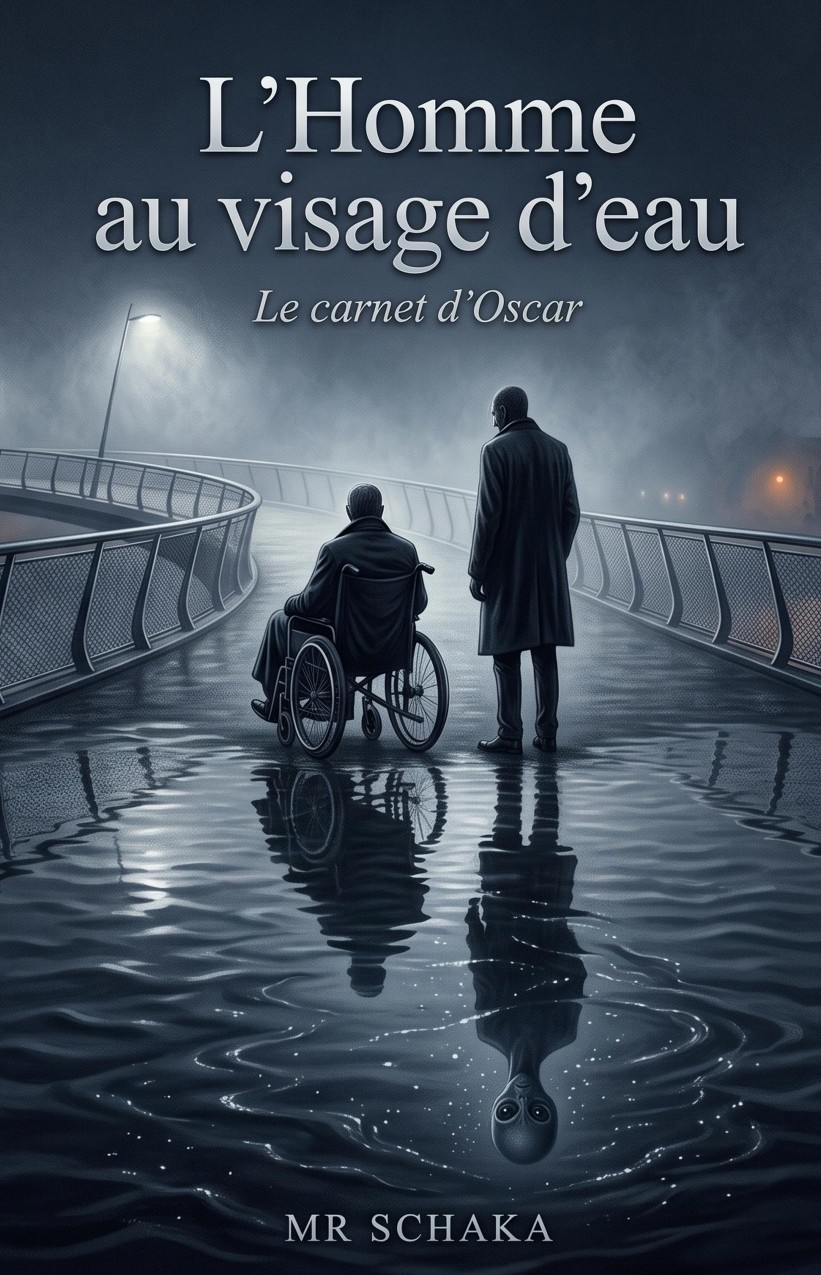
A visitor from another planet learning about péket and the unwritten rules of saying hello; a former inspector noticing details everyone else overlooks: L’Homme au visage d’eau opens Le carnet d’Oscar with an unusual encounter. Mr Schaka places his pair in Liège without asking readers to choose immediately between detective fiction and the strange. Investigation matters, but so does the way an apparently ordinary world becomes mysterious when somebody approaches it without our familiar assumptions about how people behave.
This first volume introduces Oscar Blanc and Victor Lenoir. You can begin without knowing the author’s other books, carrying one question: what becomes visible when the normal stops seeming obvious? This introduction draws on the manuscript’s opening and the official presentation. It suggests ways to read while keeping the solutions and later developments inside the novel. The aim is to encourage curiosity about the pair, their voices and their setting, rather than replace discovery with a summary that has already answered every interesting question before you start.
A chosen name becomes a first clue
The opening quickly establishes that Oscar Blanc is not the narrator’s real name. The way he selects it from things encountered among humans introduces both humour and displacement. A name is therefore more than an identifying label. It reveals a method of learning, constructing a plausible appearance and misunderstanding things the town’s residents regard as obvious. The reader meets a mind at work before receiving an abstract explanation of what makes that mind different from other people in the story.
An everyday object can consequently hold two meanings: the human interpretation and the interpretation of a newcomer. The pleasure lies in the gap, without requiring contempt for Oscar. His reasoning may be coherent while depending on incomplete knowledge. That makes the reader’s familiarity less comfortable. We know how certain things are done, yet might struggle to explain their logic to someone arriving for the first time. Have you ever tried explaining a habit without ending by saying that it is simply what everybody does?
Why does Oscar keep a notebook?
Oscar writes because communication with his own planet has failed. This gives the notebook a particular role. Telling a story is not only the transmission of an adventure whose outcome is already settled. It also preserves observations and creates a possible listener when the expected one is absent. The reader receives a voice whose existence depends partly on a missing connection, adding a sensitive note beneath the apparently light opening and its comic misunderstandings of ordinary human behaviour.
The form invites us to stay close to the narrator’s perception. Events do not arrive through an outside authority able to classify people and customs once and for all. Oscar discovers, interprets and revises. The notebook retains that movement. Without anticipating the series’ secrets, it already offers a reading question: who are we addressing when we record something the people around us cannot entirely understand? You do not need to answer immediately. Keeping the question open gives the act of telling a significance beyond the collection of clues.
An encounter at Guillemins built on attention
Victor Lenoir meets Oscar at Liège-Guillemins station. Instead of depending on a spectacular revelation, the opening gives weight to ordinary actions and details. Coffee, clothing and reading become things worth examining. That is a meaningful introduction to detective fiction. The world contains clues before a formal case has even been presented, provided someone knows how to pay attention. A familiar public place becomes a scene of interpretation without needing to change its ordinary functions as a station.
Victor does not require a lengthy declaration of exceptional intelligence. His observation demonstrates it. Readers can follow the reasoning and notice the distance between seeing and noticing. This offers a promise: appearances will matter, but so will connections between details. A fact alone may seem insignificant; placed beside another, it begins to raise a question. Would you have noticed the same thing, or would you have watched it happen without retaining any reason to look again a moment later?
Two positions within the same city
Victor is a former inspector who uses a wheelchair. The novel presents an active detective rather than reducing him to a symbol or medical explanation. Movement becomes part of the pair’s everyday organisation, as it does for Oscar. Each encounters the world from a particular position. Their differences do not have to disappear for the partnership to work. They can reveal possibilities and obstacles the other person does not immediately see, producing a relationship grounded in practical life as well as curiosity.
An attentive reading preserves that balance. Victor is not interesting only because of his wheelchair, nor merely in spite of it. He observes, decides and organises his own work. Oscar is not simply an extraordinary resource assisting a human investigator. His way of looking has a value Victor recognises. Their association begins through complementary perspectives, concrete needs and the possibility of trust. That is richer than dividing the pair into one person who thinks and another whose only purpose is to perform actions on behalf of someone else.

A stranger’s gaze unsettles everyday rules
The social conventions Oscar learns are often the ones explained least. Greeting frequency, a routine question or behaviour in a queue can feel natural because it is habitual. The narrator treats these as customs to decipher. Humour emerges, but so does the effort involved in social learning. Fitting in is not only a matter of having an acceptable face or knowing vocabulary. It also involves understanding expectations people may never state until somebody fails to meet them.
Choose a moment when you immediately understand a rule Oscar is discovering. Then consider how you would explain it without assuming universal knowledge. This small experiment follows the novel’s pleasure without imposing a heavy theory. It shows what an outside character can change in perception. The text need not make all humans absurd. Sometimes suspending a single certainty is enough to restore strangeness to a familiar situation, making readers recognise both their own knowledge and the limits of the explanations they could offer for it.
Liège takes shape through uses and places
Sart-Tilman, Guillemins and Outremeuse belong to the opening of the story. They provide recognisable anchors, yet their purpose goes beyond pins on a map. They correspond to situations: hiding, watching trains depart and finding an address. Place connects with action and a way of feeling within the city. A setting gains substance through these relationships without turning the narrative into a tourist inventory that readers must memorise before understanding why the characters are there.
Readers familiar with Liège may enjoy recognition. Those who do not know it need not verify every street to follow the pair. The novel can offer a felt geography of passages, waiting and relationships. Avoid turning every description into a guaranteed real-world itinerary. Fiction can select and arrange a city for its own purposes. That freedom belongs to reading, alongside the later pleasure of discovering actual places. A book’s use of a real name does not remove its ability to reshape the reader’s attention.
Humour reveals character as well as tone
The opening’s humour is not merely a removable joke. It operates through speech and the meeting of different kinds of reasoning. Oscar searches for acceptable answers; Victor hears what those answers betray. The mismatch tells us about both figures at once. Lightness can coexist with tension: who understands what, who knows what, and when does somebody decide to reveal that understanding? A witty exchange can therefore move the relationship forward rather than interrupt a serious story to supply a decorative moment of amusement.
This combination may appeal to readers who enjoy investigation without wanting an entirely sombre atmosphere. It does not mean the narrative lacks gravity. The official presentation announces cases and someone taking an interest in Oscar. Their place is best discovered inside the book. Humour is an entrance and a rhythm, not a guarantee that every situation will become harmless once a character finds a good reply. Allowing those elements to coexist leaves the novel more room than deciding in advance that it must belong to one fixed emotional category.
The strange does not make clues irrelevant
An extraterrestrial might suggest that anything can happen and reasoning no longer matters. The opening offers another possibility: the unusual character is himself interpreted through observation. This places the reader in an active position. You can enjoy the speculative premise while continuing to examine how a conclusion develops. Combining genres does not require abandoning the satisfaction of understanding. It adds another source of distance from the familiar, while the pair’s encounter still depends on connecting visible details with a carefully formed question.
Keep separate what you know, what a character supposes and what is actually verified. That helps you follow without trying to solve everything immediately. A light notebook is enough: one detail, one hypothesis and one unanswered question. Avoid gathering solutions from commercial descriptions or online conversations before reading. A first volume benefits from preserving the chance to be surprised by the relationships between elements. The point is not to prove you are quicker than the detective, but to enjoy how the story teaches you to pay attention.

Partnership does not require sameness
Oscar and Victor have different needs, yet their encounter makes a shared arrangement possible. An address, a room and a way of working give the alliance everyday dimensions. Trust is not presented solely as a generous idea. It also takes form through a practical arrangement in which each can find a place. Readers witness the beginning of a relationship rather than receiving a simple announcement that an effective detective pair will now exist for the convenience of the following investigations.
You can consider that relationship without assigning it one final moral. Does professional interest, curiosity or recognition of loneliness bring them together? The opening allows several elements to remain in view. The rest of the novel has room to develop them. Keeping the question open respects fiction more than a premature explanation reducing both men to one wound or quality assumed to apply unchanged throughout. Their interest lies partly in what remains to be discovered after they have agreed to begin sharing a life and some work.
Entering the series through its first notebook
The series page describes complete investigations alongside a continuing thread. L’Homme au visage d’eau provides the initial encounter and the pair’s reference points, making it a straightforward place to begin even if another title first attracted you. You enter a way of telling and can later decide whether to return to the figures in subsequent volumes. You do not need to know the eventual destination before enjoying the movement of a relationship, a voice and an investigation as they first take shape.
If preserving surprises matters, avoid reading every later volume’s presentation beforehand. A book page helps with selection; it does not replace narrative sequence. You can also read one notebook and let it settle. A series does not require immediate purchase or completion of every instalment. It offers the possibility of returning, whose value includes familiarity as well as new questions. Beginning at the first encounter lets you decide what you want from that return rather than committing to the whole journey before meeting its central characters.
Discussing the book without giving it away
To recommend it, the starting point is already enough: an outsider narrator, an attentive detective and a city becoming a field of observation. Explain the tone and the partnership without revealing solutions. In a reading group, first ask how far everyone has read. Discussing Oscar’s gaze or Victor’s attention can be rewarding without overtaking someone who has only just encountered them on the station platform. Curiosity can be shared while the discoveries themselves remain available to each new reader in their own time.
Talking about the setting also need not turn fiction into claims about the author’s personal experiences. Real places do not make every imagined event biographical. The images accompanying this article are atmospheric illustrations, not recreated covers or evidence of an exact scene. This distinction leaves space for the text and each reader’s imagination to construct faces, voices and details. Visual accompaniment can invite someone into a book without prescribing every element they should picture once they begin following the narrator’s own account.
A clear entrance into Mr Schaka’s fiction
L’Homme au visage d’eau belongs to Mr Schaka’s fictional work. His travel guides answer other needs, while personal testimonies establish a different relationship with lived experience. Recognising those differences helps readers choose. If you want characters, questions and a Liège atmosphere, the first notebook offers a clear beginning. The official page supplies the current formats and access to the broader series presentation, allowing a practical choice without requiring a reader to know the author’s whole catalogue first.
The opening’s appeal finally rests on a simple action: looking again at something thought familiar. Oscar does so while learning humanity; Victor does so because details are not automatically insignificant. Between them, Liège becomes a place where assumptions can shift. Readers need neither character’s abilities to enter the novel. They need only an unanswered question and the wish to see how this encounter learns to investigate together. What might you notice differently after spending time with a narrator who cannot rely on all the habits you usually take for granted?
The book and this introduction
Discover the book on Mr Schaka’s website.
Prepared from the book or its opening and the official book page, checked on 4 November 2026. Interpretations are offered as reading suggestions. Check the book page for current formats and availability.
French, English and Thai versions of this article do not imply that the book is sold in all three languages.
The book
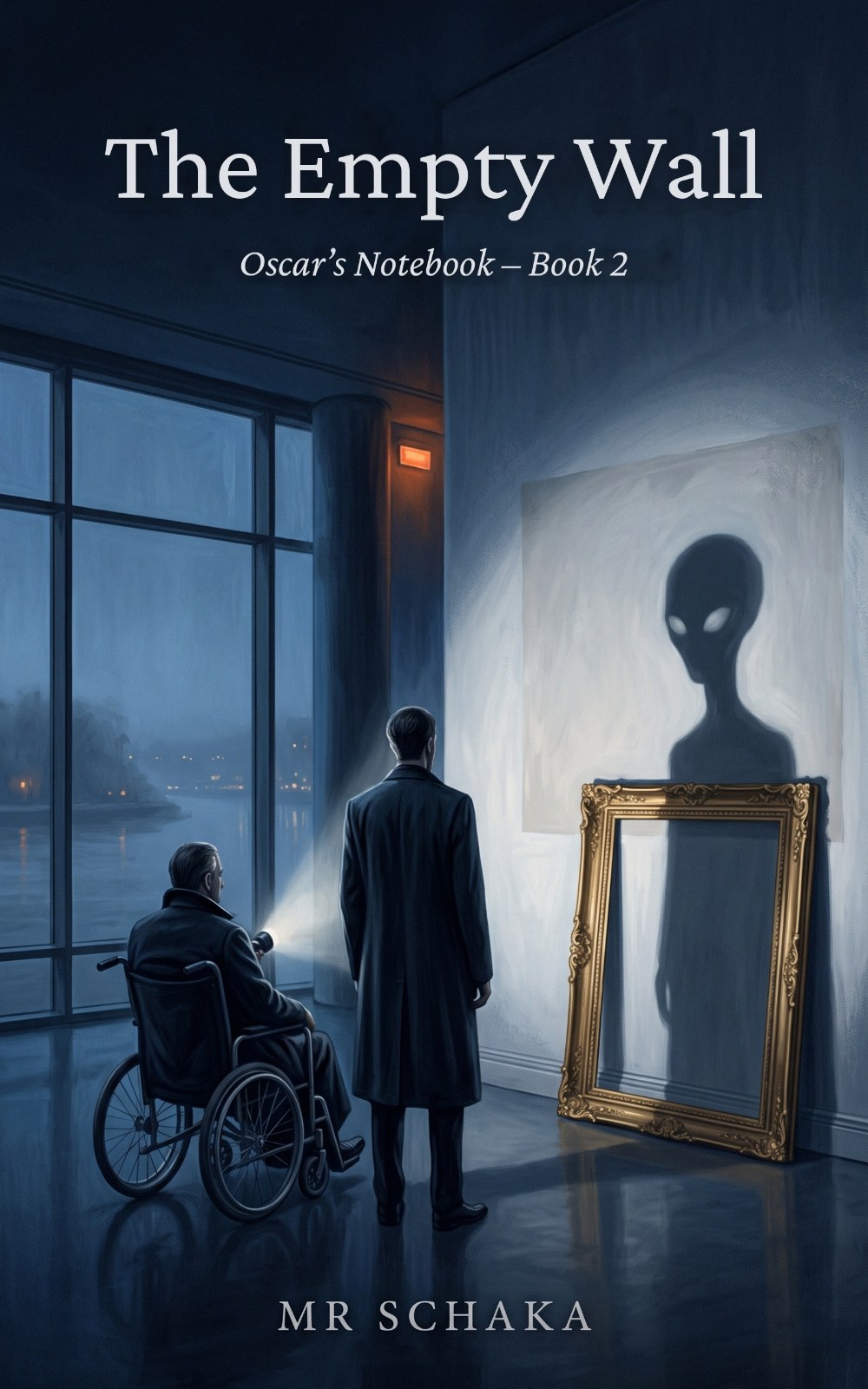
The Empty Wall is the second book of Oscar’s Notebook, a series of crime novels set in Liège.