A successful family walk is not measured by the number of attractions crossed off a list. It can consist of a short journey, a stop chosen together and a small discovery that everybody remembers differently. In Bangkok, it helps to prepare the outing as a shared experience rather than a reduced version of an adult sightseeing programme. Interests, walking speed and tolerance for noise may differ. This guide offers a method for a flexible outing with a recognisable beginning and an easy place to finish. The suggested durations are examples for organising the group, not guaranteed journey times or an official schedule for any venue.
Choose one main anchor
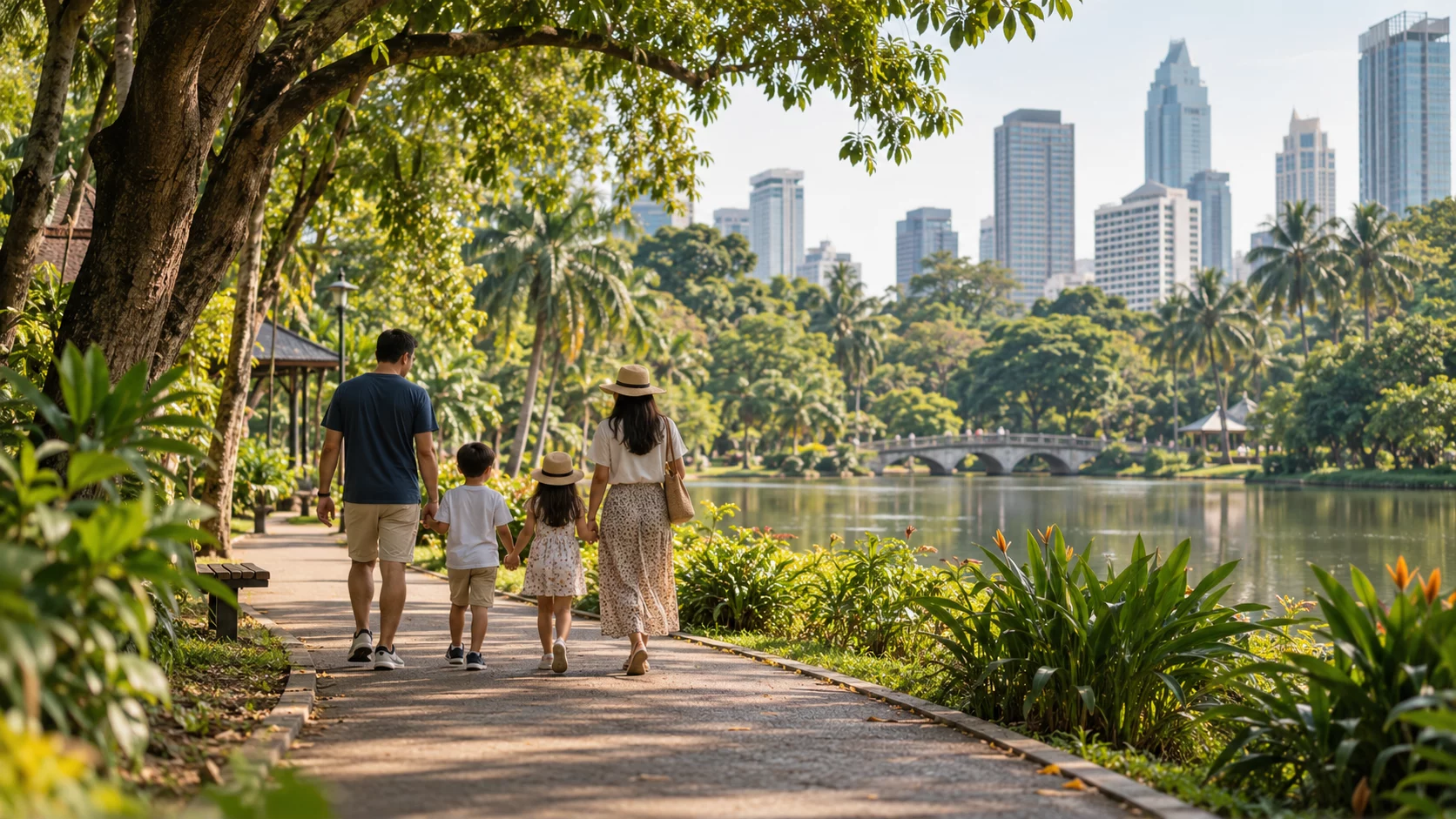
Begin with a single destination instead of immediately adding a second neighbourhood. A garden, a short street you already know or a place where stopping is appropriate gives the outing a clear shape. For a Bangkok reference, Thailand's tourism authority lists Benchasiri as a park on Sukhumvit. Use that location as a starting point for your checks rather than assuming that every entrance or facility will be available on your chosen day. The aim is to identify a place suitable for your particular group and build the rest of the plan around it.
Mark three points on a map: the start, the main stop and the return point. Look at the route that can actually be used, not simply the distance in a straight line. An entrance may be on the opposite side, a passage may require a detour and an exit may be less convenient than a picture suggests. If you have time alone beforehand, look at the first segment. Otherwise, ask your accommodation for specific directions and keep the option of shortening the plan from the beginning. Preparation should make an adjustment easier, not make you feel committed to an unsuitable route.
Ask everybody a useful question
Before proposing a complete itinerary, ask each participant what they would like to notice: a tree, a colour, a roof shape, a reflection or somewhere to draw. A concrete choice is easier to include than a very broad question about an ideal day. Avoid promising to fulfil every wish. Choose one shared idea and keep the others for another outing. Everyone should understand the proposal, including the person who would rather observe quietly than join a game. You can offer opportunities without requiring the same level of participation from the whole family.
For a child, describe the sequence using a few visible landmarks: we walk to the entrance, look for three shapes, then sit down and decide about going back. This provides structure without turning the walk into a string of instructions. A teenager might prefer choosing a photograph or preparing music for a part of the journey where listening is appropriate. A tired adult may simply want an earlier rest. Planning becomes fairer when these needs are named before they turn into conflict. Nobody should have to become visibly upset before their preference counts as useful information.
Include the time that disappears between activities
An outing includes more than the minutes spent walking. There is preparation, waiting, finding an entrance, spontaneous stops and the journey back. An activity described as one hour can take much longer when nobody has allowed for those transitions. Leave a margin between the end of the walk and a fixed appointment. If you absolutely need to be somewhere at a particular time, a familiar short return route is often easier to manage than a circuit with an uncertain final section. Count the whole experience instead of treating the return journey as time that will somehow look after itself.
As an example, you could allow an initial quarter of an hour for departure and settling into a rhythm, roughly twenty minutes for looking around, then a pause before deciding what comes next. This is an original planning suggestion, not a timetable supplied by a park. Adapt it to your group and the place. Do not continue until the next slot simply because somebody wrote a schedule. These markers should make decisions easier. If the main stop satisfies everyone, the outing can already be complete without a further attraction or a longer route added at the last minute.
Pack a bag that remains manageable
First gather what makes returning straightforward: your accommodation address, a usable way to make contact, the group's usual essentials and a means of paying for the planned journey. Add water according to individual needs and suitable protection for the expected conditions. Check the bag's weight once it is packed. An object described as indispensable can become a burden carried by the same adult throughout the outing. Share what can sensibly be shared, without giving a child responsibility beyond their ability. A lighter plan often begins with being clear about what the family actually intends to do.

A small notebook and a few pencils are enough for many activities. There is no need to bring an entire creative workshop when the main plan is walking. Choose things that can be put away quickly when you need to clear a passage or move on. Include somewhere to keep rubbish and a separate space for damp items. Before leaving, check the practical needs you already know within your own family. A personal list is usually more useful than a universal packing list copied without considering how your group travels. Bring familiar solutions to familiar needs before adding equipment for unlikely possibilities.
Keep the group together during transitions
If several adults are present, agree who leads and who watches the back. Moving between places is a useful moment for a quick check that everyone is ready. Wait until the last notebook is packed instead of giving the next instruction while somebody is still sorting their things. In a busy space, choose a clear, visible meeting point. A description such as near the big tree may be ambiguous. Show the point to everyone and check that they understand it. Simple shared references are more useful than assuming that each person has interpreted the same words in the same way.
For crossings and entrances, follow the arrangements and instructions in place. Do not make the fastest walker the standard of what everybody else should manage. If a segment appears unsuitable, turn back or find another option before committing the group. The map helps with preparation, but the decision is made in front of the real passage. No photograph, appointment or discovery is worth separating people during a poorly understood transition. When a route needs changing, explain the new direction briefly and wait until everyone is ready to follow it.
Make observation an optional game
Offer a simple search: three shades of green, two different textures or a shape that appears in several objects. The game should help people look rather than demand a correct answer at every stop. Compare discoveries without declaring a winner. Someone who does not want to search can walk and listen. A successful activity remains compatible with the presence of people who would rather not play. The pleasure of the outing does not depend on constant enthusiasm from every participant. An optional game can be stopped quietly once it has served its purpose.
Another exercise is to choose a minute of quiet observation and then share one detail each person noticed. Do not present it as a concentration test. One person may remember a colour, another a sound or a sense of movement. To continue, ask what question they would like to put to the place, without immediately inventing an answer. This creates a shared memory in which different perceptions become interesting. Residents and other visitors are not game accessories. Keep the instructions focused on shapes, objects and surroundings rather than collecting photographs or remarks about strangers.
Pause before the need becomes urgent
Agree a simple signal for requesting a pause. It should not require a long explanation or a comparison with other people's energy. The first request for rest does not mean that the outing has failed. It supplies useful information for what happens next. When stopping is possible, let people settle before asking many questions. The person who requested the break may need quiet instead of another activity. Discuss the next segment when the group is actually ready, rather than turning every pause into a planning meeting that prevents anyone from resting.
Treat purchases as separate decisions. A break does not require buying something, and buying something does not automatically provide rest. If you plan a snack, consider the participants' established needs and habits without making promises you cannot check. Keep the possibility of returning to your accommodation for a proper interruption. A short walk can become the day's best moment precisely because it does not attempt to occupy every available hour. Space left in the plan gives people room to enjoy the experience instead of hurrying through it towards another obligation.
Adapt without describing the change as failure
Prepare a short version and a longer version of the same idea. The short version might include only the main anchor and one activity. Add an extension only if the group wants it. Present both options as equally valid from the beginning. If the shorter option is chosen, nobody has to explain that the real programme has been abandoned. This wording avoids placing responsibility on the person who asked to slow down. It also makes the decision predictable, which can be helpful when different participants have different ideas about what completion should look like.
Conditions on the day may change the plan too. If the route or location no longer suits the group, keep the underlying idea and change its setting. Looking for shapes may work from a sheltered place where you are allowed to stay; drawing a detail can wait until you return. Consult current information for weather and any local instructions before leaving. A calendar prepared days earlier cannot describe exactly what you will find on arrival. Adaptation is part of planning, not something that contradicts it. Keep a simple alternative so that a change does not require designing a completely new day in the street.
Leave room for different ages and interests
Avoid assigning roles only according to age. A younger child may notice a detail nobody else saw; an older participant may prefer not to document anything. Offer tasks that can be accepted or declined: keeping the colour list, suggesting a pause, drawing a shape or describing the route in a few sentences. Roles may change without becoming duties. The aim is to make a contribution possible, not to produce a perfectly animated family outing at every moment. Quiet companionship is also participation and does not need to be corrected with another organised activity.
When wishes conflict, use a limited, concrete choice. We can look at one more detail or sit down now, then decide about returning. That is easier to address than a general debate about everything missing from the holiday. Keep more ambitious ideas for another occasion without using them as rewards or punishments. A family does not need a uniform memory of Bangkok. Someone may remember the walk, someone else a conversation or the route to the starting point. Those different memories can coexist without the adult account becoming the official version of what mattered.
Finish while there is still a margin
Before adding a final detour, treat the return as an activity in its own right. You still have to reach the planned point, collect belongings and perhaps wait. Keep enough attention for those steps. Announce the last observation clearly, then leave. Repeating the same announcement while adding more stops makes the ending hard to understand. A readable conclusion helps everyone change pace and reduces negotiations caused by a repeatedly postponed promise to return. The final part of the outing deserves the same care as the part you originally wanted to photograph.
Once settled, offer a tiny record: a drawing, three words or a dictated sentence. Ask what each person wants to remember and what they would change next time. Write down the answers without correcting the memories to make them sound more like sightseeing. A shadow, a laugh or a pause may matter more than a monument proposed earlier. This conversation prepares another outing using real information about your group. It also allows the walk to finish without immediately turning the family towards the next scheduled activity.
Practical questions before deciding
Do you need a famous destination? No. A convenient place to reach and leave can be enough for a first outing. Its value comes from shared attention rather than the prestige of an address. Still check the conditions of entry and stopping before promising a particular use. A park marked on a map does not guarantee that all its entrances and facilities will be available. For a stroller or different mobility needs, ask about the specific surfaces, changes in level and access points your route uses, rather than accepting a general description of the neighbourhood as easy.
What if only one person wants to continue? Return to the choice announced at the beginning and consider the whole group. If several adults are present and there is a clear arrangement, a separate extension can be discussed without improvisation. Otherwise, keep the idea for another time. The success of this small walk depends on a straightforward principle: everyone should be able to participate without exceeding their limits simply to make the programme appear completed. The next outing will benefit more from a comfortable ending than from one additional stop that nobody except the planner really wanted.
Source for the location reference
Tourism Authority of Thailand: Benchasiri Park. The location is a planning reference. The proposed activities and rhythm are original suggestions, not a programme announced by the park.

To go further
Mr Schaka’s guidebook, Bangkok – The Practical Guide, covers the essentials: transport, neighbourhoods, addresses, food, etiquette and safety, updated for 2026–2027.