Discover a town without asking it to be somewhere else
Waremme invites a modest starting question: what connects an urban centre with a countryside landscape? You may arrive accustomed to seeking a spectacular old town, a river in the foreground or a mountain panorama. Here, setting those expectations aside makes room for everyday forms: house alignments, passages, businesses, openings between buildings and a horizon that becomes more visible as the setting changes. This is not an attempt to beautify the town artificially. It recognises that a lived-in place deserves to be understood through its own workings. An outing can become a reading of transitions rather than a search for monuments meeting a model borrowed from elsewhere. The approach also makes a short visit worthwhile, because attention is directed towards relationships available in the actual setting rather than towards a missing spectacle.
Place Waremme within its territory
The Terres-de-Meuse tourist office places Waremme within Hesbaye and presents both its centre and localities in the municipality, including Bleret and Oleye. These points remind us that a municipal name does not describe one uniform setting. The centre, villages and agricultural spaces require different approaches and do not necessarily belong in a single walk. A map helps choose the project’s scale before fixing stops. Selecting a coherent portion is more useful than mechanically connecting several names without understanding distance and passage conditions. The territory then becomes visible through relationships rather than a checklist that makes the spaces between destinations disappear. Knowing what scale you have chosen also makes it easier to explain the visit afterwards without allowing a brief encounter with the centre to stand for the whole municipality.
Begin with the centre’s present uses
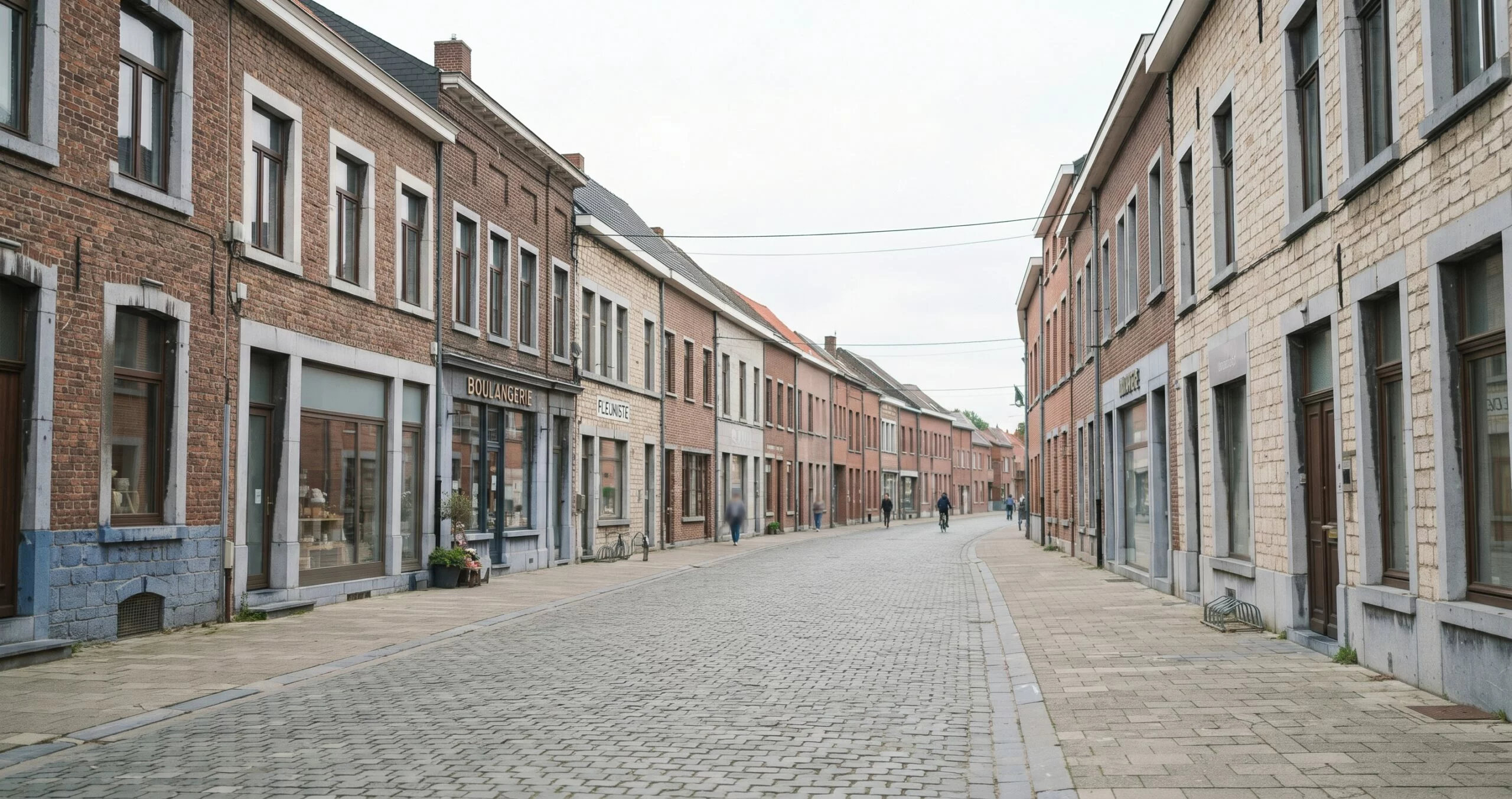
In an unfamiliar town, the centre offers practical orientation before it offers a historical narrative. Finding a shopping street, somewhere to pause and a return point creates the freedom to observe. You can then notice how ground floors meet the pavement, how a shop window fits inside a façade and how entrances give rhythm to a row of buildings. Businesses are not merely visual components. They involve working hours and everyday needs. Avoiding the idea of a decorative street produces a more accurate reading. A delivery, a used doorway or a brief movement can reveal the present organisation of a place without turning each scene into an anecdote about its inhabitants. Ordinary activity is enough to make the street interesting when you consider how it occupies and connects the available spaces.
Read brick and stone together
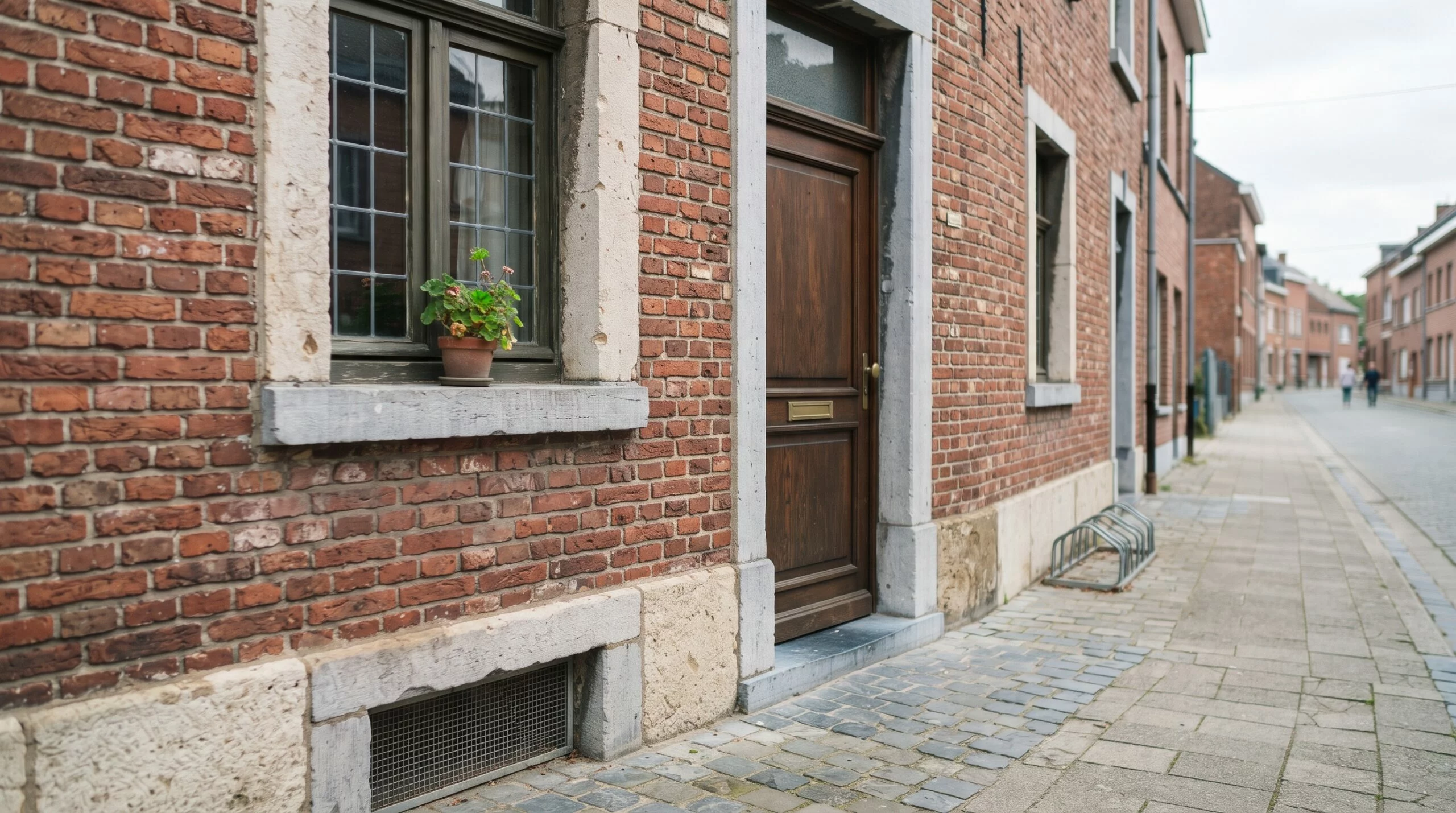
A façade combining brick and pale stone encourages attention to relationships between materials. The base, a window frame, a threshold and the courses of brick do not play identical roles in the composition. Compare their proportions and how they receive light, then notice how those elements vary on the neighbouring house. This does not immediately establish a building’s age. Repair, replacement and transformation may complicate a rapid reading. Describing differences is therefore more dependable than assigning periods with confidence. Looking becomes sharper when it recognises these limits. A façade can be interesting for its balance, maintenance or current use even when information needed for a precise history remains unavailable. Not every pause must result in a date or style label; sometimes understanding how the visible elements work together is already a useful outcome.
Follow openings rather than a style catalogue
Windows and doors shape a street as much as its materials. Their alignment, dimensions and the way one floor differs from another offer an accessible thread for exploration. Choose two or three façades and consider what changes, rather than attempting an endless survey. A frame may emphasise an opening, a level change may alter a threshold and a shop window may transform the ground floor’s appearance. The aim is not to rank houses by authenticity. It is to observe how different needs occupy an urban fabric. This leaves room for modest buildings that would be overlooked if attention were reserved only for the most decorative features. It also gives companions something concrete to discuss, without requiring everyone to recognise specialist terms before being allowed to contribute an observation about what is in front of them.
Respect the boundary between public looking and private space
Ordinary streets can bring visitors close to doors, gardens and sometimes interiors. A photograph of a façade may include more than intended: somebody behind glass, a readable address or a family scene. Before sharing an image, inspect these elements as carefully as the composition. It is possible to show a material or an alignment without exposing someone’s life. Do not enter a courtyard because it looks old, and ask before photographing an interior. Such basic care does not diminish curiosity. It provides a respectful frame in which discovering a place does not require all its spaces to be available to the passing stranger. A detail chosen well can preserve the impression that prompted the photograph while avoiding private information that contributes nothing necessary to understanding the architecture or the street.
Notice the transition from town to countryside
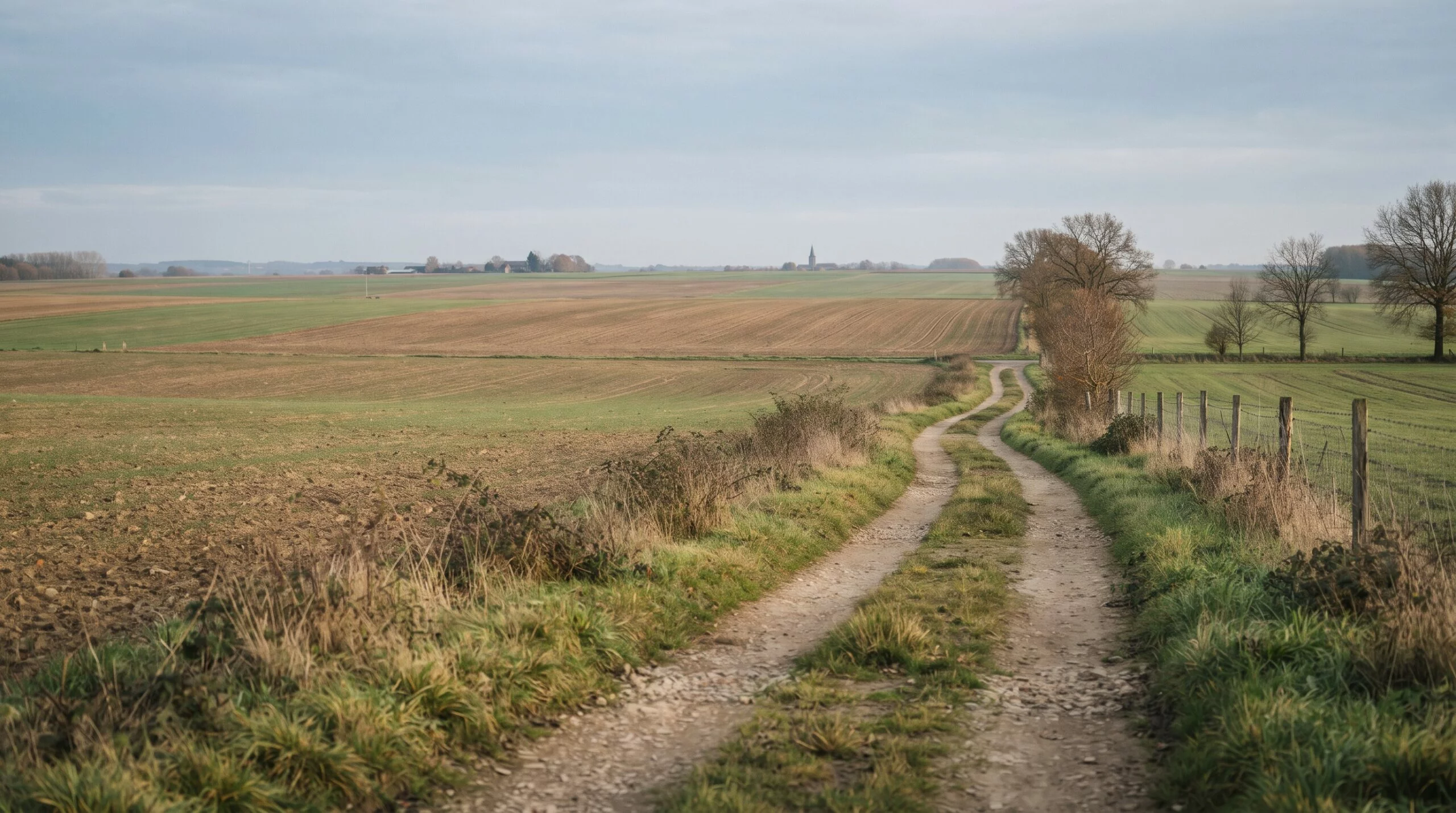
The change towards open landscapes does not always occur at a clear boundary. Façades may become more widely spaced, a garden more visible, a building larger or a view deeper between plots. These clues gradually show how the centre sits within its surroundings. There is no need to declare that every gap marks a historical phase of expansion. That story requires specific evidence. You can instead record where the horizon appears and how viewing depth changes. Landscape becomes a relationship between what is close and what opens in the distance. This gives interest to transitional spaces commonly crossed while waiting for the next named destination on a map. It also makes the journey itself part of the discovery, rather than treating all movement between selected points as empty time to be completed quickly.
Do not confuse proximity with a usable path
A field visible from a street may look close without being connected by a public route. A plot boundary, agricultural access or apparent track is not automatically an authorised walking path. Before linking the centre with a rural area, consult a route offered by a competent organisation and check its current conditions. A general map may not show changed surfaces, works or sections requiring particular attention to traffic. If you want a specific itinerary, prepare it as such instead of improvising continuity from a photograph. This article proposes an angle of discovery, not a guaranteed route. The distinction prevents an attractive visual suggestion from becoming unchecked travel instructions. It also supports a more satisfying outing, because a manageable path with understood conditions is preferable to an ambitious connection whose practical details remain unresolved until arrival.
Read an open horizon without calling it empty
An open landscape can appear simple because few objects interrupt the view. Yet plot width, a hedge, a vegetation line and a cluster of buildings all organise space. Begin by distinguishing planes: what borders the path, what occupies the middle distance and what closes the horizon. A photograph taken from an authorised point can help revisit that reading later. It cannot identify every crop or agricultural practice by itself. Soil colour and visible forms vary with work and season. Describing dark earth, vegetation or a boundary is more accurate than naming a crop you do not recognise. The horizon gains complexity when those distinctions become visible. Its apparent openness no longer means an absence of structure, but a different scale at which relationships need to be noticed before being explained.
Take agricultural work seriously
Countryside is not a park whose uses disappear when a walker arrives. Machinery, service routes and occupied plots belong to an activity. Avoid blocking access for a photograph and leave working spaces available for their purpose. A passing machine need not be interpreted as an intrusion upon the visit; it can remind you what the landscape actually does. To understand a practice, an agricultural source or an available knowledgeable person offers more than a guess from the field edge. The visitor’s perspective remains partial. Recognising that position helps appreciate forms and rhythms without reducing farming to decorative scenery. It also avoids making assumptions about a particular operator from one observed action. Looking at a working landscape responsibly means allowing its work to matter, even when that work does not match the quiet picture imagined before setting out.
Try another scale with Hexapoda
Waremme’s official tourism presentation mentions Hexapoda, devoted to insects. That possibility offers a contrast with reading a broad horizon: moving from expansiveness to small forms of life. It should not automatically be added to an already crowded outing. If the visit interests your group, verify conditions, hours and relevant arrangements before including it. The connection between landscape and close observation can nevertheless provide a useful idea even if the venue is saved for another day. What looks uniform at a distance reveals differences when the scale changes. The same principle applies to a façade, a field edge or an object. It reminds us that a place’s richness depends partly on the precision of the question brought to it, rather than only on the number of attractions included in a programme.
Approach older traces through evidence
The SPW heritage register identifies the Bois des Tombes tumuli at Waremme as protected heritage. This reminds visitors that traces of the past do not all take the form of a spectacular façade. The listing alone does not establish unrestricted access or provide a route to the site. For a visit focused on that heritage, consult relevant documentation and practical information. Distinguish a site’s documented existence from the conditions for approaching it. That separation makes curiosity more useful. You can recognise several historical layers within a territory without inventing a possible visit from a name found in an inventory. The source begins research; it does not replace preparation on the ground, nor does its official status turn every surrounding access into a public path available under all conditions.
Allow villages a place of their own
Names such as Bleret and Oleye should not become mere extensions of the town centre in an account. A village has its own relationship between buildings, routes and open space. If you choose to explore one, take time to locate it and understand the starting point rather than presenting it as an effortless detour. A separate outing with a different question may be more rewarding than accumulating stops in a single day. That choice also respects different group rhythms. Discovering a territory is not measured by the number of localities mentioned. It becomes more precise when you know why a place has been chosen and what you hope to observe there, without imposing the centre’s urban model on a setting that may invite another scale and another kind of attention.
Pause in a way that helps reread the outing
A break in the centre can organise observations rather than merely interrupt effort. Recalling a façade, an opening towards fields and a material detail helps identify what connects them. Note a question for later research without trying to answer everything immediately. In a group, each person can choose a detail to share, making different perspectives visible: somebody noticed a doorway, somebody an activity and somebody the changing horizon. None of those choices needs to dominate. Together they create a more nuanced discovery than a list followed unanimously without discussion. The pause also protects attention for the return, when familiar places may appear in another order. Seeing a street again after understanding its relationship with the wider setting can make previously overlooked transitions more apparent, even without adding any new destination.
Use images without promising an exact place
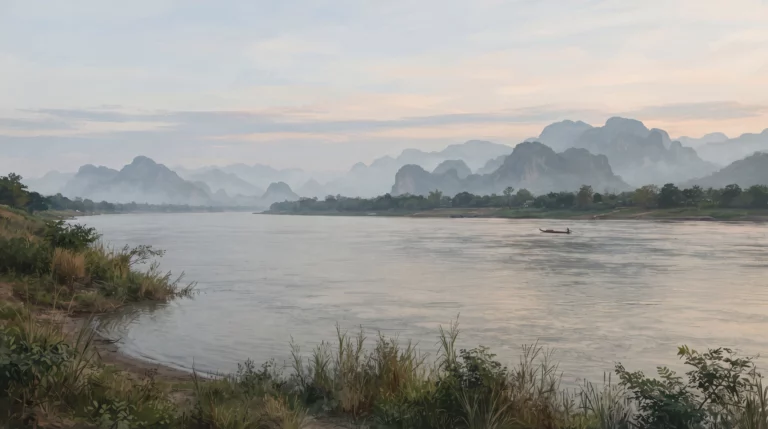
This article’s illustrations were generated with artificial intelligence. They evoke a Hesbaye town centre, a façade and late-autumn fields around Waremme. They do not depict an identified address or a path whose access has been verified. Transparency allows imagery to fulfil its role without becoming false evidence. With a personal photograph, naming a location when known and avoiding uncertain identification are equally important. Appealing light and tight framing may alter the perception of distance. A restrained caption lets readers distinguish atmosphere, observation and practical information. Those functions do not replace one another even when they appear on the same page. An image can encourage a thoughtful visit without pretending to provide a map, a current weather report or a guarantee that the pictured arrangement can be reached as shown.
Prepare for November without inventing its weather
Publication in early November does not establish the weather that will accompany a reader’s outing. Seasonal illustrations guarantee neither the sky, the condition of paths nor the precise colour of trees. Check current information and choose a project compatible with actual conditions. An alternative or shorter visit avoids dependence on a single scenario. Where accessibility matters, surface, resting and movement details need individual verification. An image of a rural track cannot establish suitability for everyone. Preparation is less about predicting every minute than retaining enough margin for a reasonable decision on arrival. That flexibility also keeps disappointment in proportion: a changed route need not mean a failed day when the purpose was to understand relationships, rather than to reproduce a photograph or complete an itinerary whose conditions were never assured.
What remains between street and fields
Waremme may leave a sense of continuity rather than an absolute contrast between town and countryside. Central uses, house materials, villages and open landscapes are not separate worlds. They form a territory discovered gradually through knowledge that remains partial. An attentive outing does not have to summarise it definitively. Three precise observations and a question inviting a return can be enough. That is already a way of seeing more without travelling further. The experience continues when the attention practised here becomes useful elsewhere: recognising a threshold, reading a boundary, noticing depth and understanding that an apparently ordinary landscape contains relationships deserving time. The memory then rests not on having covered everything, but on having learned how to make a limited encounter more accurate, more curious and more generous to the place itself.
Sources for planning the visit
- Maison du Tourisme Terres-de-Meuse — Waremme
- SPW Territoire — tumuli du Bois des Tombes à Waremme
- Terres-de-Meuse — territoire touristique

The book
The Empty Wall is the second book of Oscar’s Notebook, a series of crime novels set in Liège.