Category: Thailand Notebook

Practical tips and travel stories from Thailand: Bangkok, Pattaya, Isan, the islands.

  • What to Do in Chiang Mai: Temples, Markets, Where to Stay, How Long

    What to Do in Chiang Mai: Temples, Markets, Where to Stay, How Long

    Wondering what to do in Chiang Mai? Northern Thailand’s main city is easy to explore on foot, with old temples, evening markets and mountains on the horizon. After Bangkok, the pace changes. Here are the essentials: sights, elephants without cruelty, Chiang Rai, where to sleep, getting there from Bangkok and how many days to plan.

    What to do in Chiang Mai: Old City temples and Doi Suthep

    The Old City is a square surrounded by a moat and remains of the old walls. Tha Phae Gate, on the east side, is the usual landmark. Two temples come first.

    Wat Phra Singh, on the west side, is the city’s most revered temple. It houses the Phra Buddha Sihing, a highly respected statue in the North. The grounds are free; foreign visitors usually pay 20 THB to enter the main hall (check on site).

    Wat Chedi Luang, in the centre, stands out for its huge, partly collapsed brick chedi. The Emerald Buddha, now in Bangkok, once stayed here. Entry is around 40 THB for foreigners. Come early in the morning, while it is still cool.

    Wat Phra That Doi Suthep overlooks the city from the mountain, about 15 km from the centre. A long naga-lined staircase leads to the golden chedi; a small funicular (about 20 THB) saves the climb. Entry is around 30 THB for foreigners. Red songthaews leave from near the zoo once they are full; a car booked through a ride-hailing app is the easy alternative. Walkers can take the Monk’s Trail to Wat Pha Lat: since October 2025, this national park trail charges foreign visitors 100 THB per adult.

    In every temple, cover shoulders and knees and take your shoes off before going in. More useful rules are in our guide to Thai etiquette.

    Evening markets: Sunday Walking Street and Night Bazaar

    • Sunday Walking Street: every Sunday, from late afternoon (around 5 pm) to about 10:30 pm, Ratchadamnoen Road is closed to traffic from Tha Phae Gate to Wat Phra Singh. The biggest market in town, and the busiest.
    • Saturday Walking Street: on Saturday evenings, the same idea on Wualai Road, the old silversmith quarter south of the Old City.
    • Night Bazaar: every evening on Chang Khlan Road, east of the Old City. More touristy, handy on weekdays.

    Mr Schaka’s advice: arrive early, before the crowds, with small notes. Try khao soi, the curry noodle soup of the North, and sai ua, Chiang Mai’s herb sausage.

    Cooking classes and ethical elephant sanctuaries

    Chiang Mai is the city of Thai cooking classes. The usual format lasts half a day: a morning market visit, then four or five dishes that you cook and eat. If you are vegetarian, say so when you book.

    Elephants draw many visitors, and not every place is equal. A place that respects the animals shows a few signs:

    • no elephant rides, no shows, no painting;
    • no hooks or chains in sight, and animals moving freely on large grounds;
    • small groups and limited contact: you watch more than you touch;
    • clear information on where the elephants come from and how they are cared for.

    Bathing with elephants is debated: some groups consider it unnatural for the animal, and Elephant Nature Park stopped it back in 2018. Observation-only programmes are the safest choice for the elephants.

    Chiang Rai and the White Temple as a side trip

    Chiang Rai lies about 180 km to the north. Green Bus coaches leave from the Arcade bus station (Terminal 3) and take about 3 h 20 to 3 h 45. The White Temple (Wat Rong Khun), the work of artist Chalermchai Kositpipat, is about 13 km before the city. Since 1 January 2026, entry costs 200 THB (around US$6) for foreign visitors.

    Organised tours leave around 7 am and return around 7 pm, with a lot of driving. Mr Schaka suggests spending a night in Chiang Rai instead: you can see the White Temple, the Blue Temple and the Black House (Baan Dam) without rushing.

    #Thailand #Bangkok #ThailandTravel #TravelTips #Asia #MrSchaka

    Where to stay in Chiang Mai: Old City, Nimman or Riverside

    • Old City: everything is walkable, temples and markets included. The right choice for a short first visit, if you don’t mind some bustle, especially near Tha Phae.
    • Nimman (Nimmanhaemin): a modern area to the west, with cafés, restaurants and coworking spaces. Ideal for long stays or remote work. It lies under the airport flight path: check the noise.
    • Riverside: along the Ping River, quieter, with more comfortable hotels. Good for couples and families, but you need a car or ride-hailing to reach the Old City.

    Getting there from Bangkok and how many days to plan

    By plane, the flight takes about 1 h 10 to 1 h 20. Low-cost airlines mostly fly from Don Mueang (DMK), others from Suvarnabhumi (BKK). Chiang Mai airport (CNX) is close to town.

    By night train, allow 12 h 30 to 14 hours from Krung Thep Aphiwat station. The two most convenient Special Express trains leave in the early evening and arrive the next morning. A berth in air-conditioned 2nd class costs about 770 to 1,040 THB depending on the train and berth; 1st class, in a cabin, about 1,250 to 1,650 THB (check fares before you go). Book early on the official State Railway of Thailand (SRT) website: the wider lower berths sell out fast. The train also saves you a night in a hotel.

    How many days? Three full days are enough for the Old City, Doi Suthep and a market. Add a cooking class, a day with elephants and Chiang Rai, and plan five to six days. Many travellers start with the capital: our 3-day Bangkok itinerary links up well with the North.

    Good to know: from February to April, it is burning season in the North. The smoke drives up fine particles (PM2.5), peaking in March; the May rains clear the air. Check an air quality index (IQAir, Air4Thai) before going out, and pack an N95 or FFP2 mask. If you have a respiratory or heart condition, ask your doctor for advice before you travel. To choose the best period, see the best time to visit Thailand, month by month.

    Thaïlande en poche: before or after Chiang Mai, Mr Schaka’s free app helps you around the capital. It installs straight from the website and includes the guide’s maps and addresses. Discover the Thaïlande en poche app.

    Frequently asked questions

    How many days do you need in Chiang Mai?

    Three full days for the essentials. Five to six days if you add a cooking class, an elephant sanctuary and Chiang Rai.

    When should you avoid Chiang Mai?

    From February to April, smoke from burning often degrades air quality, especially in March. November to January is cooler and clearer.

    Plane or night train from Bangkok?

    Flying is fast (about 1 h 15 in the air). The night train takes 12 h 30 to 14 hours, but replaces a night in a hotel.

    Can you see the White Temple on a day trip?

    Yes, on an organised tour of about 12 hours, much of it on the road. A night in Chiang Rai makes the visit more enjoyable.
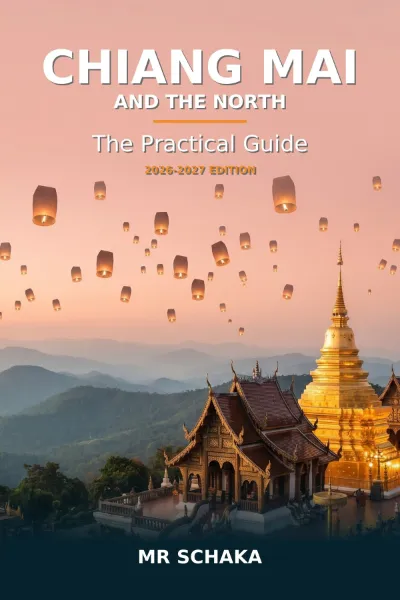
    Cover of Chiang Mai and the North – The Practical Guide

    Want to dig deeper?

    Mr Schaka’s guidebook, Chiang Mai and the North – The Practical Guide, covers the essentials: transport, neighbourhoods, addresses, food, etiquette and safety, updated for 2026–2027.

  • Saint Louis Hospital Bangkok: a practical guide for foreigners

    Saint Louis Hospital Bangkok: a practical guide for foreigners

    A fever that won’t go away, a scooter fall, a health check during a long stay: sooner or later, many travellers and expats need a hospital in Thailand. Saint Louis Hospital Bangkok (โรงพยาบาลเซนต์หลุยส์), in the Sathorn district, is one of the names often given to foreigners. Here is the practical guide: getting there, services, languages, documents, how a visit works and how to pay. This guide does not replace a doctor’s advice.

    Saint Louis Hospital Bangkok at a glance

    Saint Louis is a private Catholic hospital, run on a not-for-profit basis and linked to the Archdiocese of Bangkok. It was founded in 1898 next to Saint Louis Church and is described as the first Catholic hospital in Thailand. Pope John Paul II (1984) and Pope Francis (2019) both visited it.

    It is a general hospital with several hundred beds. Facilities include an intensive care unit (ICU), a coronary care unit (CCU), operating theatres, a cardiac catheterisation lab and a dedicated palliative care area. A prayer and meditation room is open to people of all faiths. In May 2024 the hospital signed a cooperation agreement with the Faculty of Medicine of Chulalongkorn University covering training, research and medical services.

    Address and access: BTS, taxi or Grab

    The address: 27 South Sathorn Road (Sathon Tai Road, ถนนสาทรใต้), Yannawa, Sathorn, Bangkok 10120. The main switchboard is +66 2 838 5555 (02 838 5555 from a Thai phone). Check the number on the official website, saintlouis.or.th, before calling.

    • BTS Saint Louis (S4), on the Silom Line: this is the closest station. It is named after the neighbourhood, its church and the hospital. It opened in 2021 between Chong Nonsi and Surasak.
    • BTS Surasak (S5), on the same line: the hospital lies between the two stations, so Surasak is also a short walk away.
    • Taxi or Grab: ask for “Saint Louis Hospital, Sathorn Tai” or show the Thai name, โรงพยาบาลเซนต์หลุยส์. At rush hour Sathorn is often jammed, and the BTS is faster.

    To make the most of the Skytrain and river boats, read our guide getting around Bangkok by BTS, MRT and boat.

    Services, specialties and languages

    Saint Louis covers the main specialties of a general hospital: internal medicine, surgery, obstetrics and gynaecology, paediatrics, orthopaedics, cardiology and dentistry, among others. The emergency department is open 24 hours a day, 7 days a week. The hospital also offers health check-up programmes: ask at the counter or by phone for the list of packages and exactly what each includes.

    As for languages, several sources say English is widely spoken by reception staff, nurses and doctors, and that an international desk looks after foreign patients. For any other language, don’t count on an interpreter unless you have asked: check in advance. If you speak neither Thai nor English, come with someone you trust who can translate, or write down your symptoms and medical history in English.

    Good to know: in a serious emergency, Thailand’s national medical emergency number is 1669. For basic words (“hospital”, “doctor”, “it hurts”), our Thai phrasebook can help.

    Appointments, documents and how a visit works

    For a simple consultation, many patients walk in without an appointment and are seen in order of arrival. For a particular specialist or a health check-up, call ahead: staff will tell you which days the doctor is in. Bring:

    • your passport (requested to open your patient file);
    • your insurance card or certificate, with your insurer’s assistance number;
    • a list of your medications and recent medical documents (prescriptions, results, reports), in English if possible;
    • a way to pay: bank card or cash in baht.

    In a Thai private hospital, the route is usually the same. At registration, staff copy your passport and create your file; you may get a patient card to keep for later visits. A nurse then checks your weight, blood pressure and temperature, and notes your symptoms. Next comes the consultation with the doctor. Afterwards you go to the cashier, who gives you an itemised bill, then to the hospital pharmacy, which hands over the prescribed medicines.

    Keep every invoice and the medical certificate: your insurer will ask for them if you claim a refund. Ask for them in English.

    #Thailand #Bangkok #ThailandTravel #TravelTips #Asia #MrSchaka

    Insurance, guarantee of payment and billing

    There are two cases. Either the hospital bills your insurer directly: it then requests a guarantee of payment (or guarantee letter). Once it arrives, you normally pay only the deductible or anything not covered. Or you pay yourself and then claim the money back from your insurer.

    One specialist source lists several international insurers accepted at Saint Louis (including Allianz, Cigna, AIA, April, Pacific Cross, Bupa and Aetna). That is not a guarantee: agreements change. Before a planned admission, call your insurer and the hospital to confirm direct billing. If the guarantee does not arrive in time, a deposit or full payment may be requested.

    Fees depend on the doctor, tests and medicines. We don’t publish prices: ask for an itemised estimate before any costly test, procedure or health check-up. Patient accounts describe Saint Louis as mid-range among Bangkok’s private hospitals.

    Practical tips

    • Take out travel insurance that covers medical costs in Thailand before you leave, and save its assistance number in your phone.
    • Arrive early in the morning for a walk-in visit: the wait is often shorter.
    • Write down your questions for the doctor, and ask for the exact names of the medicines prescribed.
    • Keep a photo of your passport and insurance card on your phone, just in case.
    • Stay polite and calm at the counter: it is part of Thai etiquette, and it makes everything easier.
    • For any decision about your health, follow a doctor’s advice, in Thailand or at home.

    The Thaïlande en poche app: Mr Schaka offers a free app, Thaïlande en poche. It installs from the website and brings together the guide’s maps and addresses, so you can find your way around Bangkok, Sathorn included.

    Frequently asked questions

    What is the nearest BTS station to Saint Louis Hospital?

    BTS Saint Louis (S4), on the Silom Line. Surasak (S5) is also within walking distance.

    Do I need an appointment?

    Not always for a simple consultation. For a specialist or a health check-up, call ahead to check availability.

    Do the staff speak English?

    Yes, English is widely spoken. For another language, ask in advance whether an interpreter is available.

    How much does a consultation cost?

    It depends on the doctor and the tests. Ask the hospital for an itemised estimate and check your cover with your insurer.

    Book cover

    The book

    The Season of Breath, Mr Schaka’s memoir-style story, follows a man living with a lung disease between Belgium and Thailand. An intimate look at health, travel and daily life in Bangkok, available in English.

  • Koh Samui: The Complete Guide (Getting There, Beaches, Season)

    Koh Samui: The Complete Guide (Getting There, Beaches, Season)

    Koh Samui is the big island of the Gulf of Thailand: pale sand beaches, hills covered in coconut palms, temples by the sea and an airport ten minutes from the hotels. Mr Schaka is very fond of it; several chapters of his story The Season of Breath take place here. Here is what you need to plan your trip: how to get there, which beach to choose, what to see and when to go.

    How to get to Koh Samui

    There are two ways to reach the island: a direct flight, or overland to Surat Thani and then by boat. The first is fast, the second much cheaper.

    Direct flight. Samui Airport is owned by Bangkok Airways, which runs almost all flights. From Bangkok there are departures throughout the day from Suvarnabhumi, plus a few from Don Mueang. The flight takes about 1 hr 10 min. Expect roughly 3,000 to 7,000 THB one way depending on the date, checked bag included (check before you go). The airport is 10–20 minutes from Chaweng, Bophut and Choeng Mon.

    Budget flight + bus + ferry. Several low-cost airlines fly from Don Mueang to Surat Thani (often 1,000 to 2,000 THB). In the arrivals hall you can buy combined bus + ferry tickets: the bus takes you to Donsak pier, and the ferry crosses to Nathon or Lipa Noi on Samui’s west coast. Allow 5 to 7 hours in total. Buy a single through-ticket: if your flight is late, the transfer company will normally wait.

    Night train or bus + ferry. Night trains leave from Krung Thep Aphiwat station (no longer Hua Lamphong) and reach Surat Thani’s Phun Phin station early in the morning. A 2nd-class air-conditioned berth costs about 700 to 900 THB. Overnight buses with the ferry included also leave Bangkok. The whole journey takes 12 to 16 hours. The Donsak–Samui ferry alone takes about 1 hr 30 min and costs around 150 to 250 THB.

    Koh Samui beaches: where to stay for your travel style

    You can drive around the island in just over an hour, yet each coast has its own character. Choosing a beach is really choosing a pace.

    • Chaweng (east coast): the longest and busiest beach, with the widest choice of hotels, restaurants and shops. Good for a first visit if you like having everything within walking distance.
    • Lamai (east coast, further south): a wide bay, a little quieter than Chaweng, with good mid-range options. The Hin Ta Hin Yai rocks are at the end of the beach.
    • Bophut (north coast): a peaceful beach and, above all, the Fisherman’s Village with its old wooden houses and Friday night market. Ideal for couples and evening strolls.
    • Maenam (north coast): a long, calm beach facing Koh Phangan, with simple bungalows and some lovely hotels. For real rest.
    • Choeng Mon (northeast tip): a small sheltered bay with shallow water, very pleasant with young children.

    For a more rural stay, the west coast (Lipa Noi, around Nathon) has sunsets over the sea and gentler prices, but it is further from services.

    In short, where to stay:

    • First trip, everything close at hand: Chaweng, away from the main road if you want a quiet night.
    • Couples: Bophut or Choeng Mon, for quiet evenings and restaurants by the water.
    • Families: Choeng Mon or Maenam, for calm sea and a peaceful atmosphere.
    • Tight budget: Lamai or Maenam, where simple bungalows can still be found.

    Things to do on Koh Samui

    • The Big Buddha (Wat Phra Yai): a golden statue about 12 metres tall on a small island linked to the northeast coast by a causeway. Entry is free.
    • Wat Plai Laem, close by: a large white many-armed Guanyin statue and pavilions set on a lake.
    • Hin Ta Hin Yai rocks, south of Lamai: two rock formations tied to a local legend, a twenty-minute stop.
    • Na Muang waterfalls, inland: Na Muang 1 (about 18 m) is a few minutes from the car park; Na Muang 2 needs a steeper half-hour climb. Best after the rains.
    • Bophut’s Fisherman’s Village, especially on Friday evening, when the walking street fills with food stalls and craftspeople.

    In temples, keep shoulders and knees covered and take off your shoes before entering the halls. All the useful rules are in our article on Thailand etiquette.

    A day trip to Ang Thong Marine Park. This is the best outing from Samui. About 20 km to the west, Mu Ko Ang Thong National Marine Park groups some forty limestone islands. Day trips usually include a viewpoint (a steep 30–45 minute climb on Koh Wua Talap), the inner lake of Koh Mae Koh (no swimming there), kayaking and snorkelling. Big boats leave from Nathon and take about 1 hr 30 min; speedboats are faster and cost more.

    Good to know: the park entry fee is 300 THB for a foreign adult (150 THB for a child), often paid in cash on the day. The park usually closes from 1 November to mid-December because of the monsoon; dates change every year, so check before you go.

    #Thailand #Bangkok #ThailandTravel #TravelTips #Asia #MrSchaka

    When to go to Koh Samui

    Note that Koh Samui does not follow the same calendar as Phuket. In the Gulf of Thailand, the heaviest rains fall from October to December, peaking in November: strong downpours, rough sea, some boat trips cancelled. January to April is the driest and sunniest period, and also the high season, so prices rise. March to May are the hottest months. From June to September there are showers at times, but often less rain than on the Andaman coast: a good time for lower prices. To compare every region, read the best time to visit Thailand, month by month.

    Getting around the island

    • Songthaew: these blue pick-ups with bench seats follow the ring road. Agree the price before getting in, usually 50 to 100 THB for a short ride. Scarce after dark.
    • Ride-hailing apps: Grab works on the island and shows the fare before the ride. Handy from the airport.
    • Taxis: plenty of them, but fares are negotiated and stay high.
    • Scooter: about 150 to 250 THB a day. Only if you already know how to ride, with a licence valid for motorbikes and a helmet: the hill roads are steep and insurance may refuse to pay without a licence.

    Good to know: many travellers pass through Bangkok before or after Samui. For those days, Mr Schaka’s free app Thaïlande en poche brings together the maps and addresses from his guide; it installs straight from the website.

    Frequently asked questions

    How many days should I spend on Koh Samui?

    Four to five days let you see the temples and waterfalls and do the Ang Thong trip, with time left for the beach. A week if you also want to visit Koh Phangan or Koh Tao.

    What is the quietest beach on Koh Samui?

    Maenam and Choeng Mon are the most peaceful. Bophut is calm by day and livens up a little in the evening around the Fisherman’s Village.

    Can I visit Koh Samui in the rainy season?

    Yes, but from October to December the sea can be rough and some boat trips are cancelled. Keep some slack in your plans and favour visits on land.

    Is the ferry a good alternative to flying?

    Yes, if you have time and a tight budget. The journey is long but simple with a combined ticket, and it often costs several times less than the direct flight.

    Book cover

    The book

    Koh Samui is more than its beaches: several chapters of The Season of Breath unfold here, between sea, hills and the light of the Gulf. A story to see the island differently, available in English.

  • Thailand itinerary: 2 or 3 weeks, the ideal route

    Thailand itinerary: 2 or 3 weeks, the ideal route

    Two or three weeks is enough to see Bangkok, the temples of the north and an island, as long as you don’t try to do everything. Here is the Thailand itinerary Mr Schaka recommends: a 2-week route, a 3-week variant, how to travel between stops with journey times and prices checked in 2026, and which coast to choose for the season.

    Thailand itinerary for 2 weeks: the core route

    A simple loop: Bangkok, the north, then the sea, by night train and domestic flight.

    • Days 1–3: Bangkok. The Grand Palace, Wat Pho, Wat Arun, Chinatown and the boats on the Chao Phraya. To plan these days, see our Bangkok 3-day itinerary.
    • Day 4: Ayutthaya. The former royal capital and its temple ruins, about 80 km north. In the evening, catch a night train to Chiang Mai: northbound trains stop at Ayutthaya (check the exact time).
    • Days 5–8: Chiang Mai. Old City temples, Doi Suthep, night markets, a cooking class. Add a day in nature: Doi Inthanon National Park or an elephant sanctuary with no riding and no shows.
    • Days 9–13: the sea. Fly to an island or beach base, depending on the season: Koh Samui or Koh Phangan on the Gulf side; Krabi, Koh Lanta or Phi Phi on the Andaman side.
    • Day 14: back to Bangkok by plane (about 1 h 10 to 1 h 25 in the air) for your international flight.

    The 3-week variant: more north, more sea

    With an extra week, slow down and add two stops.

    • Sukhothai (2 nights): the first capital of Siam, a vast historical park best explored by bicycle. It fits neatly between Ayutthaya and Chiang Mai.
    • Chiang Rai (2 nights): the White Temple (Wat Rong Khun), the Blue Temple and the Black House (Baan Dam). Skip the day trip from Chiang Mai: it is over three hours by road each way. Chiang Rai’s airport lets you fly back to Bangkok.
    • Two islands instead of one: Samui then Koh Phangan or Koh Tao in the Gulf, or Krabi then Koh Lanta or Phi Phi on the Andaman side.

    Sample split: Bangkok (3 nights), Ayutthaya (1), Sukhothai (2), Chiang Mai (4), Chiang Rai (2), then 8 nights by the sea on two islands and a last night in Bangkok.

    Gulf or Andaman: which coast for which season

    The two coasts don’t share the same monsoon.

    • Andaman coast (Phuket, Krabi, Phi Phi, Koh Lanta): best from November to April. From May to October the southwest monsoon brings showers and rougher seas; some boats are cancelled on bad days.
    • Gulf of Thailand (Koh Samui, Koh Phangan, Koh Tao): good from January to September, and very dry from February to April. The heavy rain falls from October to December, with November the wettest month.
    • From January to April both coasts work well. In October both are often wet.

    In short: June to September, head for the Gulf; November and December, head for the Andaman. For a month-by-month breakdown, including the north, see the best time to visit Thailand.

    Good to know: in the north, the cool season (November to February) is the most pleasant. In March and April it is very hot and the air is often hazy with smoke from agricultural burning. If you have breathing problems, ask your doctor before choosing your dates.

    #Thailand #Bangkok #ThailandTravel #TravelTips #Asia #MrSchaka

    Getting between stops: journey times and prices

    One-way price ranges, checked in 2026 across several sources. They vary with the season, so check before you go.

    • Bangkok → Ayutthaya: train from Krung Thep Aphiwat or Hua Lamphong station, 1 to 2 hours depending on the train, about 15–20 THB in 3rd class. Minivan from Mo Chit bus terminal: 1 h 30 to 2 h 30, about 150–220 THB.
    • Night train to Chiang Mai: 12 to 14 hours. Air-conditioned 2nd-class berth: about 700–1,050 THB depending on the train (lower berths cost a little more). 1st class: about 1,250–1,650 THB per berth. In high season, book several days ahead.
    • Bangkok → Chiang Mai by air: about 1 h 10 to 1 h 20 in the air, usually 1,000–2,500 THB on a low-cost airline, checked bags extra.
    • Sukhothai: from Bangkok, a 6- to 9-hour bus (Mo Chit terminal), or train to Phitsanulok then a bus of about 1 h 30. To Chiang Mai: 5 to 6 hours by bus, about 300–450 THB.
    • Chiang Mai → Chiang Rai: Greenbus, about 3 h 20 on VIP and 3 h 45 on Express, roughly 260–420 THB depending on class.
    • To the Gulf islands: direct Bangkok–Samui flight (Bangkok Airways), about 1 h 10, but pricey (about 2,800–6,800 THB). Cheaper: a low-cost flight to Surat Thani then bus and ferry (5 to 7 hours door to door, 1,500–3,000 THB in total), or a combined bus + boat ticket (11 to 14 hours, about 1,250–1,750 THB).
    • Between the Gulf islands: Samui–Koh Phangan in 20 to 60 minutes (about 200–500 THB), Samui–Koh Tao in 1 h 30 to 3 h 15 (about 450–800 THB).
    • To the Andaman coast: Bangkok–Krabi flight of about 1 h 25 (about 900–2,000 THB) or Bangkok–Phuket (1 h 20 to 1 h 35). From Chiang Mai, direct flights reach Krabi in about 2 hours.
    • Andaman ferries: Phuket–Phi Phi in 2 hours by ferry (about 500–700 THB) or 1 hour by speedboat (750–850 THB); Krabi–Phi Phi in about 2 hours (490–750 THB). A small fee of about 20 THB is paid in cash on arrival at Phi Phi.

    Train tickets are sold at stations or on the official State Railway of Thailand (SRT) website; booking platforms add fees.

    Tips for a realistic itinerary

    • Expect to lose half a day every time you change base: four stops done well beat eight rushed ones.
    • A night train replaces a hotel night and saves you a day of travel.
    • Keep at least one spare night in Bangkok before your flight home: rough seas can delay a boat.
    • Check entry requirements before booking: see our Thailand visa 2026 guide.

    Good to know: for your days in Bangkok, Mr Schaka’s free app Thaïlande en poche brings together the maps and addresses from the guide. It installs straight from the website.

    Frequently asked questions

    Is two weeks enough for Thailand?

    Yes, for Bangkok, Ayutthaya, Chiang Mai and one island. Any more and you spend your time in transit.

    Night train or flight to Chiang Mai?

    Flying is faster. The night train takes 12 to 14 hours, but you sleep on board and save a hotel night.

    Which island in November or December?

    Go for the Andaman coast: Krabi, Koh Lanta, Phi Phi or Phuket. The Gulf (Samui, Phangan, Tao) gets its heaviest rain then.

    Should I book transport in advance?

    Yes for night trains and flights in high season (December to February) and at Songkran (April). For buses and ferries, a few days ahead is usually enough.

    Cover of Bangkok – The Practical Guide, Mr Schaka’s practical guide to Bangkok

    Want to dig deeper?

    Every Thailand itinerary starts and ends in Bangkok. Mr Schaka’s practical guide helps you make the most of your first and last days there: neighbourhoods, transport and addresses. The English edition is out now as a PDF ebook: buy it here →

  • In the Footsteps of La Saison du souffle: From Pattaya to Isan

    In the Footsteps of La Saison du souffle: From Pattaya to Isan

    The Season of Breath tells the story of three months in Thailand, from Pattaya to the rice fields of Isan. Every place in the book is real. Here is a little road journal for following Michael, Gabriel and Chu, with a line from the book at every stop.

    Pattaya: the trip begins among friends

    For the first few days, they play tourist, crisscrossing Pattaya by Grab: “a pharmacy worker from Isan, a sick guy from Liège and another guy from Liège in flip-flops.” At the Terminal 21 shopping mall, every floor is dressed up as a different country, with a papier-mâché fishing harbor and an Eiffel Tower standing among the escalators. Then a speedboat to the island across the bay, and at last, a real beach.

    The Pratumnak neighborhood, between Pattaya and Jomtien, gives the third chapter its title. Quieter than the center, it’s where the journey really begins.

    Bangkok: the river and the hospital lobby

    In Bangkok, Chu works at the pharmacy of Saint Louis Hospital. Every evening, Michael waits for her in the lobby, in a wooden armchair facing a statue of the Virgin Mary. Then she steps out of the elevator, her jacket over her arm, and says: “Shall we eat?”

    The chapter “The River” follows the Chao Phraya, the city’s great artery. And on the flight to Koh Samui, Chu points out to Michael a round green patch in a bend of the river: Bang Krachao, “the green lung of Bangkok.” “Even Bangkok breathed better than I did. I found that unfair, and then I found it funny, and then I found it beautiful.”

    Koh Samui: Bophut and the Fisherman’s Village

    In Bophut, on Samui’s north coast, the hotel balcony looks out over a sea that is “pale green, clear, calm as a bowl of soup left to cool,” and over the old pilings of a long-gone pier, “very dignified.”

    Bophut’s Fisherman’s Village doesn’t have many fishermen left. It’s a narrow street running along the beach, lined with old wooden houses where Chinese merchants once bought copra and dried fish. On Friday evenings it closes to cars and becomes the Walking Street: wok-fried pad thai, skewers, banana pancakes, musicians… and fried insects, which Chu buys “the way you’d buy a bag of chips.”

    #TheSeasonOfBreath #Thailand #TravelStory #TrueStory #MrSchaka

    Ang Thong: the day of happiness

    Ang Thong National Park is a cluster of some forty islands off Samui, an hour away by speedboat: “green islands planted in a turquoise sea like broccoli in a bowl of soup.” Michael and Chu go kayaking there, her up front, him on the paddle. “It was there, between two strokes of the paddle, at the foot of a cliff in Ang Thong, that I thought I was happy. Not pleased. Not fine. Happy.”

    Good to know: in Ang Thong, you have to earn the viewpoint overlooking the famous emerald-green lagoon: the climb is steep. Michael chose to stay at the bottom, “and I didn’t regret a thing.”

    Isan: Chu’s house and the lake

    The journey ends in the northeast, in Isan, in Chu’s village: a straight road between flooded rice paddies, a two-story house from two different eras, and life lived under a big corrugated-metal awning. It’s there, far from the beaches, that you understand Thailand best.

    And then there’s the lake, with its floating restaurants: bamboo platforms tied to the shore by a cable, which a boy pushes out onto the water. “A restaurant that delivers you to the middle of a lake, where nobody can leave before the meal is over.” And if the cable snaps? “Then we live here.”

    And you, what would your itinerary be?

    This trip isn’t a tourist circuit; it’s a life. But it makes you want to take your time, to climb the steps one by one, and sometimes to stop just before the top. To plan the Bangkok part, the Thailand Notebook and the practical guide are there for you.

    Book cover

    The book

    The Season of Breath: three months in Thailand, a true story that is funny and full of light. Available in English as a PDF ebook.

  • Thai Etiquette: The Rules to Know Before You Go

    Thai Etiquette: The Rules to Know Before You Go

    Thailand is nicknamed “the Land of Smiles,” and it’s no cliché. But behind the gentleness lies a subtle code of conduct, built on respect, self-control and a constant concern never to make anyone lose face. Thais are quick to forgive foreigners’ blunders, but they deeply appreciate those who make the effort. Here are the rules of Thai etiquette to know.

    Four words to understand Thai people

    • Sanuk: fun. Everything should be enjoyable, even work.
    • Mai pen rai: “it’s nothing, no problem.” The national philosophy in the face of life’s annoyances.
    • Jai yen: “cool heart,” in other words, calm. Keeping your cool is a cardinal virtue.
    • Kreng jai: consideration for others. That’s why a Thai person will rarely say “no” to your face, and why a “yes” can mean “I heard you.”

    1. Never raise your voice

    Shouting, criticizing someone in public or embarrassing them is the worst faux pas of all. If you have a problem (a room, a bill, an order), explain it calmly and with a smile: you’ll get much further.

    2. The monarchy: a very serious matter

    Thai law severely punishes lèse-majesté, with three to fifteen years in prison, and foreigners have been convicted. Make no remarks or jokes about the royal family, whether out loud or on social media. Never step on a banknote or a coin, as they bear the king’s image. Stand up when the royal anthem is played, notably at the movies before the film starts.

    3. At the temple

    • Shoulders and knees covered, no tight or see-through clothing.
    • Take your shoes off before entering the main building.
    • Step over door thresholds, never on them.
    • When seated, tuck your legs to the side: never point your feet at a Buddha statue, a monk or a person.
    • Don’t climb on any statue, and keep your voice down.

    #Thailand #Bangkok #ThailandTravel #TravelTips #Asia #MrSchaka

    4. With monks

    Monks are highly respected, and seats are reserved for them on the metro and on boats. A woman must not touch a monk or hand him an object directly: she sets it down in front of him.

    5. Head and feet

    The head is the most sacred part of the body, the feet the lowest. Never touch anyone’s head, not even a child’s. Don’t point at anything with your foot, don’t put your feet on a table or a seat, and don’t step over someone sitting on the floor.

    6. The wai, the Thai greeting

    You press your palms together at chest height while slightly bowing your head. Return the wai to anyone who gives you one, especially older people, but don’t wai children, waiters or vendors. As a foreigner, a smile and a “khop khun khrap” (thank you, said by a man) or “khop khun kha” (said by a woman) always go down well.

    7. Other good manners

    • Going shirtless away from the beach or pool: frowned upon, and sometimes fined.
    • Shoes: take them off at someone’s home, and wherever you see shoes outside the door.
    • Tipping: not mandatory, but appreciated. Small change in simple restaurants, 5 to 10% in fancier ones, 50 to 100 THB for a massage.
    • Photos: always ask, with a gesture or a smile, before taking a close-up of someone.
    • Offerings: don’t touch the ones placed in front of spirit house altars.

    What if you get it wrong?

    Mai pen rai. Life moves more slowly than in Europe, punctuality is more flexible, and blunders are quickly forgiven as long as you keep smiling. Patience and good humor are your best assets.

    Good to know: don’t be surprised to see “2569” on a receipt: Thailand counts years using the Buddhist calendar, which is 543 years ahead. 2026 corresponds to 2569.

    Cover of Bangkok – The Practical Guide, Mr Schaka’s practical guide to Bangkok

    Want to dig deeper?

    The “Etiquette” chapter of Mr Schaka’s guide, Bangkok – The Practical Guide (“Bangkok: The Practical Guide”), together with a short Thai survival phrasebook, gives you all the keys to being welcomed like a friend. The English edition is out now as a PDF ebook: buy it here →

  • A Little Thai Phrasebook: The Words You Need to Get By in Bangkok

    A Little Thai Phrasebook: The Words You Need to Get By in Bangkok

    Thai is a tonal language: the same sound, pronounced with a rising, falling, high, low or mid tone, means something completely different. Don’t let that put you off. With context, and a smile, people will understand you. This little Thai phrasebook, taken from Mr Schaka’s practical guide, gathers the words you’ll actually use. And the slightest effort is met with touching enthusiasm.

    The secret: the politeness particle

    Polite sentences end with a particle that depends on who is speaking:

    • a man says khrap (often pronounced “khap”);
    • a woman says kha (“kha” or “khâ”).

    So “hello” is sawatdii khrap for a man and sawatdii kha for a woman. In the lists below, (k) means “add khrap or kha.”

    A word on pronunciation: say “kh,” “th” and “ph” like a slightly breathy “k,” “t” and “p” — never “f” for “ph,” and never the English “th.” And say “ng” as in “singer,” even at the start of a word.

    Thai phrasebook essentials

    • Hello / goodbye: sawatdii (k)
    • Thank you: khop khun (k)
    • Yes, that’s right: chai / khrap (k)
    • No, that’s not it: mai chai
    • Sorry, excuse me: kho thot (k)
    • No problem, never mind: mai pen rai
    • How are you? sabai dii mai? I’m fine: sabai dii
    • I don’t understand: mai khao jai
    • Do you speak English? phuut phasa angkrit dai mai?
    • I’m from Belgium / France: ma jak Belyiam / Farangset
    • Beautiful! suay maak!

    Mai pen rai deserves a closer look. According to the guide, it’s the national philosophy in the face of setbacks: you don’t get worked up, you move on. Slow service, a forgotten booking? Mai pen rai. Patience and good humor are your best assets.

    At the market and in shops

    • How much? thao rai?
    • That’s expensive! phaeng maak!
    • Can you lower the price? lot noi dai mai?
    • I’ll take this one: ao an nii
    • I don’t want it, thank you: mai ao, khop khun (k)
    • Just looking: du chuey chuey
    • Where’s the restroom? hong nam yu thii nai?

    A reminder from the etiquette chapter: if something’s wrong, explain it calmly and with a smile. Raising your voice means losing face, and that’s the worst blunder of all. You’ll get much further by keeping your smile.

    #Thailand #Bangkok #ThailandTravel #TravelTips #Asia #MrSchaka

    At the restaurant

    • The menu, please: kho menu noi (k)
    • Not spicy: mai phet. A little spicy: phet nit noi. Very spicy: phet maak
    • I’m vegetarian: kin jay / kin mangsawirat
    • I’m allergic to… peanuts / seafood: phae… thua / ahan thale
    • Delicious! aroi! / aroi maak!
    • The check, please: chek bin (k) / kep tang duay (k)
    • Water: nam plao. Ice: nam khaeng
    • Rice: khao
    • Chicken / pork / beef / shrimp / fish: gai / moo / nuea / goong / pla
    • No sugar / a little sugar: mai wan / wan noi

    Mai phet will probably be your best friend for the first few days. And an aroi maak called out to the cook at a food stall always goes down well.

    In taxis and on public transport

    • Go to…, please: pai… (k)
    • Please turn on the meter: poet meter duay (k)
    • Straight ahead: trong pai
    • Left / right: liao sai / liao khwa
    • Stop here: jot thii nii
    • Slowly, please: cha cha noi (k)
    • Is it far? klai mai?
    • Hotel / airport: rong raem / sanam bin
    • Skytrain station: sathanii rot fai fa. Pier: tha ruea

    For counting, learn at least the first few numbers: nueng (1), song (2), sam (3), sii (4), ha (5), hok (6), jet (7), paet (8), kao (9), sip (10), yii sip (20), nueng roi (100).

    The gesture that goes with it: the wai

    Words often come with a gesture. The wai means pressing your palms together at chest or face height while slightly bowing your head. It’s used to greet, to thank and to apologize.

    You return a wai to someone who gives you one, especially older people. You don’t wai children, waiters or vendors: a smile and a nod are enough. As a foreigner, a smile, a slight nod and a khop khun khrap or khop khun kha always go down well.

    Cover of Bangkok – The Practical Guide

    Want to go further?

    Mr Schaka’s practical guide, Bangkok – The Practical Guide (“Bangkok – The Practical Guide,” in English), contains the full phrasebook, with emergency words and numbers, plus a whole chapter on etiquette in Thailand. The English edition is out now as a PDF ebook: buy it here →

  • When to Visit Bangkok: Seasons, Rain, Songkran and Major Festivals

    When to Visit Bangkok: Seasons, Rain, Songkran and Major Festivals

    When to visit Bangkok? The city is hot all year round. So the real question isn’t “Will the weather be nice?” but “Just how hot, humid or rainy will it be?” Here’s how to choose your dates, and why the rainy season isn’t necessarily a bad idea.

    Bangkok’s three seasons

    • The “cool” season, November to February: 24 to 32 °C, clear skies, drier air. The best time to go, but also high season: higher prices and packed sights.
    • The hot season, March to May: 28 to 36 °C, sometimes feeling like 40 °C. Crushing heat, especially in April.
    • The rainy season, June to October: 25 to 33 °C, heavy but often short downpours in the late afternoon. September is the wettest month.

    The best compromise is from mid-November to early February. To avoid the crowds and pay less, aim for late October or June: it rains, but rarely all day.

    Should you really avoid the rainy season?

    No. The downpours are often short, the city is green, prices are low, and Bangkok is packed with indoor things to do while you wait it out:

    • the big museums: the National Museum, Museum Siam, the BACC;
    • the shopping malls and their food halls;
    • a massage, or half a day at the spa;
    • a Thai cooking class;
    • a movie in a luxury cinema with reclining seats.

    Pack a compact umbrella and sandals that don’t mind getting wet: some streets flood in places after a big storm. And protect yourself from mosquitoes, because dengue spreads more during this season.

    #Thailand #Bangkok #ThailandTravel #TravelTips #Asia #MrSchaka

    Songkran, Thai New Year (April 13–15)

    Songkran is the biggest water fight in the world. Silom, Khao San and the party districts turn into a giant swimming pool, and nobody escapes. It’s also when many Bangkokians head back to their home provinces: the city empties out, so do the roads, and it’s a pleasant time to visit… as long as you don’t mind getting soaked.

    Good to know: book your hotel well in advance for Songkran, as you would for Chinese New Year and the end-of-year holidays: it’s high season.

    Other key dates

    • Chinese New Year (January or February): Chinatown in red and gold, dragons and firecrackers. In 2027, it falls on February 6.
    • Vegetarian Festival (late September or October): yellow flags and meat-free food in Chinatown.
    • Loy Krathong (November full moon): people float small, illuminated flower rafts on the water. In 2026, around November 24.
    • December 31: fireworks over the river, especially in front of Iconsiam.

    On Buddhist holidays (Makha Bucha, Visakha Bucha…) and on election days, alcohol sales are banned everywhere, except in some hotels and at the airport.

    Beware of air pollution early in the year

    From January to March, Bangkok often sees spikes in fine-particle pollution (PM2.5). If you have asthma, a respiratory or heart condition, are traveling with children or are pregnant, keep an eye on the air quality index (IQAir or AirVisual apps) and pack FFP2 masks. On peak days, stick to indoor visits.

    Good to know: from December 15 to 19, 2026, the royal funeral of Queen Mother Sirikit will bring road closures in the old town and modified opening hours at the Grand Palace. If you’re in town, dress soberly near the ceremony sites.

    Read also: Loy Krathong 2026: Where to Celebrate in Bangkok and Chiang Mai

    Cover of Bangkok – The Practical Guide, Mr Schaka’s practical guide to Bangkok

    Want to dig deeper?

    Mr Schaka’s guide, Bangkok – The Practical Guide (“Bangkok: The Practical Guide”), helps you plan every detail: seasons, budget, packing, health, money and the festival calendar, updated for 2026–2027. The English edition is out now as a PDF ebook: buy it here →

  • Chu’s House in Isan: One Family, One Village

    Chu’s House in Isan: One Family, One Village

    Nong Theng isn’t on the maps the narrator is used to reading. You get there by a straight road between flooded rice paddies, then down a street of dirt and concrete where the chickens cross whenever they feel like it. In chapter 5 of The Season of Breath, Mr Schaka finally steps through the gray wall behind which stands Chu’s house, in Roi Et province.

    Chu’s house, a house of two ages

    The house has two floors and two ages. Downstairs, concrete painted a pale aqua green, peeling in patches to reveal older greens underneath, like the layers of a cake. Upstairs, dark wood, wide planks worn by the rain, and white windows with arched frames cut like lace. Downstairs, the house of today. Upstairs, the house of before.

    Out front there’s even a third house, brand new: the massage parlor of Lalita, Chu’s sister. Apple-green walls, air conditioning, midnight-blue curtains scattered with white stars, and her diploma framed on the wall. It’s the cleanest and proudest room in the house.

    Life under the awning

    Everything happens out front, under a big corrugated-iron awning: concrete benches, red and green plastic chairs, blue water jugs, a fan turning for nobody and a hammock strung between two posts. A little girl does her homework on a flowery tablecloth. A white-and-pink dog, the size of a small pig, comes to sniff the visitor’s ankles and decides he’s acceptable.

    Before going in, you take your shoes off, and the narrator adds his Crocs to the mountain of flip-flops by the door. The book recalls a few simple rules from Isan, and from all of Thailand:

    • the head is the highest and most sacred part of the body: you never touch it, not even a child’s;
    • the feet are the lowest part: you never point them at a person, at the altar or at an image of the Buddha;
    • when sitting on the floor, you tuck your legs to the side, feet pointing backward.

    The narrator spends the evening keeping an eye on his feet “like two badly behaved dogs.”

    #TheSeasonOfBreath #Thailand #TravelStory #TrueStory #MrSchaka

    A family too big to count

    Then the family arrives, from everywhere: from the house, from the yard, from next door. The narrator never did find out how many of them there were. There’s Lalita, who looks like Chu with ten more years of sun. Wichan, the brother, in a red shirt, who laughs so hard when he sees him that he has to lean on the doorframe. Nephews, nieces, nephews’ children. In the middle of it all, Chu answers everyone in Isan, laughing, touching arms, shoulders, cheeks.

    Wichan declares that the man from Liège is now his brother. He says that to everyone, Chu translates, but this time she thinks he means it. Neither understands a word of what the other is saying, and it doesn’t matter in the slightest.

    On a bamboo table, Lalita pounds som tam in a wooden mortar: shredded papaya, garlic, tomatoes, lime, tiny crabs and a handful of chilies. Tok, tok, tok, “the sound of Isan.” When the narrator asks in Thai for it not to be too spicy, the whole terrace bursts out laughing, and Lalita takes out one chili. Just one. The fire makes him cough; everyone thinks it’s the chili. Only Chu doesn’t quite laugh.

    Lalita’s hands

    After a nap in the hammock, offered the way you’d offer the best room in a hotel, Lalita is waiting for him on the threshold of her parlor. She has decreed that he walks like an old man, and that it’s his back. She kneads his shoulders with all her weight. Then her hands reach his ribs, and stop. They listen. Nobody in the village knows anything about his illness, but her hands have understood. Without a word, she lightens her touch there and goes back at his shoulders with renewed vigor. When he comes out, he walks a little less like an old man.

    The parents’ floor

    Chu then shows him around the house. On the ground floor, Bombay’s delivery scooter is parked indoors, like a horse in its stable. At the foot of the stairs, under a red plastic bag, two gilt frames are waiting: her father, and her mother, who had exactly her chin. She tucks them under her arm and climbs the thirteen wooden steps.

    Upstairs, everything is wood, golden light and cobwebs. Nobody really lives there; the floor belongs to the past. Chu shows where she slept with her sister, where her brother and parents slept, then sets the portraits down at the exact spot where her childhood bed stood. That evening, during dinner under the neon light, she quietly gets up with sticks of incense and climbs the stairs without stopping. Nobody comments. Here, everyone knows what you go upstairs to do with incense.

    Book cover

    The book

    The Season of Breath: the true story of a season in Thailand, from Bangkok to Chu’s house in a village in Isan. Available in English as a PDF ebook.

  • Day Trips from Bangkok: 7 Ideas for a Day Out

    Day Trips from Bangkok: 7 Ideas for a Day Out

    Bangkok is a great base for exploring central Thailand. In a single day, you can wander the ruins of an ancient capital, watch a market pull back as the train goes through, drift along canals or cycle through a jungle in the middle of the city. Here are seven day trips from Bangkok, taken from Mr Schaka’s practical guide.

    How to plan your day trips from Bangkok

    For each outing, you have two options: an organized tour (agencies, online platforms, hotels), convenient but often tightly timed, or public transport, cheaper and more flexible. A third option is very comfortable if there are several of you: hire a car with a driver for the day, for about 2,500 to 4,000 THB depending on the distance.

    Ayutthaya, the ancient capital

    Eighty kilometers to the north, Ayutthaya was the capital of the Kingdom of Siam for more than four centuries (1351–1767). In the 17th century, it was one of the largest and richest cities in the world, where Portuguese, Dutch, Japanese, Chinese, Persian and French merchants rubbed shoulders. Destroyed by the Burmese army in 1767, it was never rebuilt. Its ruins, a UNESCO World Heritage Site, spread across an island ringed by rivers.

    • Wat Mahathat, famous for its Buddha head caught in the roots of a fig tree.
    • Wat Phra Si Sanphet and its three great stupas in a row.
    • Wat Chaiwatthanaram, on the riverbank, magnificent at sunset.
    • Wat Lokayasutharam and its huge open-air Reclining Buddha.
    • Wat Yai Chai Mongkhon, with its great stupa surrounded by saffron-draped Buddhas.

    Getting there: by train from Krung Thep Aphiwat station (about 1.5 hours), by minibus from Mo Chit, or on an organized tour. Once there, get around by bike, by tuk-tuk hired by the hour (about 200 to 300 THB) or by boat. The main temples cost about 50 to 100 THB each.

    Tip: visit Ayutthaya early in the morning or late in the day, and stay the night if you can. The ruins lit up in the evening are magical, and you’ll avoid the midday heat.

    Maeklong and the floating markets

    About 70 kilometers southwest, the vendors at Maeklong Market have set up their stalls right on the railroad tracks. Several times a day, when the siren sounds, they fold up their awnings in a matter of seconds. The train creeps through, inches from the goods, and then everything goes back into place. It’s nicknamed “talat rom hup,” the market of the folding umbrellas. Check the train times, which change regularly, and get there a little early.

    Maeklong is often combined with a floating market:

    • Damnoen Saduak, the most famous, about 100 kilometers away. Very photogenic, but it’s become a tourist product. Go very early in the morning.
    • Amphawa, more authentic and popular with Thais, from Friday to Sunday in the late afternoon and evening. You eat seafood grilled on boats, then boats take you out to watch the fireflies twinkling in the trees.
    • Khlong Lat Mayom and Taling Chan, small waterside markets on the Thonburi side, popular with families on weekends.

    #Thailand #Bangkok #ThailandTravel #TravelTips #Asia #MrSchaka

    Bang Krachao and Ko Kret: nature on the city’s doorstep

    Bang Krachao, just across from Khlong Toei port, is a peninsula that has stayed surprisingly green, nicknamed “Bangkok’s green lung”: orchards, mangroves and stilt houses linked by paths and raised walkways. Rent a bike (about 100 THB for the day) and ride around Sri Nakhon Khuean Khan Park, with its lake and observation tower. On Saturdays, the small Bang Nam Phueng floating market sells local produce. Getting there: taxi to Wat Khlong Toei Nok pier, then a boat across for a few baht.

    Ko Kret, on the Chao Phraya north of Bangkok, is home to a Mon community, a people originally from Burma, known for their pottery. Car-free, the island is best explored on foot or by bike, along a path that loops all the way around it: potters’ workshops, temples, traditional desserts. Very busy on weekends, quieter during the week.

    Muang Boran and Kanchanaburi

    Muang Boran, the Ancient City, in Samut Prakan, is a vast park shaped like a map of Thailand. More than 100 replicas of the country’s finest monuments are scattered among lakes and gardens, to be explored by electric cart or bike. Admission: about 700 THB. Close by, the Erawan Museum is topped by a gigantic three-headed bronze elephant. Getting there: BTS to Kheha, then a ten-minute taxi ride.

    Kanchanaburi, about 130 kilometers west, is known for the Bridge on the River Kwai. It was part of the “Death Railway,” built during World War II at the cost of tens of thousands of prisoners’ and forced laborers’ lives. The war cemeteries and the railway museum bear witness to it. The region also offers the Erawan waterfalls, rivers and forests. It’s doable in a day but long: ideally, spend one or two nights there.

    And for the beach?

    The closest are Pattaya (2 hours), nicer on the Jomtien side, Hua Hin (3 hours), calm and family-friendly, and Ko Samet (3.5 hours including the boat), a small island with white-sand beaches. Phuket, Krabi and Ko Samui are about an hour away by plane.

    Read also: Ayutthaya from Bangkok in a Day: Trains, Temples and Tips · Kanchanaburi and the River Kwai Bridge: a guide from Bangkok · Hua Hin: Bangkok’s Favourite Beach Escape, a Practical Guide

    Cover of Bangkok – The Practical Guide

    Want to go further?

    Mr Schaka’s practical guide, Bangkok – The Practical Guide (“Bangkok – The Practical Guide,” in English), covers each day trip from Bangkok in detail, with transport, prices and multi-day itineraries to plan your stay. The English edition is out now as a PDF ebook: buy it here →