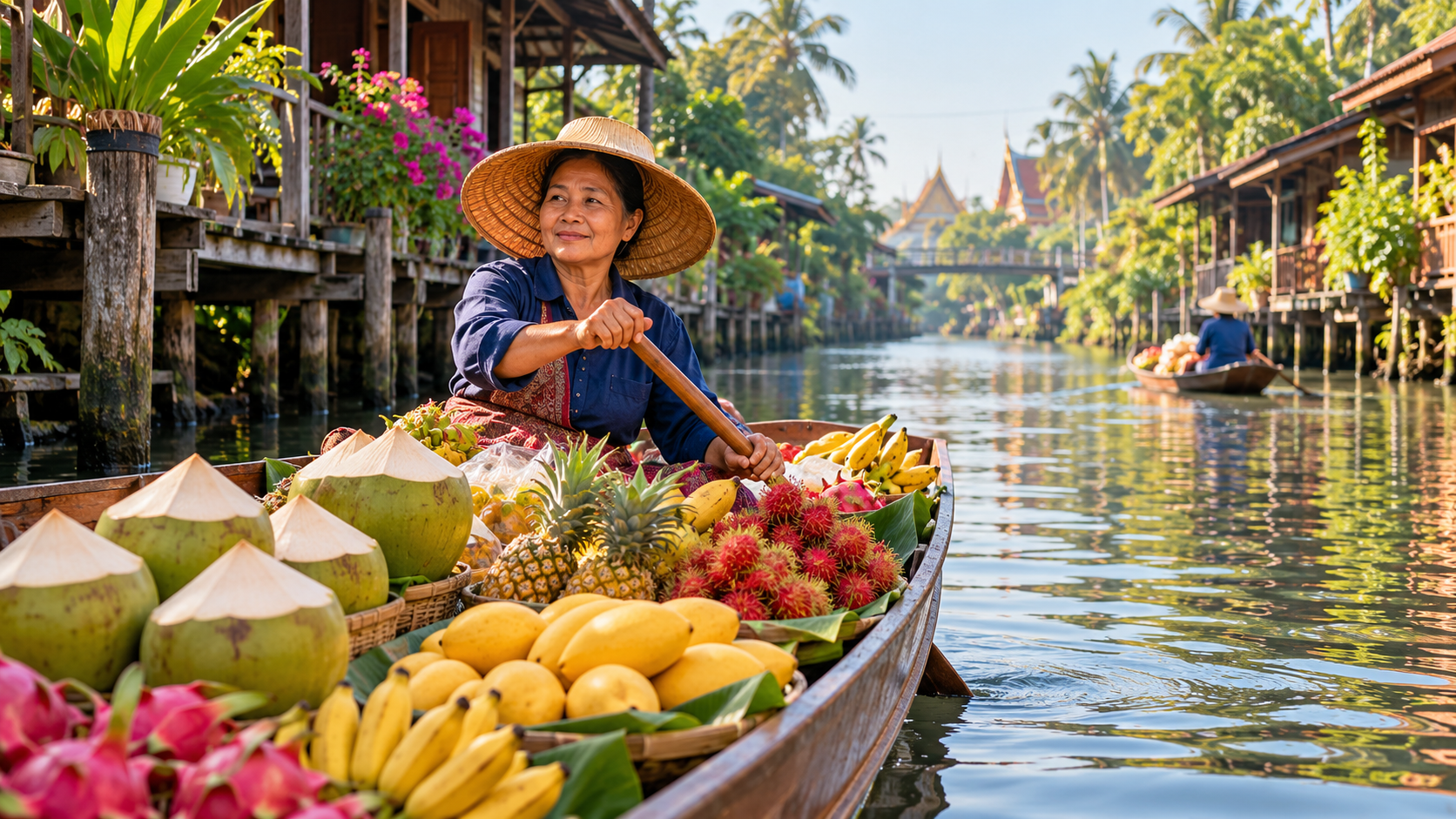

Thai fruits are one of the great pleasures of a stay in Thailand. Durian, mangosteen, rambutan, mango: here is what they look like, when to find them, how to choose them and what to pay. Plus the rules to know before you carry a durian back to your hotel.
The stars of the hot and rainy seasons
Durian
A large green-brown fruit covered in spikes, with creamy yellow flesh. The taste is like almond custard, but the very strong smell divides people. The most common variety, monthong, is fairly mild: a good choice for a first try. Season: mainly April to August, peaking around May. To choose, ask the seller to open the fruit in front of you, or buy pieces in a tray: the flesh should be neither too hard nor too soft. In 2025, Rayong monthong sold for an average of 120 to 220 baht per kilo.
Mangosteen
A small ball with thick, dark purple skin and white flesh in segments. Sweet, slightly tangy and very refreshing. Peak season is around May and June, and it is often still around in summer. To open it, score the skin in a circle with a knife without cutting the flesh, then lift off the top. Careful: the purple juice stains. Choose skin that gives a little under your finger, not hard as wood. Expect 40 to 50 baht per kilo at a local market in season, up to 100 baht at tourist stalls (prices checked in 2026).
Rambutan and longan
Rambutan has red skin covered in soft hairs; longan has a thin beige skin. Both have translucent flesh around a stone, sweet and juicy, close to lychee. Rambutan is around from roughly May to September, longan mainly in July and August. Pinch the skin with your nails, pop the fruit in your mouth and spit out the stone. About 40 to 50 baht per kilo of rambutans at the market (2026).
Mango, dragon fruit, jackfruit and rose apple
Mango
The queen of summer. Nam dok mai, yellow and very sweet, is the best known. Season: late March to July, with about 70% of the crop reaching markets between March and May. A ripe mango gives slightly under your finger and smells sweet near the stem. Expect 50 to 60 baht per kilo at a local market (2026). The classic to try: mango sticky rice, around 140 baht a portion on average according to a 2025 estimate.
Dragon fruit
Bright pink skin with green scales, white or red flesh dotted with tiny black seeds. Very mild taste, with a texture close to kiwi. Cut it in half and eat it with a spoon, well chilled. It is available for much of the year, especially April to October. About 60 baht per kilo at the market (2026).
Jackfruit
A huge fruit with bumpy green skin, but no real spikes and no strong smell: do not mix it up with durian. Inside are firm, sweet yellow pods. Best period: roughly January to May.
Rose apple (chomphu)
A bell-shaped fruit with waxy green or pink skin. Crunchy, juicy and only lightly sweet: perfect in the heat. Available almost all year, best in the cool season, around December.
Where to buy fruit in Bangkok
Everywhere: street carts, neighbourhood markets, supermarkets. Carts sell ready-cut fruit in a bag with a wooden skewer.
For quality, head to Or Tor Kor market, opposite Chatuchak Weekend Market (MRT Kamphaeng Phet, exit 3). It opens every day, roughly 6am to 6pm. The fruit is superb and sellers let you taste, but prices are a little higher than elsewhere.
For lower prices, try Khlong Toei market (MRT Khlong Toei, exit 1), which opens very early, roughly 4am to 2pm. For getting there, see my guide to getting around Bangkok.
A simple rule: stalls in very touristy areas can charge up to double. Prices are per kilo; ask before the fruit is weighed.
Durian: the rules to know
Its smell clings to closed, air-conditioned spaces. As a result, many hotels put up a “No durian” sign at the entrance or in the lifts. Check your hotel’s rules before taking one up to your room.
The same goes for transport. Since May 2023, Bangkok’s public buses (BMTA) have banned durian on board, based on a 2014 directive against strong-smelling items. The BTS operator also asks passengers not to bring durian onto the train. For the MRT, taxis or planes, assume it is frowned upon or refused: check case by case.
The simplest solution: eat it on the spot, at the market.
Mr Schaka’s practical tips
- Shop in the morning: the fruit is fresher and the markets are cooler.
- Follow the season: March to July is the time of plenty. For the weather, see the best time to visit Bangkok.
- Ask to taste: at good markets, it is normal.
- Start with cut fruit to try things cheaply before buying by the kilo.
- No durian in your room without the hotel’s agreement, and none in your suitcase.
Frequently asked questions
What is the best season for fruit in Thailand?
Roughly March to July: mango, durian, mangosteen and rambutan all arrive at the same time.
Can I take a durian back to my hotel?
Often not. Many hotels ban it because of the smell. Ask at reception, or eat it at the market.
How much does a kilo of mangoes cost?
About 50 to 60 baht at a local market in season, and 60 to 80 baht at tourist stalls (prices checked in 2026).

To go further
Mr Schaka’s guidebook, Bangkok – The Practical Guide, covers the essentials: transport, neighbourhoods, addresses, food, etiquette and safety, updated for 2026–2027.