Liège is a city of stairways. But only one of them has a real reputation: the Montagne de Bueren, 374 steps in a dead-straight line, from the Hors-Château district up to the edge of the Citadel. Here is its history, the legend that surrounds it, the view waiting at the top, the Coteaux to explore afterwards, the candlelit festival and Mr Schaka’s advice for climbing it without rushing.
Montagne de Bueren: a 19th-century military staircase
Despite its name (“montagne” means mountain), the Montagne de Bueren is not a mountain. It is a stepped street of brick and stone that climbs straight up the Citadel hill. Sources date it to between 1875 and 1881; 1881 is the year most often given.
Its purpose was very practical. The Citadel and its garrison stood at the top, the city centre at the bottom. Until then, soldiers used Rue Pierreuse, a narrow street with a rowdy reputation. The staircase gave them a direct, faster route into town. It partly follows the line of old 15th-century ramparts.
The gradient reaches about 30%. Landings, some with benches, break up the climb. The bottom of the stairs opens onto Rue Hors-Château, a few minutes’ walk from Rue Féronstrée and Place Saint-Lambert.
Vincent de Bueren and the 600 Franchimontois: history and legend
The name honours Vincent de Bueren, a 15th-century defender of Liège. In October 1468, the city was besieged by Charles the Bold, Duke of Burgundy, together with King Louis XI of France. On the night of 29 to 30 October, a band of men led by Vincent de Bueren and Gossuin de Streel attempted a desperate sortie: to surprise the enemy camp and capture, or kill, the duke and the king.
The attack failed. Tradition remembers 600 Franchimontois (men from the Franchimont area), almost all killed along with their leaders. Liège fell shortly afterwards and the city was sacked and burned. The episode remains one of the great stories of Liège’s collective memory.
Good to know: many people say the 600 climbed these very stairs. That is impossible: the staircase did not exist in 1468, as Liège’s own tourist office points out. Historians also debate the exact figure of 600 and where the men came from. The staircase is a tribute, not the site of the battle.
“The world’s most extreme staircase”: where does the title come from?
You will often read that the Montagne de Bueren is “the most extreme staircase in the world”. The phrase comes from a list published in 2013 by The Huffington Post: a countdown of seven spectacular staircases, presented as the editors’ “favorites”, with Liège in first place.
So it is a media ranking, not an official measurement. The article itself said its picks were not necessarily the highest or steepest, and it repeated the legend of patriots marching up the steps. The title went around the world and still draws curious visitors, camera in hand.
Some have turned it into a challenge. In July 2020, Belgian explorer Louis-Philippe Loncke climbed up and down the staircase 135 times with a 15 kg backpack to simulate an ascent of Everest. Nobody expects you to copy him.
The view from the top and the Coteaux de la Citadelle
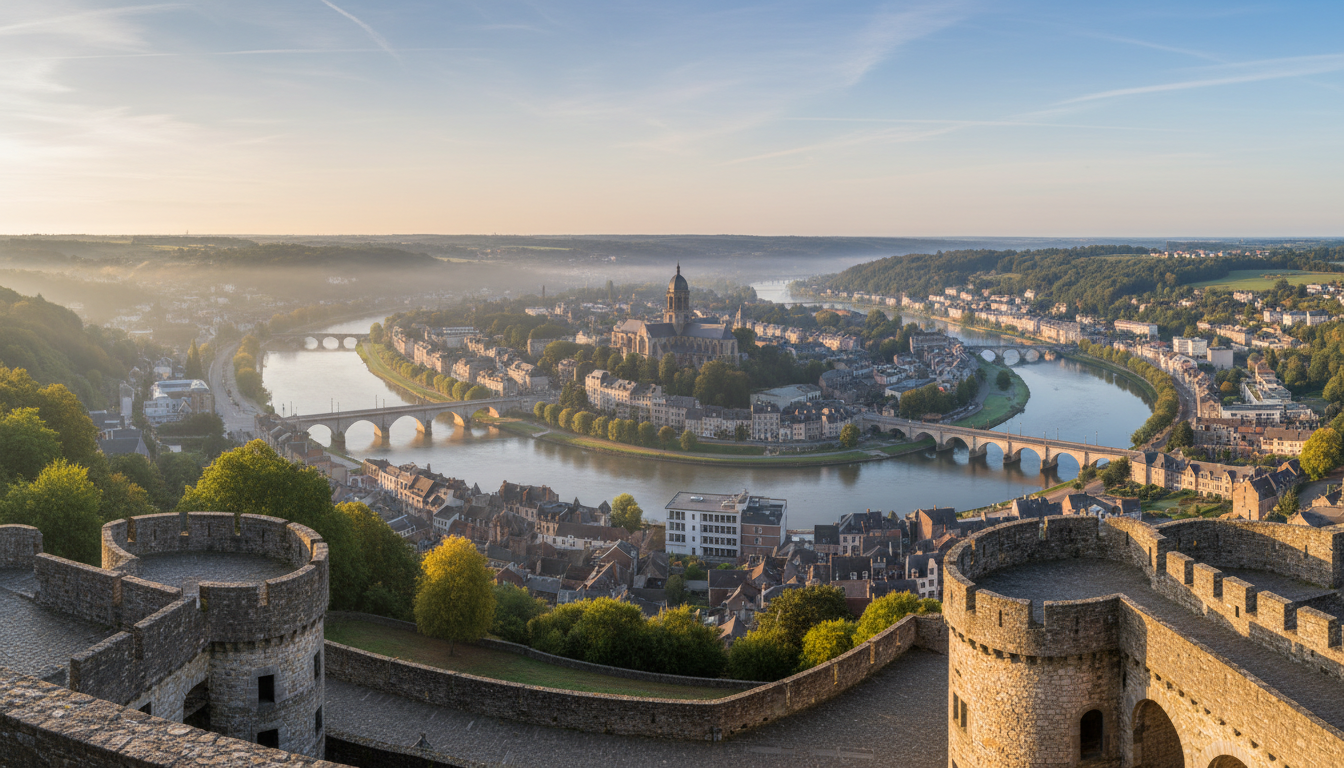
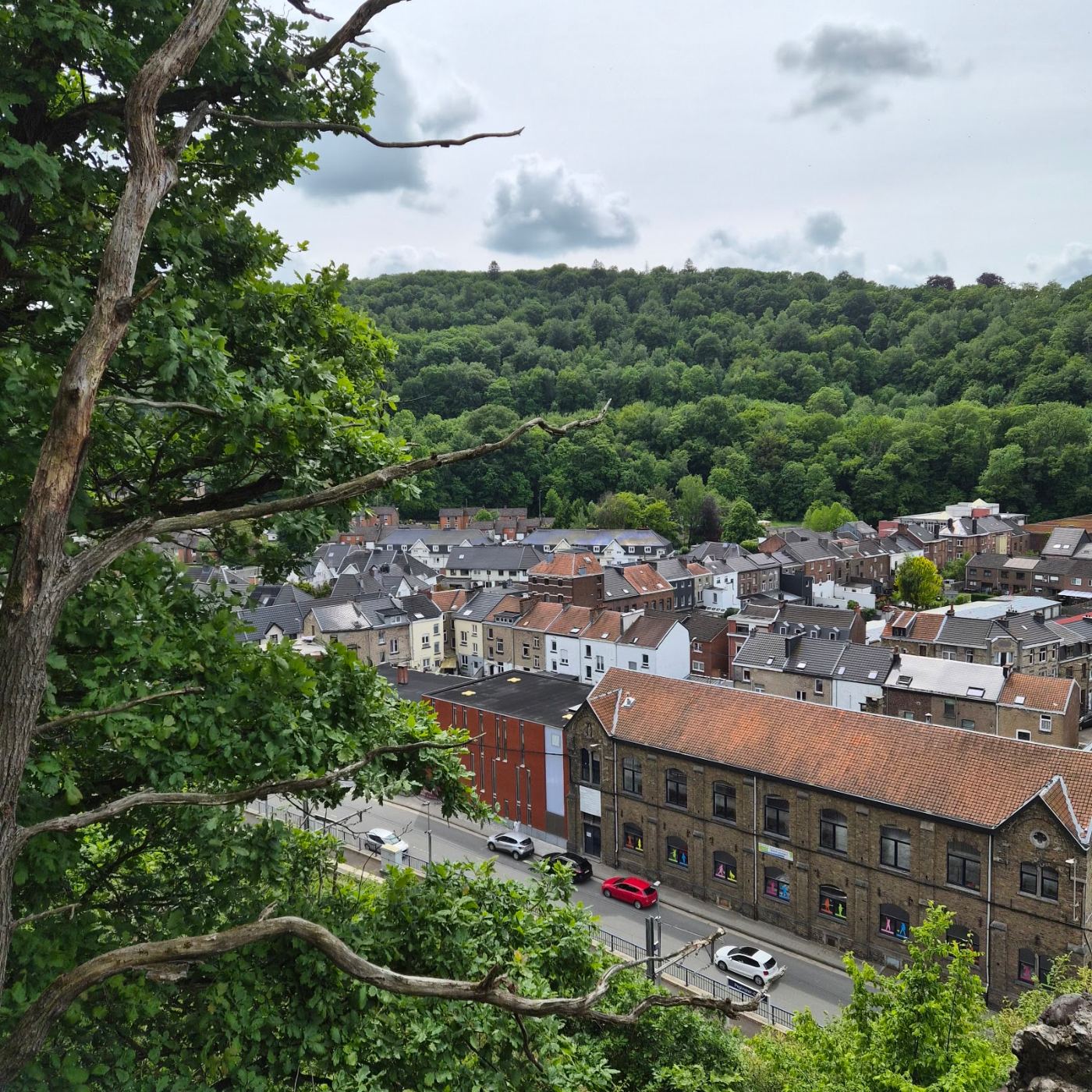
As you climb, the houses fall away and your eyes pass over the rooftops. At the top, Liège spreads out below you: church towers, the Meuse valley, the hills opposite. It is one of the finest viewpoints in the city. Up there you will find a memorial and the start of several walking trails.
The Montagne de Bueren is also a gateway to the Coteaux de la Citadelle: about 90 hectares of green hillside right in the centre, partly protected as a Natura 2000 site. A path links Rue Pierreuse to the staircase, past grassy terraces, the ruins of the former Minims convent, a medieval tower and tall walls of coal-measure sandstone. You walk at rooftop level, in peace, a stone’s throw from busy streets.
A marked loop of about 5.5 km takes roughly two and a half hours. Some paths are steep, so wear good shoes. If you like places with stories, Mr Schaka has also gathered the Liège locations of the Oscar’s Notebook mysteries.
The Nocturne des Coteaux: 374 steps by candlelight
For years, the Nocturne des Coteaux de la Citadelle took place on the first Saturday of October. That evening, the steps are lined with candles and the neighbourhood’s lanes fill with musicians and street performers. In 2024, for the 26th edition, 1,596 candles lit the 374 steps, and police estimated the crowd at around 30,000 people.
The format has changed. After a year off for financial reasons, the event became the Week-end des Coteaux and moved to spring, on 4 and 5 April 2026. The stairs were lit again from 8 pm, with light installations across the Coteaux. Check future dates with the Liège tourist office.
Tips for climbing the 374 steps
- Start at the bottom. Going up, the view opens little by little; going down is harder on the knees.
- Take your time. Use the landings and benches. Nobody is timing you.
- Pick your moment. Access is free and open at all hours. Morning and late afternoon give the softest light on the rooftops.
- Keep it quiet. People live along the staircase, and the city asks visitors to respect the calm.
- Watch out in the rain. The steps get slippery. Good shoes are enough.
- If steps are a problem: Rue Pierreuse, a sloping cobbled street, also climbs towards the Coteaux, more gradually. The staircase and the trails are not suitable for people with reduced mobility.
Good to know: Mr Schaka lives with interstitial pulmonary fibrosis. For him, these steps are counted one by one, landing after landing, and the view is all the sweeter for it. If you have a heart or lung condition, talk to your doctor before this kind of effort. He writes about it in connection with his novel The Season of Breath.
In Mr Schaka’s crime series, Oscar’s Notebook, one chapter is even called “Les 374 marches” (“The 374 Steps”). The staircase is part of the Liège backdrop of the investigations, along with the lanes, squares and hills around it. And if you are staying in the area, consider a visit to Waroux Castle too.
Frequently asked questions
How many steps does the Montagne de Bueren have?
374 steps in a straight line, with a gradient of about 30% and landings to catch your breath.
How long does the climb take?
Allow about ten minutes with a few pauses. Take longer if you need to: there is no reason to hurry.
Is there a fee, or is it closed at night?
No. It is a public street, free and open at all hours.
Did the 600 Franchimontois really climb these stairs?
No. The staircase dates from the 19th century; it honours Vincent de Bueren and the 1468 sortie, but it was not where it happened.

The book
The Montagne de Bueren has its own chapter in Oscar’s Notebook: “Les 374 marches”. After your climb, follow Victor and Oscar through the Liège of their investigations. Available in English.